



Most do not. Carrier freeze-out stops standard silicon from working. We select and characterize specific components that survive.
Engineering
Cryogenic Electronics
Develop control electronics that function flawlessly near absolute zero to support next-generation quantum and space domains.
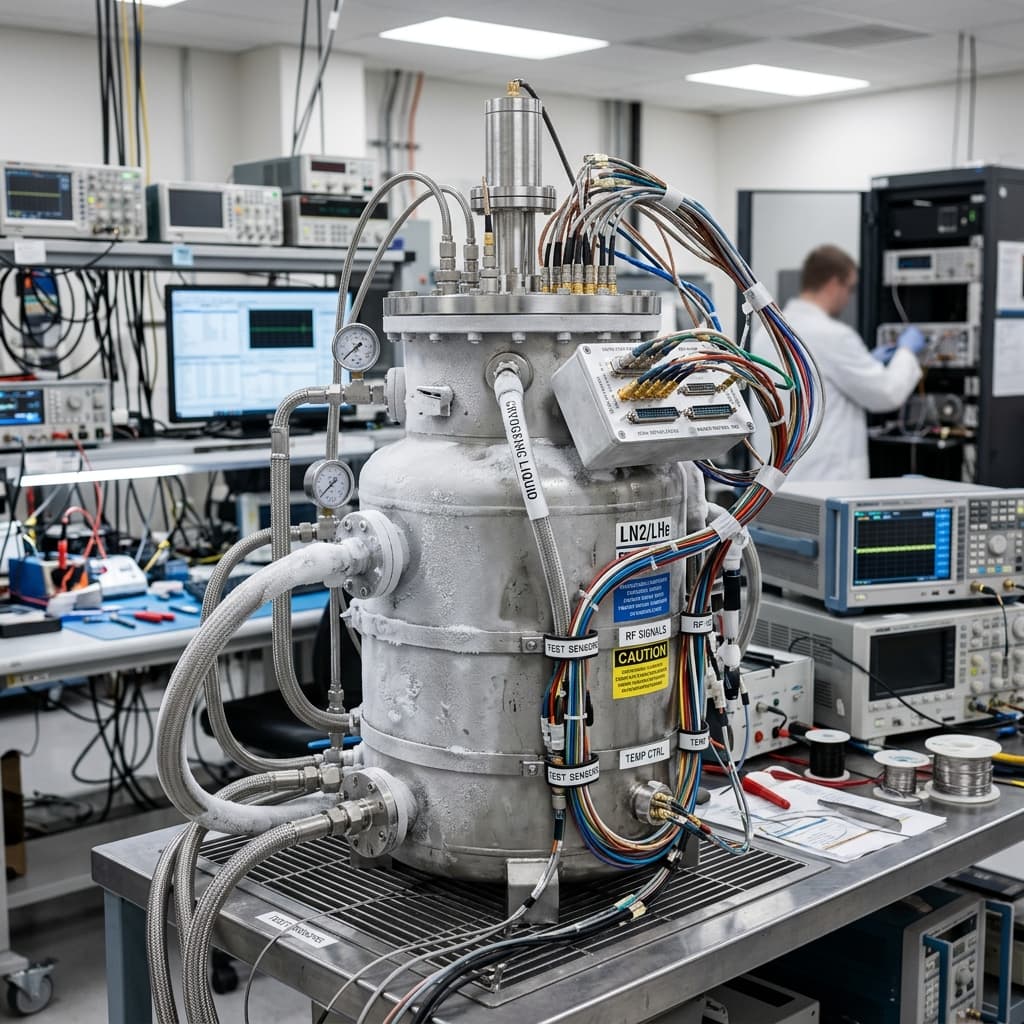
How we approach Cryogenic Electronics
Advanced sensors, such as superconducting nanowire single-photon detectors (SNSPDs), only operate at cryogenic temperatures. Bringing analog signals from a 4 Kelvin environment out to room-temperature electronics introduces unacceptable thermal noise. We engineer electronics designed to operate directly inside the cryostat.
Our designs utilize specialized semiconductor processes - like specific CMOS nodes or SiGe BiCMOS - that exhibit enhanced performance rather than freezing out at low temperatures. This allows for in-situ amplification and digitization.
Thermal budgeting is rigorous; every microwatt of power dissipated by the electronics places a load on the cryogenic cooling system. We build ultra-low power ASICs and tightly manage thermal conduction paths along harnesses.
The result is a radically improved signal-to-noise ratio, enabling profound leaps in deep space communication, quantum computing, and high-sensitivity intelligence gathering.
Related areas in this practice
Operating at the Limit
Conventional engineering rules fail near absolute zero. We design for the physics of deep cold.
- In-cryostat signal amplification.
- Strict milliwatt thermal budgeting.
- Cryo-compatible PCB substrates.
- Superconducting interconnects.
Beating Thermal Noise
By digitizing the signal while still at 4 Kelvin, we prevent the noise that inevitably creeps into analog cables spanning the vast temperature gradient up to room temperature.
Cryogenic Electronics FAQ
Questions on extreme environment engineering.
Cryo Development
Component Char
Characterize silicon performance at 4K.
Thermal Modeling
Calculate heat dissipation limits.
Dewar Testing
Validate board assemblies in liquid helium.

Talk with engineers who own the work
Request a technical pass on Cryogenic Electronics: constraints, risks, and a practical next step with clear assumptions.