



We supply deeply defensible technical content, exact hardware diagrams, and exhaustive software evidence indexes. The final legal filings and negotiations remain securely within your respective legal counsel's scope of practice.
Engineering
BVLOS programs
Safety cases, communications, and evidence packages for extended-range and shared airspace contexts.

How we approach BVLOS programs
Beyond visual line of sight operations demand an airtight quantifiable safety case: validated detect and avoid methodologies, certified communications performance, and heavily rehearsed contingency routes. Expanding operational spheres beyond raw visual contact fundamentally shifts the regulatory burden entirely onto engineered sensor reliability.
We proactively structure detailed technical narratives and empirical evidence mapped directly to evolving strict regulatory frameworks. Rather than supplying generic flight logs, we generate highly dense statistical representations confirming your specific detect-and-avoid (DAA) hardware consistently recognizes intruding aircraft miles before a theoretical collision.
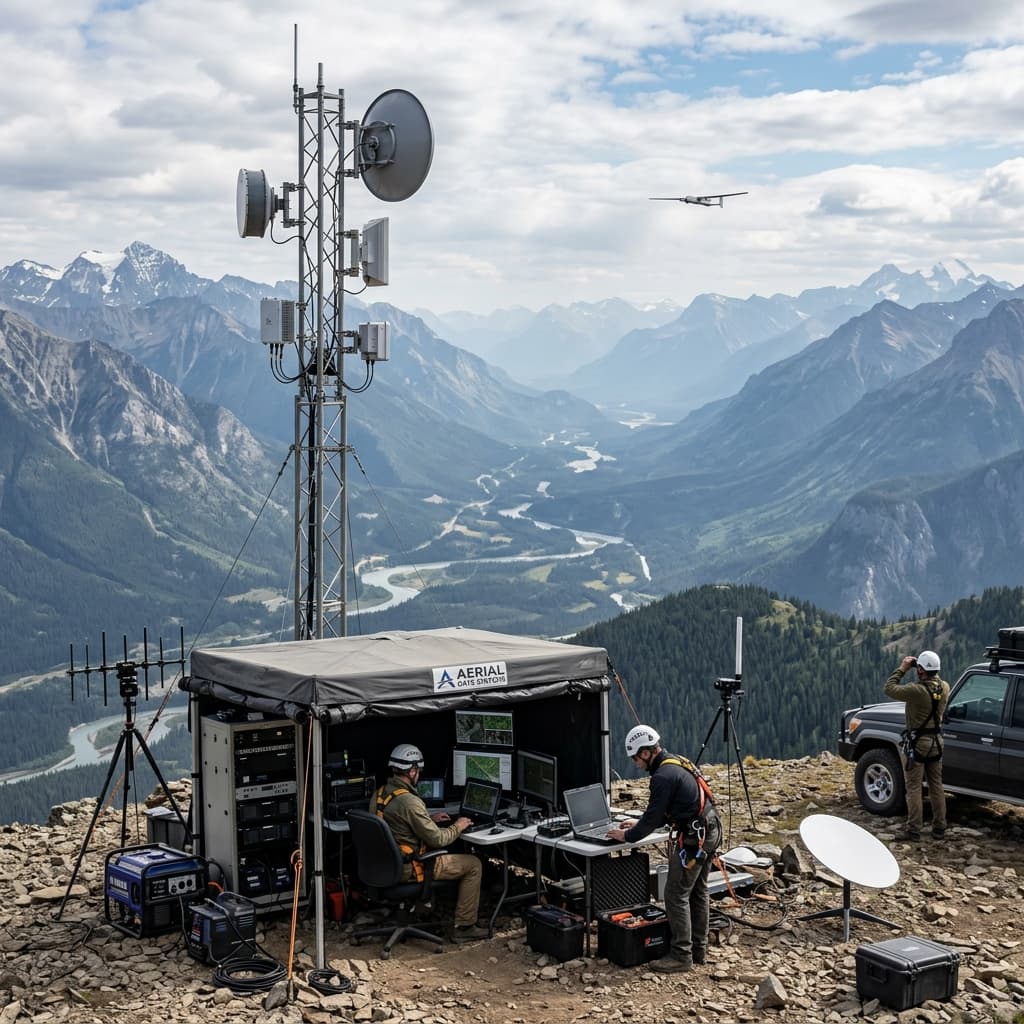
Rigorous simulation environments and iterative flight test campaigns are systematically staged to validate assumptions about airspace traffic density, communication relay availability, and physical aerodynamic performance at extreme range limits.
Spectrum congestion is the invisible killer of BVLOS ambitions. Transitioning across diverse cellular towers or dedicated mesh networks requires absolutely deterministic handoff protocols. We thoroughly flight-test these roaming configurations across varying terrain, actively hunting for destructive multipath interference zones that could sever the C2 lifeline.

Risk calculations concerning Kinetic Energy (KE) over populated ground areas are meticulously compiled within our specific operator manuals. By actively quantifying the drone's terminal velocity combined with integrated parachute deploy envelopes, we construct mathematically unassailable arguments that explicitly satisfy demanding civil aviation regulators.
Ultimately, BVLOS is achieved through a deliberate aggregation of hundreds of microscopic engineering verifications. We deliver the complete configuration-managed dataset proving that the aircraft, the communication network, and the ground crew collectively perform as an infinitely scalable, predictably safe system.
Related areas in this practice
Defensible range mapped with accountability
Long range operations are fundamentally as much about developing bulletproof standard operating procedures and quantifiable safety evidence as they are about base airframe capability.
- Detect and avoid concepts mathematically linked directly to hardware sensor latency budgets and pixel recognition algorithms.
- Communications reliability models calculating path loss across varied terrain elevations and congested spectrum conditions.
- Escalation matrices and lost link recovery behaviors purposefully scaling with restrictive airspace classes and populated ground geography.
BVLOS Waivers and Engineering
Clarifying engineering responsibilities versus legal filings.
Phased BVLOS Testing
Spectrum Evaluation
Detailed radio frequency noise modeling across the intended operational corridor.
Simulated Encounter Scenarios
Feeding millions of synthetic intruding aircraft flight paths into the avoidance logic.
Controlled Airspace Validation
Executing heavily shadowed flight operations within restricted areas to validate telemetry dropouts.

Talk with engineers who own the work
Request a technical pass on BVLOS programs: constraints, risks, and a practical next step with clear assumptions.