



Yes. We calibrate exact relative offsets between the optical center and the laser emitter to fuse high density point clouds smoothly with orthomosaic imagery.
Engineering
Survey missions
Flight planning and sensor timing that hit accuracy and productivity targets in the field.

How we approach Survey missions
Survey missions succeed completely only when flight planning methodologies, precision sensor timing, and final post processing assumptions match flawlessly. We aggressively connect optical overlap, sidelap geometry, and flying altitude choices directly to mandatory ground accuracy targets and operational productivity. Understanding this intricate relationship allows us to optimize flight times while strictly adhering to contractual mapping standards.
Ground control points (GCPs), PPK and RTK GNSS configurations, and intensive IMU aiding strategies are deliberately selected for the complex environments you fly in, systematically eliminating generic uncalibrated defaults. When operating in dense urban canyons or deep mining pits where GPS signals aggressively bounce, we deploy tight inertial coupling techniques to maintain locational truth.

The physical design of the mission route heavily dictates the efficiency of the battery drain. We factor in prevailing wind directions, elevation changes, and automated terrain-following algorithms to construct survey lines that respect the platform’s absolute power budget, eliminating the dangerous risk of a mid-mission forced landing.
Furthermore, camera shutter timing and electronic exposure synchronization are critical vulnerabilities. We actively measure real-world shutter lag against GPS pulse-per-second (PPS) signals, creating deterministic offset tables that guarantee every single image is perfectly tagged with its exact spatial origin.
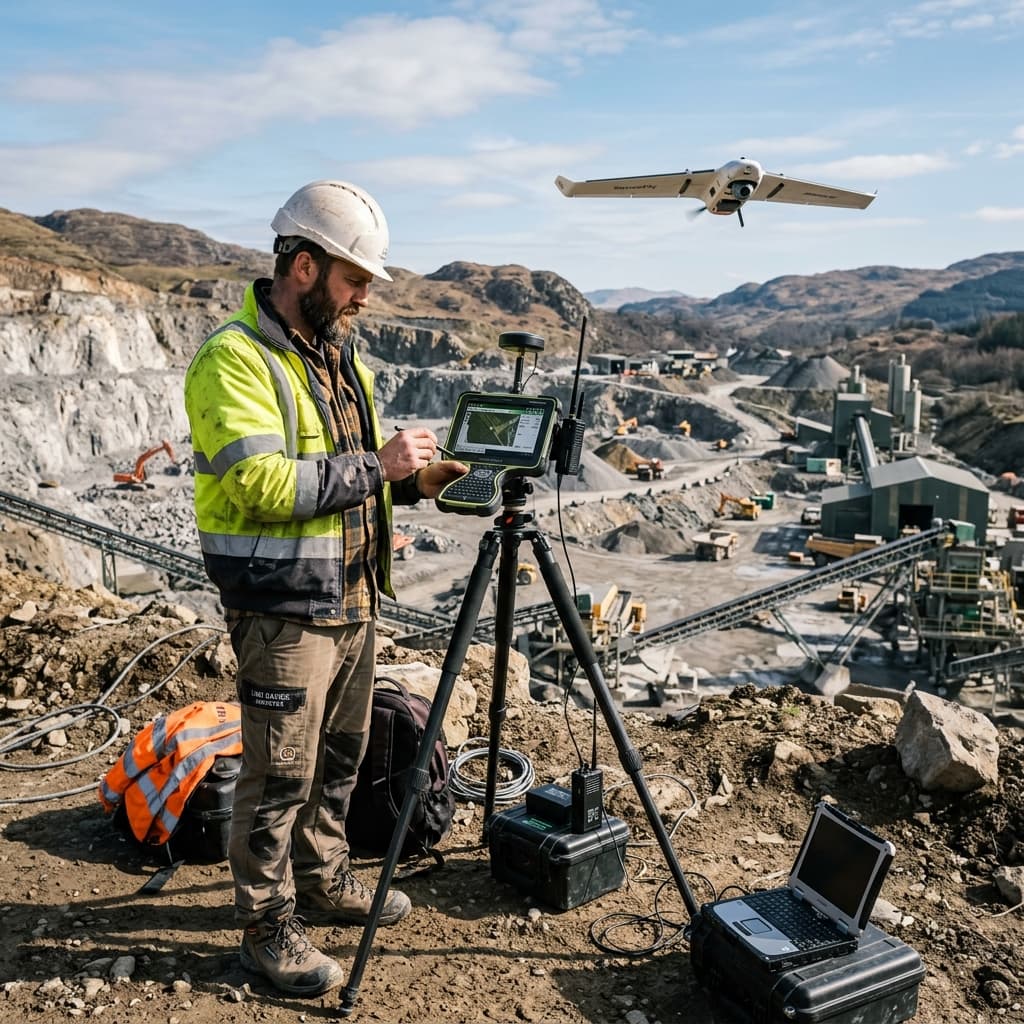
Our holistic quality assurance philosophy deeply embeds anomaly detection algorithms, realtime strip alignment checks, and strict re-flight protocols that human operators can confidently execute even under severe field pressure. Catching an out-of-focus camera or an RTK float state while the drone is still in the air prevents costly repeat mobilizations.
The operational outputs we provide include definitive standard operating procedures (SOPs) that guide field crews through every step - from placing base stations over known benchmarks to exporting raw RINEX data. We ensure your teams possess the procedural rigor necessary for delivering defensible geospatial evidence.
Related areas in this practice
Uncompromising geospatial rigor
We lock raw mission parameters precisely to certified accuracy classes and final digital deliverables, empowering your clients and oversight regulators to trust the output entirely.
- Custom flight line architecture accounting for dynamic terrain following and unpredictable wind margins.
- Absolute sensor synchronization combined with unyielding timestamp integrity across diverse onboard devices.
- Interactive quality assurance dashboards crafted to natively catch geometric gaps before crews ever leave the site.
Optimizing productivity versus pinpoint accuracy
Flying faster at higher altitudes using wider sensor swaths inherently trades millimeter accuracy for rapid geographic coverage. We transparently quantify these operational trades using your precise deliverable specifications, ensuring stakeholders actively agree on all acceptable error budgets upfront.
Utilizing modern direct georeferencing payloads heavily reduces the reliance on easily disturbed physical ground control points, vastly accelerating operational workflows within otherwise inaccessible or hostile terrain.
Survey Mission FAQ
Resolving common questions around aerial mapping operations.

Talk with engineers who own the work
Request a technical pass on Survey missions: constraints, risks, and a practical next step with clear assumptions.