



Yes. In many cases, their elasticity allows them to survive impacts that would shatter rigid joints or strip gears.
Engineering
Soft Robotics
Utilize advanced elastomers and pneumatic actuation to navigate confined spaces and handle fragile objects safely.
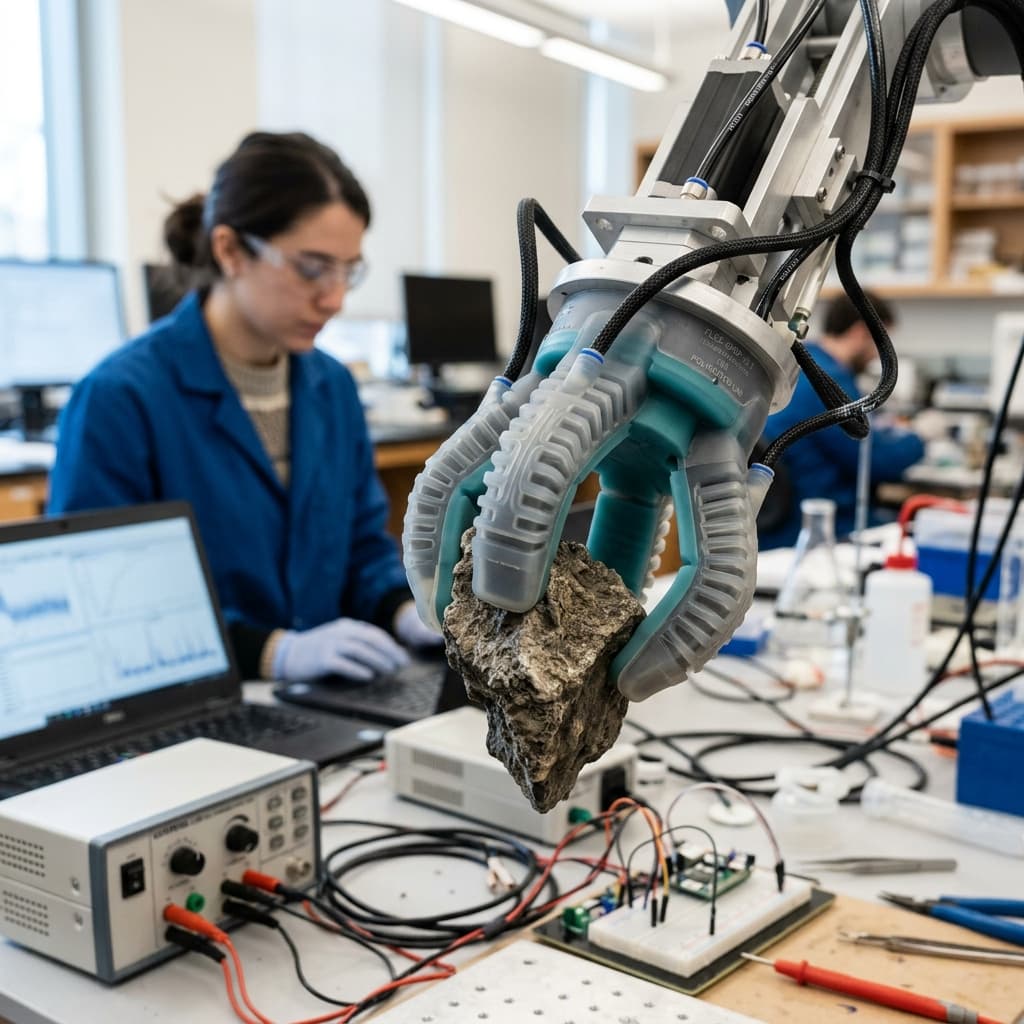
How we approach Soft Robotics
Traditional rigid robotics struggle in unstructured environments where precise positioning is impossible. We engineer soft robotic end-effectors and compliant structures that adapt naturally to their surroundings, distributing force evenly to avoid damaging delicate payloads or their own mechanisms.
We utilize advanced pneumatic and hydraulic artificial muscles, embedded with stretchable strain sensors for closed-loop control. These systems can change their stiffness dynamically, allowing a single arm to squeeze through a narrow gap and then rigidify to lift a significant load.
In tactical search and rescue or medical extraction, soft robotics eliminate the risk of crushing injuries associated with rigid metallic joints, making human-robot collaboration intrinsically safe.
Our simulation teams model the complex non-linear dynamics of these highly deformable materials, creating robust control algorithms that maintain accuracy despite the inherent flexibility of the system.
Compliant by Design
Fluidic actuation and elastic materials provide unparalleled adaptability in environments designed for humans, not machines.
- Pneumatic artificial muscles.
- Variable stiffness structures.
- Stretchable sensor integration.
- Damage-resilient kinematics.
Control of the Unpredictable
Controlling a mechanism with an infinite number of degrees of freedom is computationally intense. We utilize machine learning techniques to map pressure inputs to precise spatial trajectories.
Soft Robotics FAQ
Insights into compliant systems.
Development Cycle
Material Selection
Identify elastomers with the correct hysteresis.
Sensor Embedding
Integrate flexible liquid-metal strain gauges.
Dynamic Modeling
Simulate inflation and elongation profiles.

Talk with engineers who own the work
Request a technical pass on Soft Robotics: constraints, risks, and a practical next step with clear assumptions.