



We regularly handle components in the 1 to 5 micrometer range, such as bare fiber optic cores.
Engineering
Nano-Manipulation
Achieve unparalleled accuracy with piezoelectric stages and closed-loop optical feedback for micro-manufacturing.
How we approach Nano-Manipulation
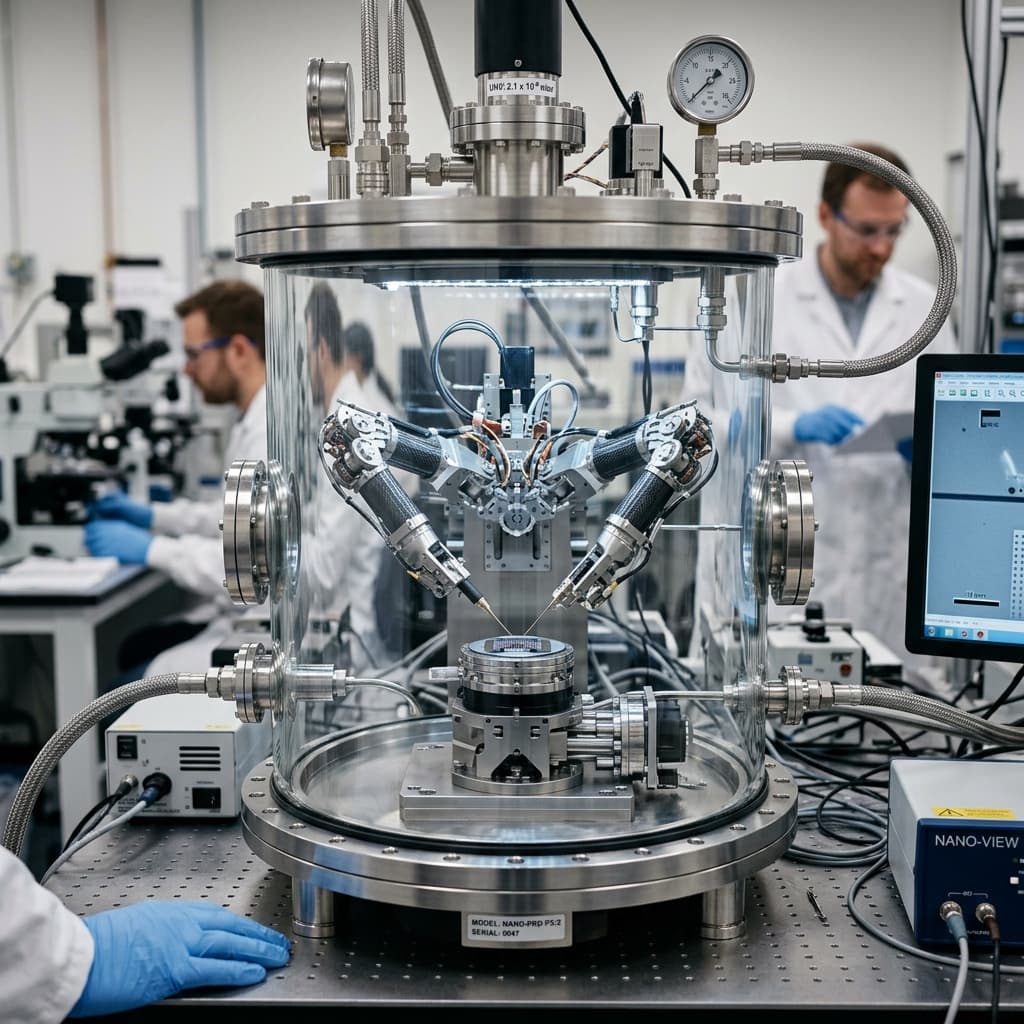
As advanced materials and quantum devices shrink, human hands - and even traditional robots - are too clumsy to assemble them. We engineer nano-manipulation cells that provide sub-micron repeatability, essential for integrating photonics, MEMS, and microscopic bio-sensors.
These systems rely on piezoelectric slip-stick actuators, providing high-resolution motion without the backlash inherent in geared mechanisms. We integrate these actuators into hermetically sealed vacuum or cleanroom environments.
To guarantee precision, we implement multi-camera computer vision and laser interferometry feedback loops, dynamically correcting for thermal expansion and ambient vibration in real-time.
Our custom end-effectors include micro-capillary grippers and laser-assisted soldering tips, turning theoretical nanoscale designs into mass-producible realities.
Related areas in this practice
Precision at the Nanoscale
When the components are smaller than a speck of dust, thermal drift and acoustics become major engineering challenges.
- Piezoelectric actuation.
- Laser interferometer feedback.
- Active vibration isolation.
- Cleanroom compatible architectures.
Defeating Vibration
In the sub-micron realm, a passing truck outside the facility looks like an earthquake. We design active pneumatic dampening tables that decouple the robotic cell from the building's foundation.
Nano-Manipulation FAQ
Questions on extreme precision.
System Architecture
Stage Design
Select piezo actuators for expected mass.
Isolation
Engineer acoustic and thermal shielding.
Vision Integration
Calibrate high-magnification optical feedback.

Talk with engineers who own the work
Request a technical pass on Nano-Manipulation: constraints, risks, and a practical next step with clear assumptions.