



Yes, advanced variants utilize terrain contour matching and robust inertial sensors to navigate without satellite signals.
Engineering
Precision Airdrops
Deliver heavy mission-critical supplies to isolated operators with autonomous guided airdrop systems (AGAS).
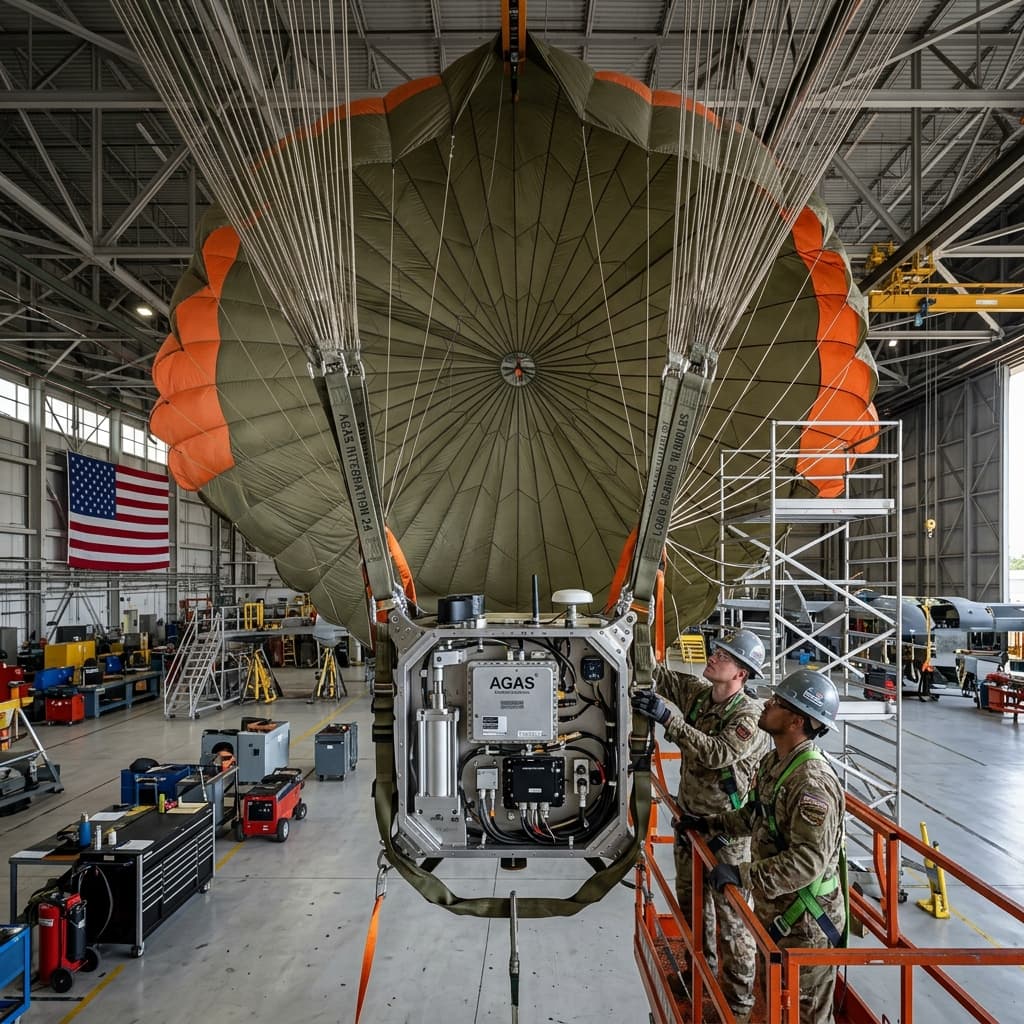
How we approach Precision Airdrops
When logistical convoys are too dangerous, precision airdrop is the only option. We integrate massive ram-air canopies with autonomous GPS-guided robotic steering units, capable of delivering thousands of pounds of cargo to within meters of a target.
These systems are effectively massive uncrewed gliders. We design the avionics that continuously calculate wind-fields during descent, dynamically pulling the steering toggles to fly complex approach patterns that avoid hostile terrain or anti-air threats.
Integration involves rigorous structural engineering. The forces exerted on the robotic actuators by a loaded canopy in high winds are immense. We design robust geartrains and heavy-duty risers that translate motor torque efficiently into canopy deformation.
Our teams support the full mission profile, providing software tools for the loadmasters to program the drop coordinates and verify the hardware integrity prior to pushing the pallet off the ramp.
Related areas in this practice
Logistics Without Runways
True expeditionary operations demand the ability to accurately resupply from high-altitude, standoff distances.
- GPS and INS guided descent.
- Heavy winch-actuator steering.
- Wind-field compensation algorithms.
- Massive ram-air cargo canopies.
Wind Penetration vs Payload
A guided parachute must fly forward fast enough to penetrate prevailing winds, otherwise it will be blown off course regardless of its steering logic. We optimize the wing loading of the canopy to maximize glide speed while ensuring touchdown forces remain survivable for the cargo.
Guided Airdrop FAQ
Autonomous resupply capabilities.
Integration
Canopy Scaling
Scale ram-air designs for heavy pallet masses.
Actuator Sizing
Engineer heavy-duty toggle pull mechanisms.
Flight Testing
Verify navigation accuracy through rigorous drop tests.

Talk with engineers who own the work
Request a technical pass on Precision Airdrops: constraints, risks, and a practical next step with clear assumptions.