



Yes, specific pigments and topcoats can drastically alter the apparent temperature to IR sensors.
Engineering
Stealth Coatings
Reduce your platform's radar cross-section and thermal signature with our advanced stealth coating integration strategies.
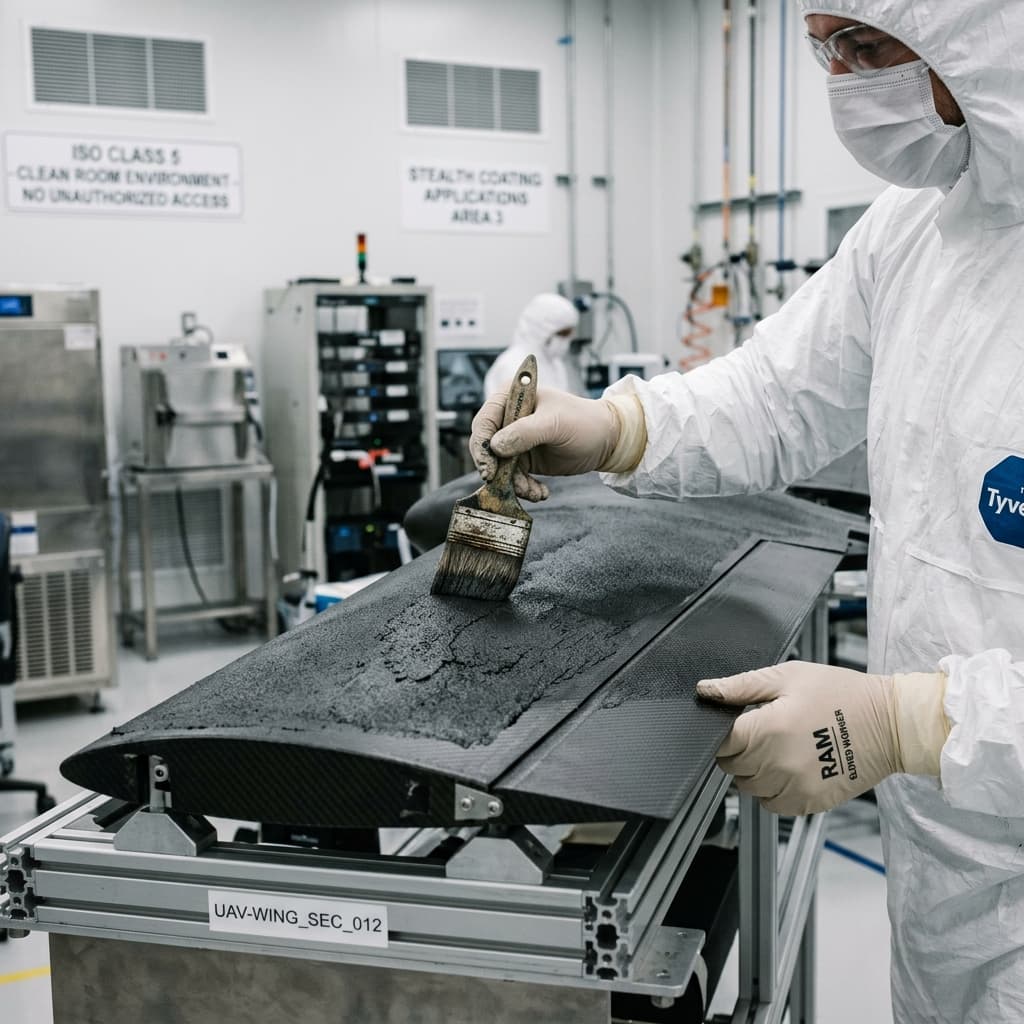
How we approach Stealth Coatings
Surviving in contested airspace requires a multi-spectral approach to signature management. We integrate advanced radar-absorbent materials (RAM) and infrared-suppressing coatings directly into the composite layup of your UAV, rather than applying them as a heavy aftermarket afterthought.
Our engineers optimize the aerodynamic surfaces to eliminate radar traps, while our specialized coatings absorb RF energy across multiple bands. We rigorously test these profiles in anechoic chambers to validate the theoretical radar cross-section (RCS) models.
Thermal signatures are equally critical. We design active exhaust cooling and apply emissivity-controlled coatings to mask engine heat from advanced IR seeking sensors.
These specialized materials are designed to withstand extreme environmental degradation, from salt fog to high-altitude UV exposure, without losing their signature reduction properties.
Related areas in this practice
Multi-Spectral Dominance
True stealth requires a holistic approach addressing radar, infrared, and acoustic signatures synchronously.
- Broadband radar absorption.
- Infrared emission control.
- Acoustic baffling for propulsion.
- Durable environmental resistance.
The Weight Cost of Stealth
Traditional RAM adds significant mass. We mitigate this by utilizing structural RAM that bears aerodynamic loads while absorbing radar, maximizing payload capacity.
Stealth Coating FAQ
Details on signature management.
Signature Reduction
RCS Modeling
Simulate radar reflection points.
Material Selection
Choose appropriate absorbing composites.
Chamber Testing
Validate RCS in controlled environments.

Talk with engineers who own the work
Request a technical pass on Stealth Coatings: constraints, risks, and a practical next step with clear assumptions.