



We use formal methods and runtime assurance architectures to guarantee that the AI cannot command unsafe states.
Engineering
AI Flight Control
Integrate deterministic neural architectures into your UAV's flight control loop for robust stability in degraded aerodynamic states.
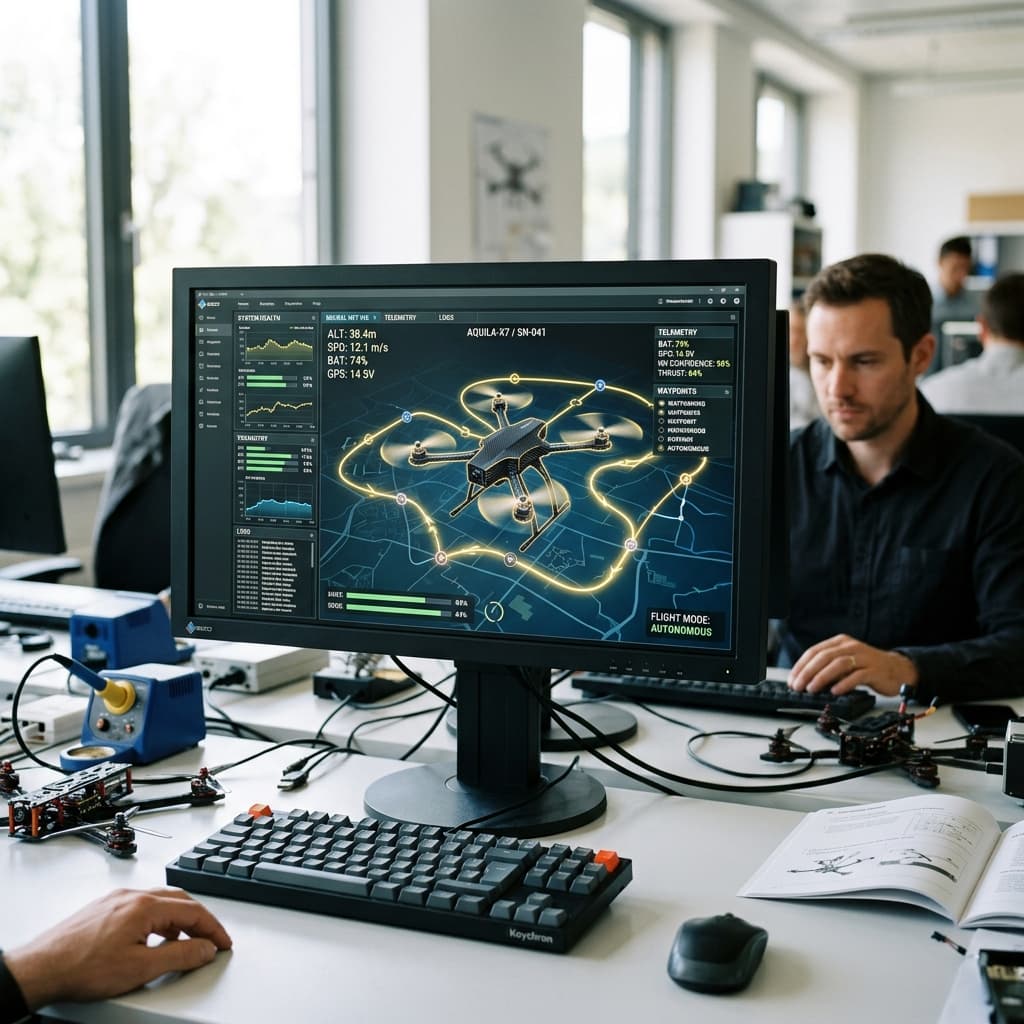
How we approach AI Flight Control
Legacy PID control loops struggle to compensate for battle damage or rapidly changing aerodynamic profiles. Our AI-driven flight control architectures leverage deterministic neural networks to provide millisecond-latency corrections, allowing platforms to remain stable even when missing control surfaces or experiencing critical actuator failure.
We prioritize safety and certification in our AI implementation. By bounding the neural network's outputs within a deterministic safety envelope, we ensure that the aircraft never exceeds structural limits. This bounded approach bridges the gap between advanced machine learning and rigorous aerospace certification standards.
Hardware-in-the-loop simulation is critical to validating these models. We deploy your flight control networks onto true edge-compute hardware to measure latency, thermal output, and power consumption under stress, guaranteeing mission reliability.
From urban turbulence modeling to high-altitude recovery, our specialized neural flight controllers enable new mission profiles that were previously too risky for autonomous operations.
Related areas in this practice
Resilient Control Systems
Next-generation flight control requires a hybrid approach: mathematical guarantees combined with adaptive learning for edge cases.
- Bounded neural network outputs.
- Hardware-accelerated edge inference.
- Damage-tolerant flight profiles.
- Regulatory-compliant safety cases.
Surviving the Unpredictable
In theater, predictability is a vulnerability. AI flight controls allow UAVs to adapt their flight dynamics dynamically, countering sudden crosswinds or degraded propulsion rapidly.
AI Flight Control FAQ
Common questions regarding neural networks in aviation.
Integration Process
Modeling
Train models on vast aerodynamic datasets.
Bounding
Establish deterministic safety limits.
HIL Testing
Verify performance on real avionics.

Talk with engineers who own the work
Request a technical pass on AI Flight Control: constraints, risks, and a practical next step with clear assumptions.