Insights · Report · Parachutes · Apr 2026
Statistically modeling emergency parachute deployments: examining failure metrics of spring-loaded pilot chutes, evaluating AAD cutter resilience, and analyzing heavily packed nylon degradation.
A primary parachute malfunction is a highly chaotic, wildly unpredictable aerodynamic event. The reserve parachute system represents the absolute final engineering failsafe. It must launch flawlessly out of an incredibly dense container, punch cleanly through swirling turbulent wake, and achieve massive inflation from impossibly low altitudes in a matter of violently short seconds. Evaluating the reliability of this ultimate backup requires shifting away from theoretical design assumptions into hard, strictly collected statistical models surrounding component failure.
The spring-loaded pilot chute is the foundational engine of the reserve sequence. Unlike a primary system that often relies on manual deployment, the reserve must eject itself autonomously. This relies entirely on a heavily compressed coil spring. Over aggressive packed timelines, this metal spring is physically crushed flat for months or years. If the spring succumbs to severe specific metal fatigue and loses its necessary launch velocity, it will barely push the massive canopy outside the aerodynamic 'burble' surrounding the falling jumper, guaranteeing a catastrophic non-deployment. Aggressive extraction metrics dominate the reliability models.
Automatic Activation Devices (AADs) introduce deeply complex software logic into the mechanical survival chain. A beautifully packed reserve canopy is totally irrelevant if the unconscious jumper never pulls the handle. The AAD is heavily tasked with constantly measuring massive barometric pressure differentials to definitively calculate precise altitude and terminal velocity. The reliability data focuses heavily on the AAD's physical pyrotechnic cutting loop. When commanded, the microscopic blade must sever the incredibly strong closing cord with 100% certainty simultaneously across thousands of varying temperature gradients.
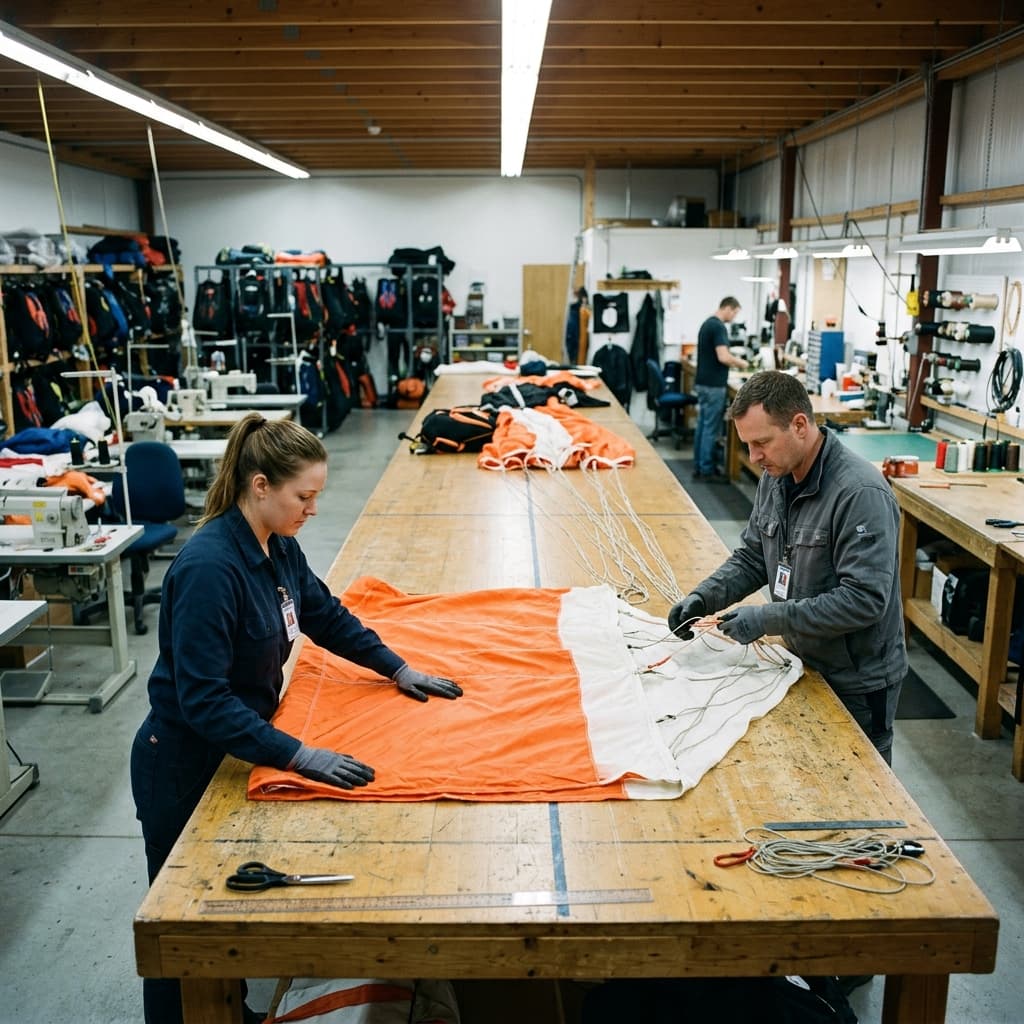
Packing density aggressively defines inflation speed. A reserve parachute is deeply compressed into a much smaller, tighter container volume than a primary canopy. This massive compression structurally forces the nylon weave tightly against itself. The reliability models aggressively track hesitation timings—the severe micro-seconds it takes for the heavily crushed fabric to separate and suck in the crucial initial gulp of air. The data explicitly proves that an over-packed reserve system significantly increases deployment hesitation, directly narrowing the final survivable altitude envelope.
Line stretch dynamics must perfectly sequence. A massive messy knot of Kevlar suspension lines represents immediate death. The freebag deployment system is heavily engineered to completely force the lines to fully extend and aggressively snap taut before the massive canopy itself is allowed to release from the bag. Analyzing the reliability of this freebag system involves studying high speed telemetry to ensure no suspension lines violently wrap back around the massive inflating fabric during extreme chaotic tumbles.
Material degradation over strictly mandated repack cycles provides the baseline statistical risk. Even if a reserve parachute is never deployed, simply sitting tightly crushed inside a sealed container causes the specialized coatings on the ZP (zero-porosity) nylon to slowly adhere to themselves, creating severe 'stickiness' that inhibits rapid deployment. Reliability data directly dictates the non-negotiable mandatory repack cycle (e.g., 180 days or 365 days). Exceeding this strictly modeled date fundamentally destroys the mathematical guarantee of inflation.
The true statistical model for reserve reliability demands combining all unique edge case factors into a unified matrix. It evaluates the exact probability of aggressive AAD cutter failure combined with severe spring fatigue during a massive asymmetric load scenario. By deeply analyzing the incredibly rare but heavily documented failures across the global fleet, the rigid reliability models strictly force the necessary hardware upgrades and aggressive packing manual revisions that incrementally push the survival margin closer to perfection.
We can present findings in a working session, map recommendations to your portfolio and risk register, and help you prioritize next steps with clear owners and timelines.