Insights · Report · Drones · Apr 2026
Constructing rigorous, data driven safety cases for advanced autonomous flight: utilizing SORA methodologies, modeling ground risk buffers, and proving system determinism to aviation regulators.
Securing regulatory approval for high risk drone operations—such as flying heavy payloads over densely populated urban centers or executing Beyond Visual Line of Sight (BVLOS) missions through controlled airspace—requires far more than demonstrating pilot proficiency. Aviation authorities demand an exhaustive, mathematically rigorous Safety Case. A Safety Case is a formal, defensible assertion that the drone operation is acceptably safe, supported overwhelmingly by technical evidence. Failing to construct an airtight safety case guarantees the operation will be grounded.
The Specific Operations Risk Assessment (SORA) methodology provides the internationally recognized framework for these documents. A SORA explicitly forbids narrative assurances of safety. Instead, it forces the engineering and operations teams to systematically dismantle their proposed flight profile into two harsh metrics: Ground Risk Class (the probability of killing a person on the ground if the drone falls) and Air Risk Class (the probability of colliding with a crewed aircraft in flight). The entire safety case engineering effort is dedicated to applying mitigations to lower these two numbers to an acceptable threshold.
Modeling the Ground Risk Buffer is a heavily mathematical exercise. If a fixed wing drone cruising at sixty knots suffers a catastrophic total power failure, it does not drop straight down. It glides, enters a ballistic trajectory, and crashes into the ground potentially hundreds of meters away from its flight path. The safety case must calculate the kinetic energy of the drone upon impact, map the statistical population density beneath the flight route, and define an explicitly calculated geographical buffer zone that must be kept clear of uninvolved civilians to achieve regulatory compliance.
Strategic mitigations focus on avoiding the hazard entirely. Reducing the Air Risk Class involves strategic planning before the drone ever spins its propellers. The safety case must demonstrate that the mission is scheduled during off peak airspace hours, restricted entirely to low altitude corridors physically separated from defined airport approach vectors, or conducted inside specialized geofenced volumes coordinated directly with local air traffic control. Proving strategic separation is significantly easier and cheaper than attempting to engineer complex onboard detect and avoid sensors.
Tactical mitigations involve the hardware's active capability to prevent disaster mid flight. If strategic separation fails and a rogue helicopter enters the drone's airspace, the safety case must heavily document the drone's Detect and Avoid (DAA) systems. This requires supplying explicit radar detection ranges, camera field of view data, and the precise latency of the autonomous avoidance algorithm. The regulator must be convinced mathematically that the drone will see the threat and maneuver out of the way significantly faster than a human pilot could react.
System determinism is arguably the hardest element to prove in modern autonomous architecture. If the drone utilizes 'black box' machine learning neural networks for critical flight control, it is fundamentally impossible to prove to a regulator what the software will do in every edge case scenario. The safety case must aggressively partition the software architecture. Unpredictable AI modules can be used for sensor processing and target mapping, but the core flight controller dictating motor output and parachute deployment must be driven by rigid, deterministic, explicitly verifiable code logic.
The integration of independent flight termination systems (FTS) provides the ultimate regulatory fail safe. The safety case frequently demands proof that a catastrophic software crash or a severed control link will not result in a 'fly away' event where the drone wanders uncontrollably into commercial airspace. An acceptable FTS requires a completely separate communication link, powered by an isolated battery, triggering a distinct hardware relay to sever total power to the motors and deploy a certified parachute system.
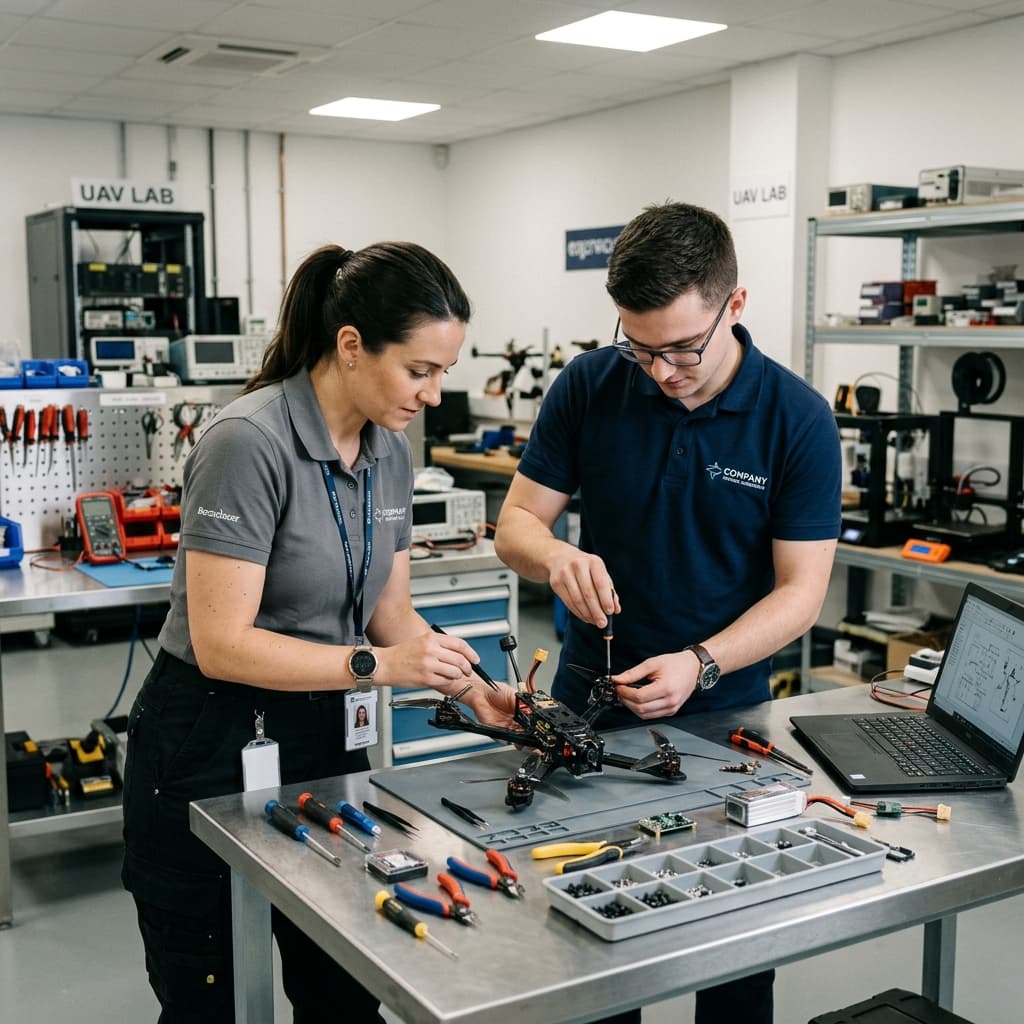
Human factors and operational procedures form the final pillar of the document. A flawlessly safe drone architecture is negated by terrible crew resource management. The safety case must include thousands of pages of deeply specific standard operating procedures (SOPs), maintenance schedules, and stringent pilot training qualifications. Regulators must be assured that an exhausted operator suffering from target fixation has a rigid checklist to follow when multiple system warnings begin blaring.
Constructing a safety case is deeply tedious, heavily bureaucratic, and entirely non negotiable for advanced operations. It forces an organization to transition from an agile, fast failing hardware startup mentality into the deeply disciplined, highly conservative mindset of commercial aviation engineering.
We can present findings in a working session, map recommendations to your portfolio and risk register, and help you prioritize next steps with clear owners and timelines.