Insights · Article · Rugged Hardware · Apr 2026
Protecting C6ISR transit cases from severe tracked and wheeled vehicle vibration: calculating isolator sway space, selecting wire rope versus elastomeric mounts, and avoiding resonant frequency amplification.
Mounting commercial-off-the-shelf (COTS) or semi-ruggedized server equipment inside a military vehicle subjects delicate hard drives, heavy GPU cards, and intricate fiber interconnects to a brutal mechanical environment. A tracked vehicle traversing rough terrain transmits massive, sustained, low-frequency shocks directly through its hull. Without an engineered vibration isolation system, the kinetic energy will literally shake the server components to pieces—shearing PCIe slots, unseating RAM modules, and fracturing solder joints. A rugged transit case is useless if it is hard-bolted to a shaking floor.
The physics of isolation center on decoupling the equipment from the vibration source. An isolator acts as a low-pass mechanical filter. It is designed to be softer than the mounting structure, compressing and expanding to absorb the violent movements of the vehicle so that the server rack floating inside experiences a much smoother, dampened motion. However, if the isolator is selected incorrectly, it can actually amplify the vibration at certain frequencies, causing more damage than if the rack had been hard-mounted.
Resonant frequency is the critical mathematical calculated risk in any isolation design. Every spring-mass system (the isolators and the heavy server rack) has a natural frequency at which it 'wants' to bounce. If the vehicle's vibration profile (e.g., the engine RPM or the track-link impact rate) hits that exact resonant frequency, the system enters resonance. The oscillations multiply, causing the server rack to swing violently out of control until it slams into the chassis walls or rips the isolators apart. The engineer must select isolator stiffness such that the system's natural frequency falls well below the vehicle's dominant forcing frequencies.
Wire rope isolators are the gold standard for heavy, vehicle-borne military racks. Constructed of stranded stainless-steel wire wound in a helix between two mounting bars, they offer immense load capacity and multi-axis isolation. Crucially, as the wire strands rub against each other during compression, they generate friction, which provides inherent damping. This damping prevents the rack from continuing to bounce endlessly after a shock event. Wire rope is also largely impervious to extreme temperatures, oils, and the ozone degradation that destroys rubber mounts.
Elastomeric (rubber or silicone) mounts are utilized for lighter equipment or where high-frequency vibration damping is prioritized over severe shock absorption. They are inexpensive and easily tuned by altering the polymer formula (the durometer). However, elastomers stiffen significantly in extreme cold, meaning an isolator that works perfectly in the desert may become a rigid block of ice in the Arctic, transmitting every jarring impact directly into the servers. Elastomeric selection must consider the full temperature operating range, not just standard room temperature behavior.
Sway space is the physical clearance required around the isolated rack. Because the isolators allow the rack to move, the rack must have room to swing. If a 19-inch rack is mounted inside a transit case with only a half-inch of clearance, a severe shock will cause the rack to bottom out against the case wall. This 'snubbing' impact is often more destructive than the original shock, as it creates an instant, high-G deceleration spike. The case volume must be sized to accommodate the maximum calculated excursion of the isolators under worst-case loading.
Center of Gravity (CG) alignment dictates exactly how the isolators are positioned. If heavy UPS batteries are placed at the bottom of the rack and lightweight network switches at the top, the CG is low. If the four corner isolators are mounted symmetrically at the vertical midpoint of the rack, a forward shock will induce a massive rotational moment, causing the rack to pitch violently forward. The isolators must be positioned in a plane that passes directly through the true Center of Gravity to ensure straight, linear translation rather than destructive rotation.
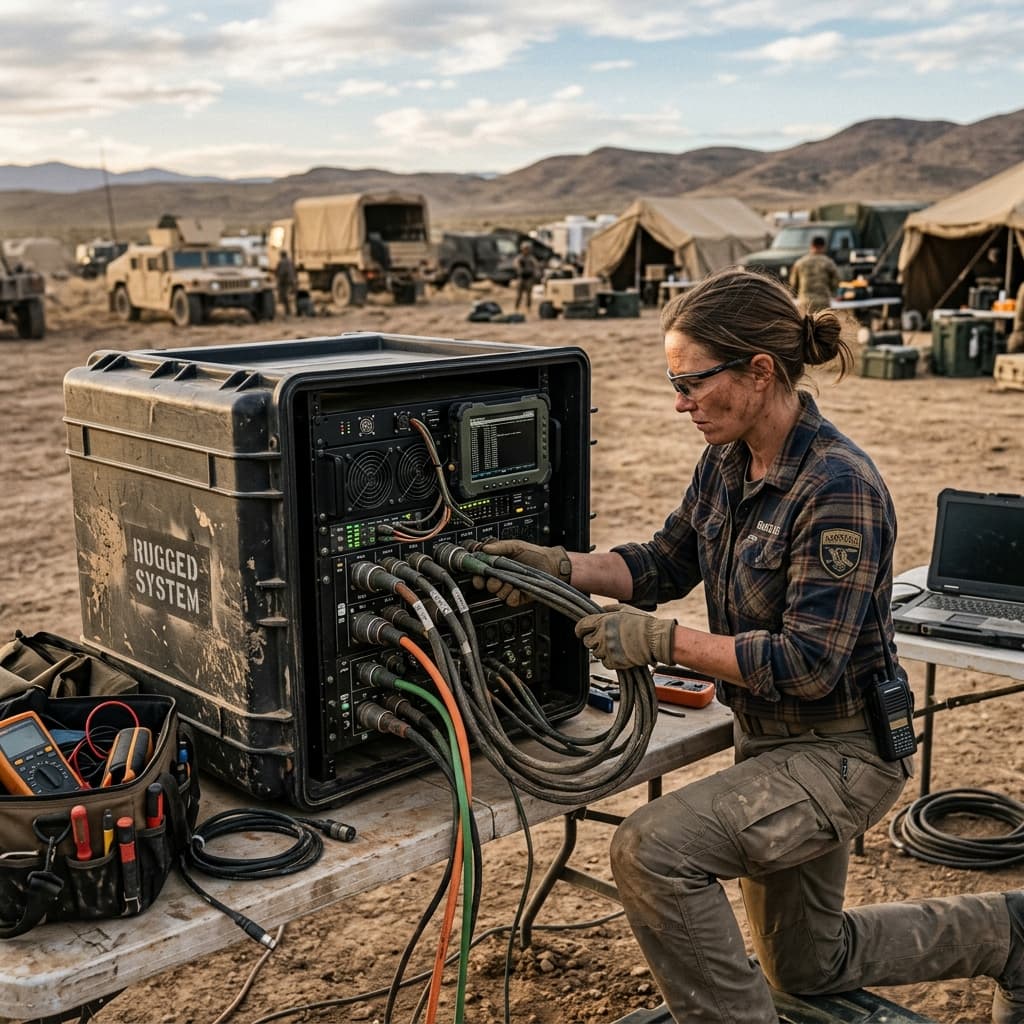
Cable management across the isolation boundary is a frequent failure point. A thick bundle of heavy power and network cables bridging the gap between the floating server rack and the rigid outer vehicle hull creates a mechanical short circuit. If the cables are pulled tight, they bypass the isolators entirely, transmitting vibration directly into the servers and eventually ripping the connectors out of their sockets. All cables crossing the isolation plane must feature generous, engineered service loops that allow full travel of the rack without applying tension.
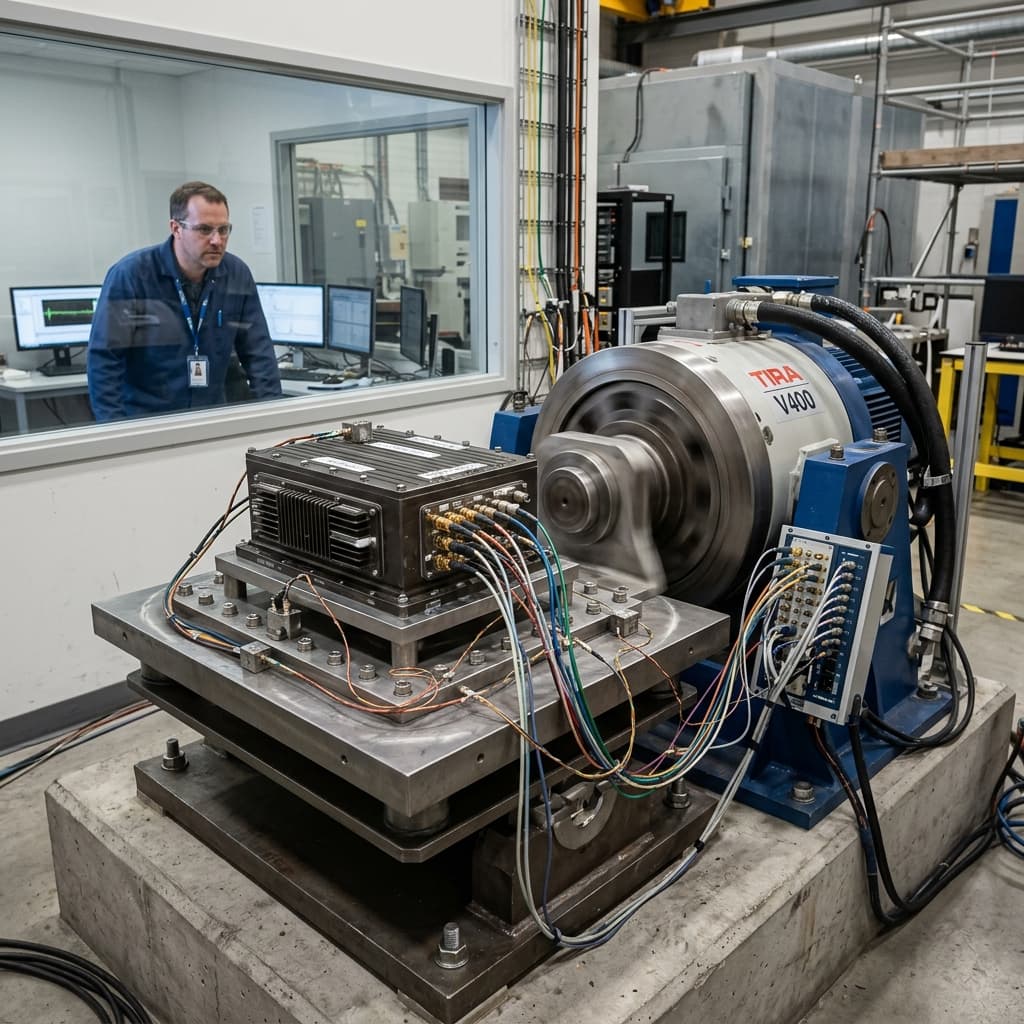
MIL-STD-810 vibration testing is the ultimate validation of the isolation design. The fully loaded rack must be subjected to the specific vibration profiles defined for wheeled or tracked vehicles. Attempting to simulate a 400-pound server rack using sandbags during testing is a common mistake; sand acts as a massive 'dead' damper, whereas real servers contain moving parts and flexible PCBs that respond differently to resonance. The test must utilize a mass-mockup that accurately replicates both the weight and the rigidity of the actual electronics.
Maintenance of the isolation system is minimal but critical. While wire rope isolators are highly durable, catastrophic shock events—such as an IED blast or a severe vehicle collision—can permanently deform them. Post-incident inspection must verify that the isolators maintain their original free height and that the wire strands have not separated or frayed. An isolator that has yielded has lost its designed stiffness and must be replaced to protect the payload from future sustained vibration.
We facilitate small-group sessions for customers and prospects without requiring a slide deck, focused on your stack, constraints, and the decisions you need to make next.