Insights · Article · UAV Systems · Apr 2026
How to design, test, and qualify a GNSS-denied navigation fallback for UAV systems: sensor stack selection, dead-reckoning accuracy budgets, failure mode analysis, and field qualification protocols for reliable operations where GPS is unavailable or jammed.
GNSS-denied operations expose the navigation assumptions that most UAV programs never test explicitly. A quadrotor that hovers steadily outdoors in good GPS conditions may drift, oscillate, or fail to hold altitude the moment the receiver loses lock. The reason is rarely a single sensor fault. It is the combination of an inertial measurement unit that was never characterized for bias drift without GPS correction, an optical flow sensor that was never validated at the operational altitude, and a barometer that responds to wind pressure changes near obstacles in ways that bench testing did not capture.
Designing a GNSS-denied navigation fallback requires defining an accuracy budget before selecting sensors. The budget should specify the maximum allowable position error and drift rate during a defined mission segment at a defined speed and duration. From that budget, the team can work backward to determine how much inertial drift is tolerable, what minimum optical flow resolution is required, and whether a secondary ranging technology such as visual-inertial odometry or ultra-wideband positioning is needed for the specific environment.
Inertial measurement unit selection for GNSS-denied applications should be based on bias instability and random walk coefficients from the manufacturer's data sheet, validated against independent laboratory measurements where available. A tactical-grade IMU with low bias instability allows longer dead-reckoning intervals before position error exceeds the budget, but it also adds cost, mass, and power draw. The selection tradeoff should be documented explicitly so that future program changes that alter the mission profile can be evaluated against the original accuracy budget assumptions.
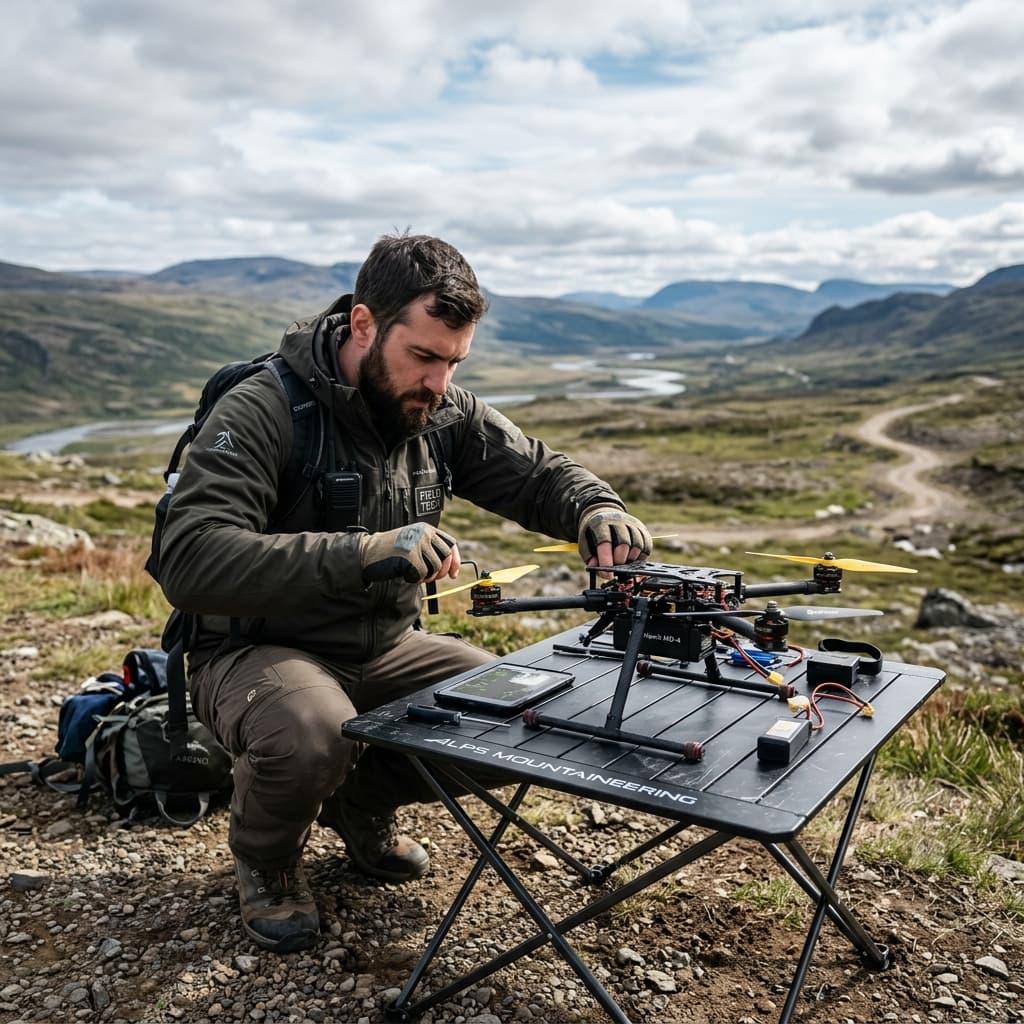
Optical flow sensors complement inertial navigation by providing velocity measurements relative to the ground surface. Their effectiveness degrades in low-light conditions, over featureless terrain such as water or uniform sand, and at altitudes where the ground texture is too fine to resolve at the sensor's frame rate. The fallback stack design should specify the minimum contrast and texture requirements for optical flow to contribute a reliable measurement, and the system behavior when those conditions are not met. Defaulting to inertial-only navigation with explicit drift warnings is safer than allowing an optical flow sensor to contribute corrupted measurements silently.
Barometric altitude holds significant appeal as a fallback because it is passive, lightweight, and widely available. Its limitation in GNSS-denied environments is sensitivity to pressure changes caused by proximity to structures, rotor downwash reflection, and rapid horizontal motion. Programs operating in urban or indoor environments should characterize barometric error under representative conditions, including different rotor configurations and varying distances from walls and floors, before relying on baro altitude as the primary vertical reference.
Visual-inertial odometry, or VIO, has become a practical option for platforms with sufficient compute resources. By combining camera imagery with IMU data using a tightly coupled estimation filter, VIO can produce position estimates that remain accurate over longer distances than pure inertial navigation. Its limitations include degraded performance in environments with repetitive textures, sensitivity to motion blur at high speeds, and significant computational overhead that must be budgeted against the platform's power and thermal envelope. Programs adopting VIO should characterize these limits during lab testing before integrating the capability into a field qualification plan.
Failure mode analysis for the GNSS-denied navigation stack should enumerate every sensor fault condition and define the system response. Faults include sensor dropouts, corrupted outputs that remain within plausible ranges but are incorrect, and environmental conditions that render a sensor unreliable without generating a fault flag. For each fault condition, the analysis should document whether the system can detect the fault autonomously, what the crew is expected to do when the fault is announced, and what the aircraft behavior is expected to be during the detection-to-response interval.
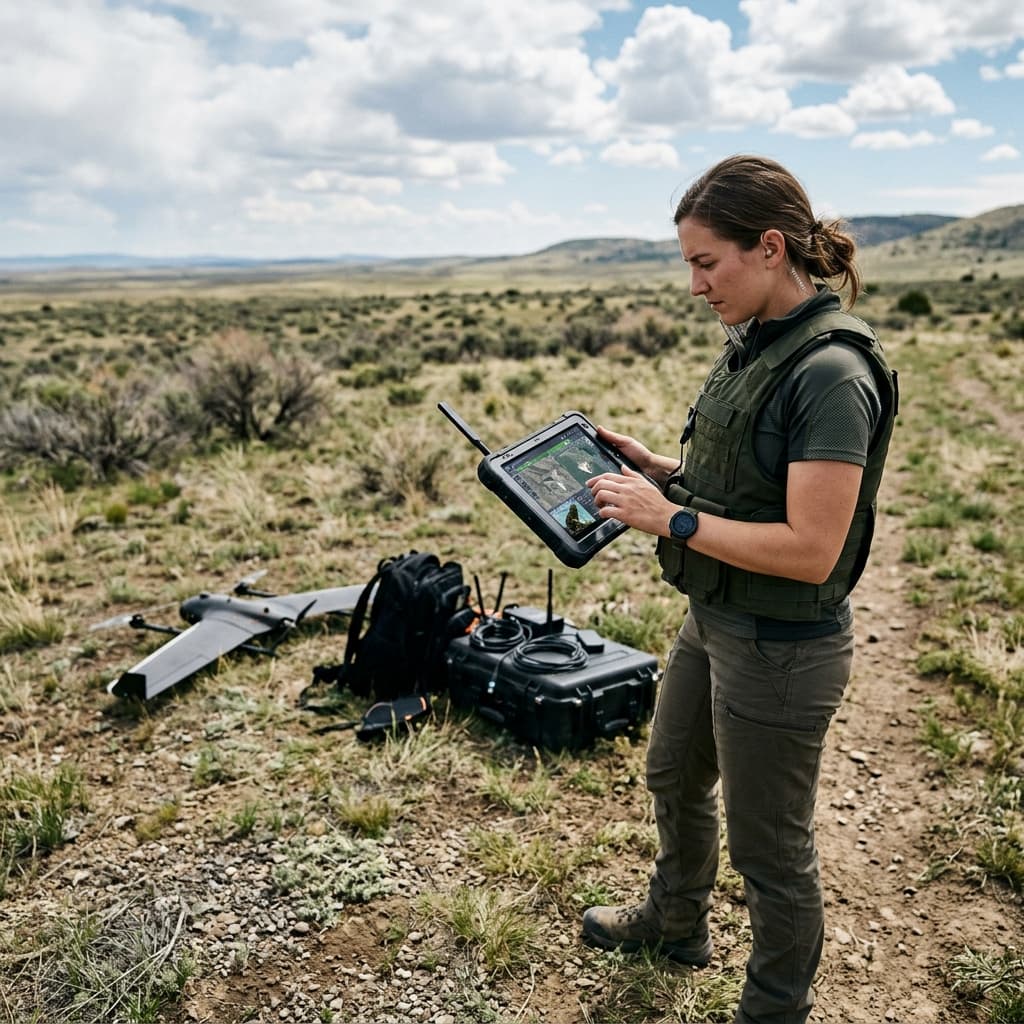
Field qualification for GNSS-denied operations should be conducted in at least two distinct environments: one that is representative of the most demanding expected operational setting, and one that is a controlled baseline where ground truth position can be measured accurately for comparison. The qualification plan should specify the test maneuvers, the duration, the evaluation metrics, and the pass criteria. Logging all sensor data during qualification tests, not just the fused state estimate, allows the engineering team to diagnose failures in post-analysis without needing to repeat tests.
Transition management between GNSS-available and GNSS-denied states is a scenario that programs frequently neglect to qualify. When a UAV transitions from outdoor GPS-guided flight to an area of signal denial, the navigation filter must hand off smoothly without position jumps or velocity discontinuities that could destabilize the aircraft. The same is true for the return transition. Qualification should include repeated entries and exits of the denial zone at different speeds and headings to verify that the transition logic is robust across the expected operational parameter space.
Operator training for GNSS-denied operations is an extension of the qualification process, not an afterthought. Pilots who have only operated in GPS-available environments develop instincts that rely on position hold behavior. When that behavior changes under GNSS denial, the instinctive control inputs required are different and must be practiced before the first live mission. Simulator training that models the degraded navigation behavior, followed by supervised field training in a controlled denial environment, ensures that the human element is as well qualified as the hardware.
Documentation that emerges from GNSS-denied qualification becomes part of the operational envelope definition. The qualified operating envelope should state the minimum sensor conditions required before a GNSS-denied sortie is authorized, the maximum allowable drift rate before mandatory return or landing is triggered, and the crew configurations required for monitoring. An operational envelope that is not documented cannot be enforced consistently, and a program that allows informal exceptions to navigation qualification requirements is accepting undefined risk on every sortie flown in those conditions.
We facilitate small-group sessions for customers and prospects without requiring a slide deck, focused on your stack, constraints, and the decisions you need to make next.