Insights · Article · Field Robotics · Apr 2026
Analyzing traction mechanics for tactical ground robots: contact patch area, obstacle approach angles, center-of-gravity shifting, and the engineering tradeoffs between speed and obstacle negotiation.
The defining characteristic of an urban rubble environment is chaotic, non-uniform geometry. A tactical ground robot deployed in post-blast concrete debris, collapsed stairwells, and tangled rebar does not encounter predictable terrain. It faces shear vertical faces, deep voids, and shifting, unstable surfaces. The choice between a wheeled architecture and a continuous tracked architecture fundamentally dictates whether the robot will successfully negotiate the obstacle or flip over in a narrow gap, failing the mission.
The contact patch is the fundamental metric of traction. A wheeled robot, even with large pneumatic tires, has a relatively small contact patch—the precise point where the tire meets the ground. In loose debris or deep mud, this small area concentrates the vehicle's weight into high ground pressure, causing the wheels to dig in and sink. A tracked robot distributes the same vehicle weight over the entire length of the continuous belt resting on the ground. This exponentially larger contact patch drastically lowers ground pressure, allowing the tracked vehicle to 'float' over loose rubble and bridge wide horizontal gaps that would swallow a wheel.
Approach angle and obstacle scaling heavily favor tracked designs. A standard wheeled robot cannot climb a vertical obstacle taller than the radius of its wheels; the tire will merely spin futilely against the flat face. A tracked robot, particularly one equipped with articulated leading 'flippers', can raise its track profile to address the obstacle directly. The tracked flipper hooks the lip of the stair or rubble block, and the continuous belt pulls the entire chassis up and over with immense traction. For severe urban exploration, tracks are the only viable mechanism for climbing steep, jagged geometry.
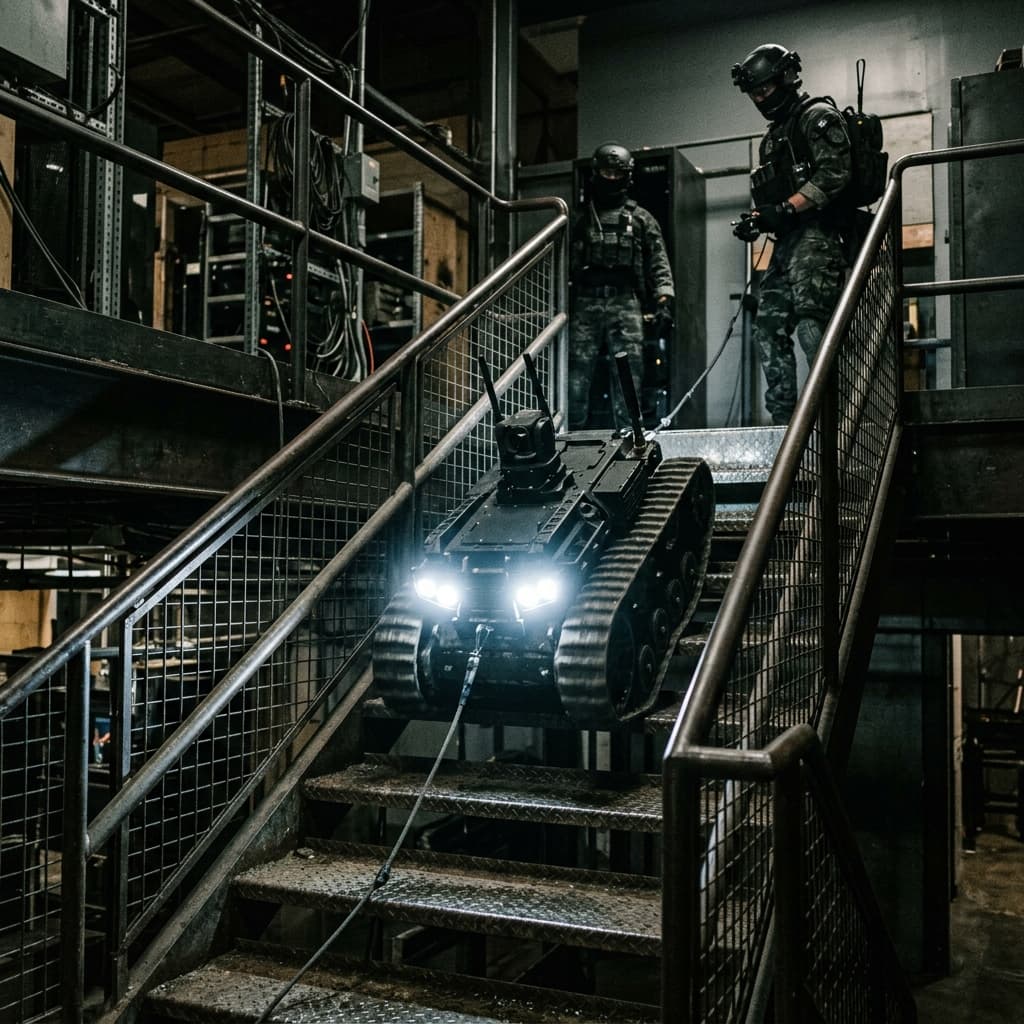
However, tracked systems incur significant engineering penalties. Tracked drives represent a massive increase in mechanical complexity, weight, and friction over a wheeled system. The continuous belt must be driven by sprockets, guided by idlers, and constantly tensioned. All of this internal friction acts as a parasitic drain on battery performance. A wheeled robot of equivalent weight will travel significantly faster on flat ground, run much quieter, and deplete its battery much slower than its tracked counterpart. The tactical decision rests on whether the mission prioritizes long-range sprint speed down clear corridors or slow, brute-force climbing over blast debris.
Turning mechanics provide another constraint. Wheeled robots typically employ Ackerman steering (like a car) or skid steering (like a tank). Skid-steering a wheeled robot is inefficient, violently scrubbing the tires against the ground, but allows pivot turning in tight spaces. Tracked robots use purely skid steering by driving one track forward and the other in reverse. While this allows true zero-degree pivot turns in incredibly tight rubble confines, the lateral friction generated requires massive torque from the drive motors. If a tracked robot attempts a rapid pivot turn on high-friction concrete or thick carpet, the torque demand can instantly trip internal motor protection circuits, stalling the platform.
Track throw is the singular catastrophic failure mode unique to this architecture. In a chaotic rubble field, jagged concrete blocks or thick rebar can wedge between the track belt and the drive sprocket. If the motor continues to grind, the lateral force will leverage the thick rubber track entirely off the idler wheels. A 'thrown' track renders the robot completely immobile and requires a human operator to enter the hazard zone, manually tension the heavy belt, and pry it back onto the sprockets. Mitigating track throw requires aggressive track guards, self-cleaning sprocket geometries, and intelligent motor controllers that sense the sudden current spike of a jam and automatically reverse torque before the track is derailed.
Wheel articulation offers a compromise for specialized systems. Certain highly complex wheeled robots utilize independent, articulated legs fitted with wheels at the ends. By independently lifting each wheel, the robot can step over obstacles or reshape its footprint to climb stairs, combining the low friction of wheels with the climbing geometry of tracks. Yet, this introduces dozens of vulnerable servo motors and incredibly complex kinematic software control, drastically increasing the points of failure compared to a simple, brute-force tracked chassis.
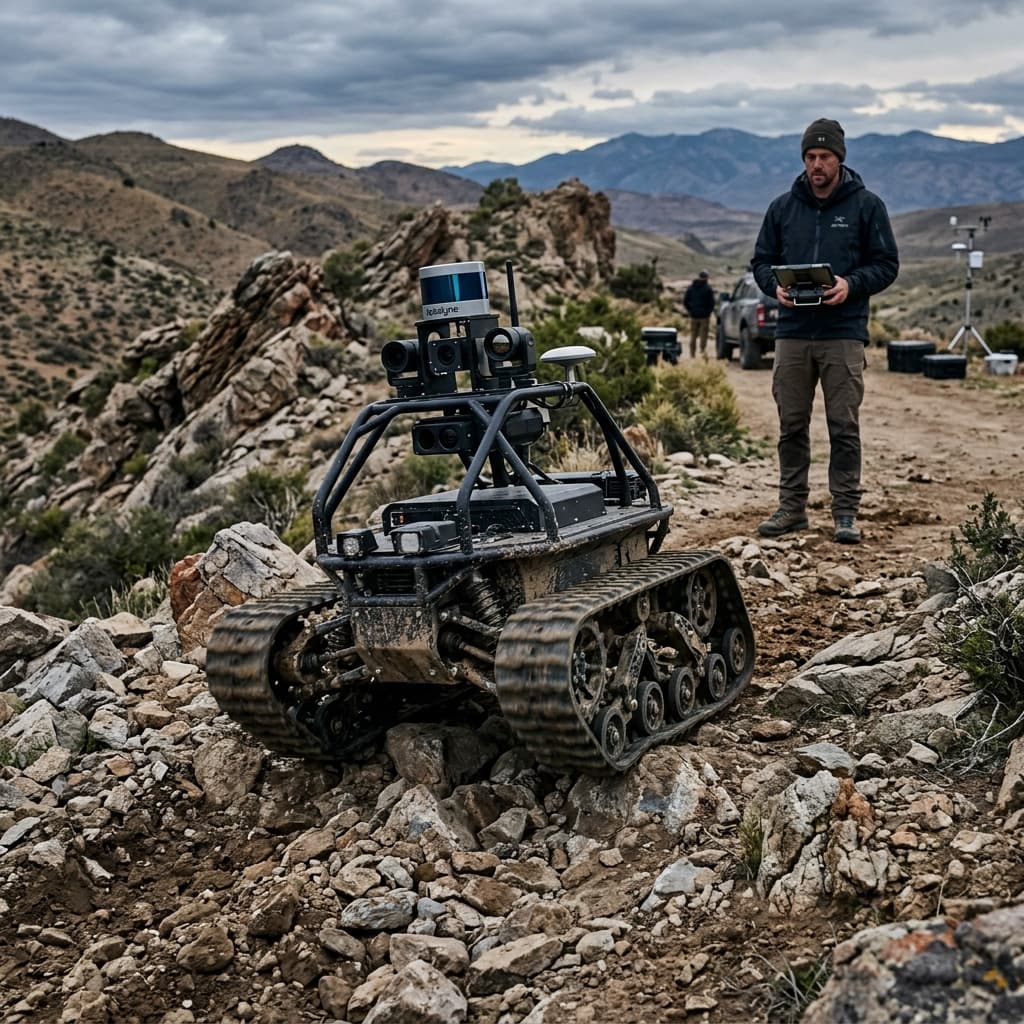
Ultimately, evaluating mobility architecture requires ruthless honesty about the operational environment. A bomb-disposal unit clearing a paved airport terminal will benefit from the speed, precision, and efficiency of a wheeled platform. An explosive ordnance team breaching a collapsed, rubble-filled structural shell requires the bridging capability and aggressive obstacle-scaling geometry that only a dedicated tracked chassis can provide.
We facilitate small-group sessions for customers and prospects without requiring a slide deck, focused on your stack, constraints, and the decisions you need to make next.