Insights · Article · Field Robotics · Apr 2026
Overcoming the most dangerous threat to tactical teleoperation: data latency, signal occlusion, managing control inputs during network brownouts, and shifting toward semi-autonomous edge behaviors.
Teleoperation is the core operational paradigm for the majority of tactical field robots; an operator sits at a secure console, analyzing incoming video feeds, and pushes a joystick to command the remote machine. This paradigm relies entirely on a high-bandwidth, zero-latency communication link. In a perfect, line-of-sight test range, this works flawlessly. In a real-world urban environment characterized by thick concrete walls, multi-path interference, and active electronic jamming, the network inevitably degrades. Managing this degradation, known as latency and packet loss, is the critical boundary between a successful robotic manipulation and a catastrophic failure.
Latency is the deadly enemy of fine manipulation. When a robotic arm is tasked with snipping a wire or inserting a key, the operator relies on visual feedback from the robot's camera. If the network introduces even a 500-millisecond delay, the operator sees where the robot's arm was half a second ago, not where it is now. The operator issues a command to stop, but the command takes 500 milliseconds to travel to the robot. Overcompensating for this delay leads to violent, jerky 'pilot-induced oscillations', resulting in the robot smashing the sensitive target it was intended to defuse. Pure teleoperation becomes functionally impossible above 800 milliseconds of round-trip latency.
Mitigating video latency requires aggressive, adaptive compression algorithms. Streaming high-definition 4K video from four separate robot cameras simultaneously consumes massive bandwidth. When the RF signal degrades due to distance or obstacles, attempting to push that much data causes the video feed to freeze entirely. The robot's communication architecture must automatically sense the shrinking pipe and deprioritize telemetry. It must drop frame rates, increase compression, and switch the video stream to black-and-white high-contrast mode—all to guarantee that a continuous, unbroken, albeit lower-fidelity, image reaches the operator without lag.
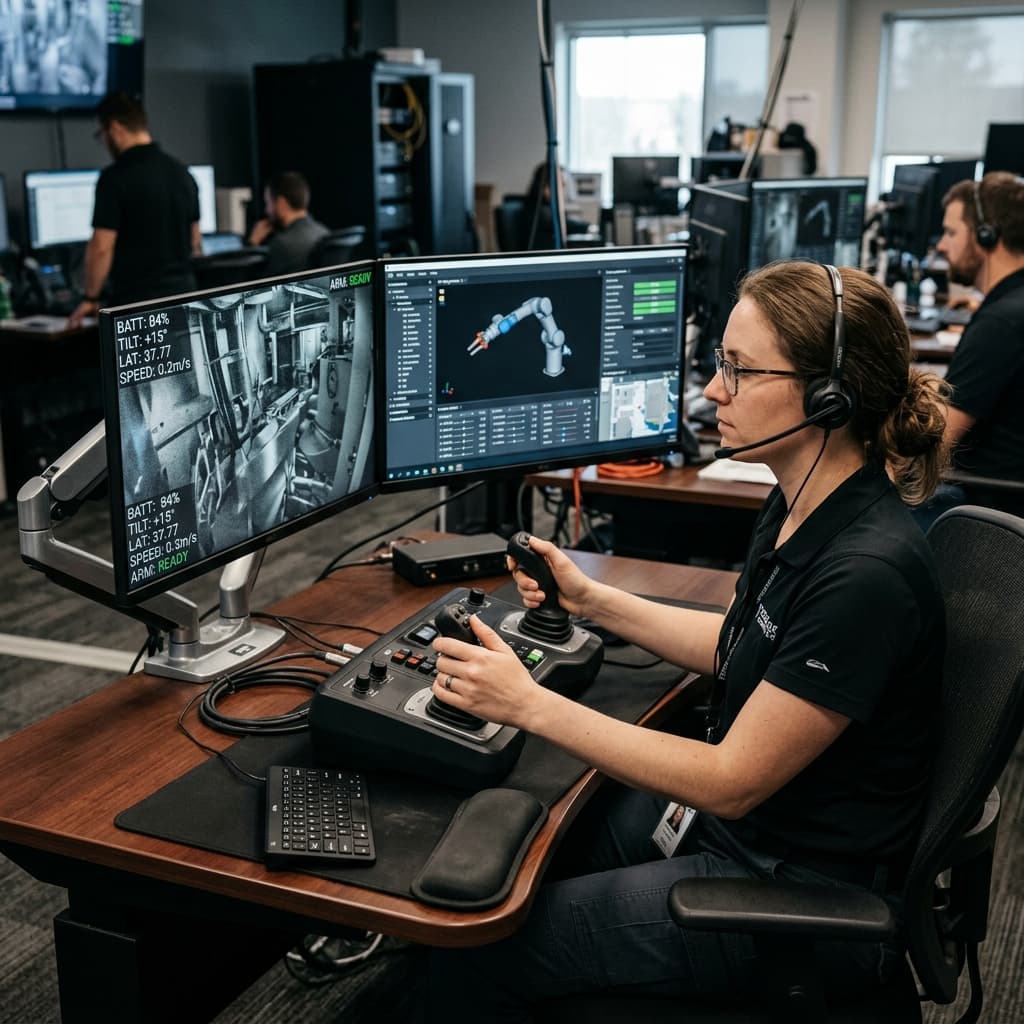
Control link priority is paramount. If the network experiences severe momentary packet loss (a 'brownout'), the robot will receive fragmented data. A poorly designed system will attempt to execute an incomplete driving command, causing a dangerous, unpredictable lurch. The architecture must rigidly separate the control stream from the video stream, prioritizing the micro-kilobytes of driving instruction above all else. Furthermore, the robot's firmware must implement a watchdog timer. If the control heartbeat is lost for more than a fraction of a second, the robot must instantly halt and enter a safe state, ignoring any stale joystick commands that arrive late.
Semi-autonomous edge behaviors represent the true engineering solution to network latency. Instead of relying on the operator to manually joystick every inch of an approach, the intelligence is pushed 'to the edge'—dwelling on the robot's own internal processor. The operator issues a macro-command: a single click on the screen indicating 'drive to that doorway.' The robot then uses its own local sensors and compute to navigate the terrain smoothly, avoiding rubble and halting exactly at the door, completely immune to the latency of the network link because the control loop is closed locally.
Retro-traverse (automatic return to comms) is an essential failsafe. When a robot drives around a thick concrete corner or deep into a subterranean tunnel, the RF signal will abruptly terminate. The robot is now blind and deaf to the operator, a highly expensive stranded asset. Advanced field robots must actively map their incoming route. Upon detecting a hard sever of the communication link, the robot autonomously reverses its path, driving backward along its known safe route until it reacquires the RF signal from the operator control unit.
Physical tethering remains the foolproof, brute-force solution when RF environments are completely hostile. Tactical robots deployed into deep culverts, ship hulls, or active EW (electronic warfare) jamming zones abandon wireless operation entirely. An ultra-thin, ruggedized fiber-optic spool pays out behind the robot, guaranteeing zero-latency, gigabit-speed, unjammable communication. The engineering challenge shifts from RF mitigation to complex mechanical tether management—ensuring the delicate fiber does not kink around a corner or get severed by the robot's own tracks when reversing.
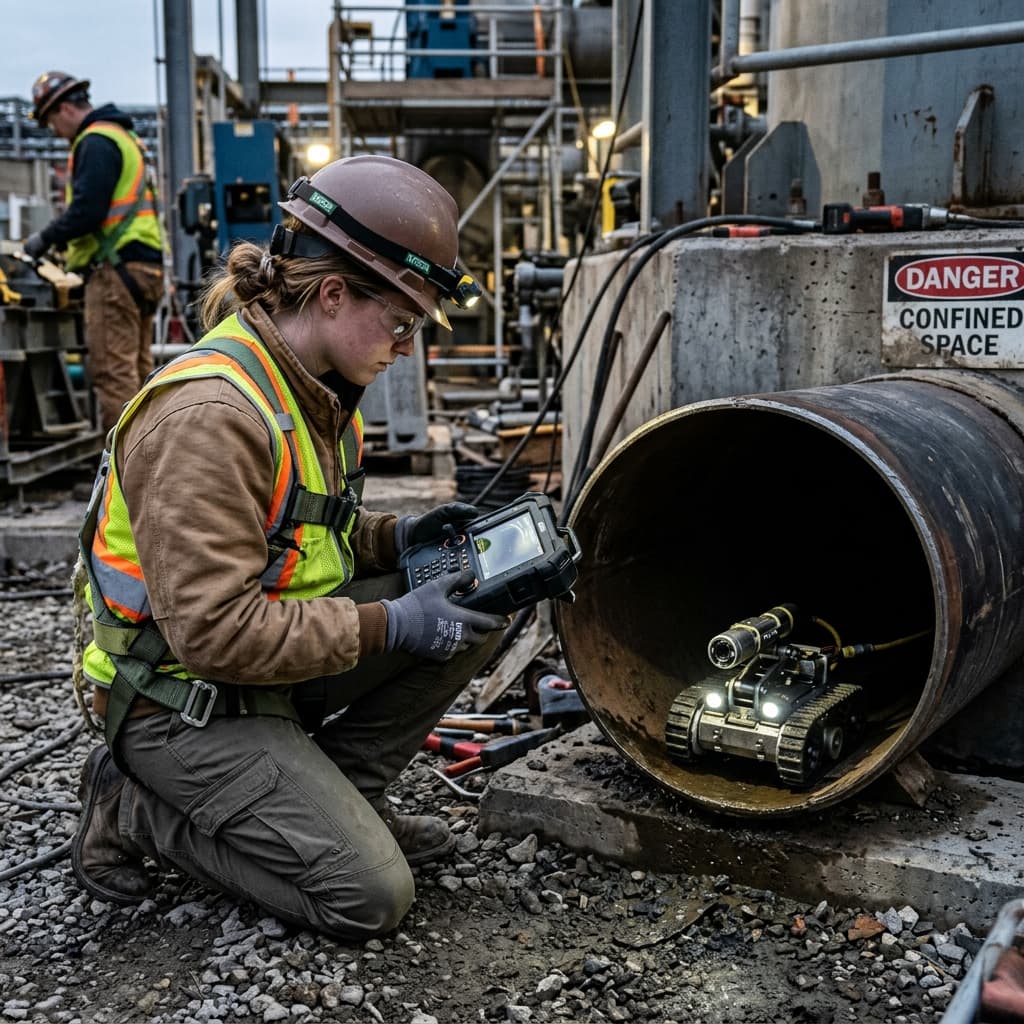
To survive in austere environments, operators must be trained to recognize the symptoms of network degradation and switch their operational tempo. An aggressive, rapid driving style must shift to a deliberate 'move-and-wait' strategy when latency spikes. However, training is only the backup. The primary responsibility rests on the robotic engineers to build adaptive networks, resilient safety watchdogs, and semi-autonomous behaviors that bridge the gap when the invisible wireless tether begins to fray.
We facilitate small-group sessions for customers and prospects without requiring a slide deck, focused on your stack, constraints, and the decisions you need to make next.