Insights · Article · Field Robotics · Apr 2026
Navigating the challenges of deep subterranean robotics: why RF communication fails underground, the mechanical intricacies of fiber-optic tether management, and the tactical deployment of breadcrumb relay networks.
Subterranean (SubT) environments—subway tunnels, sewer networks, deep caves, and reinforced bunkers—represent the ultimate hostile environment for robotic teleoperation. The primary casualty of heading underground is the radio frequency (RF) control link. Soil, rock, and thick concrete are incredibly effective RF attenuators. A 2.4 GHz control signal that easily reaches a mile in open air will be completely absorbed within fifty feet of driving around a sharp bend in a concrete pipe. To operate deep underground, engineers must abandon long-range wireless assumptions and implement physical or specialized relay architectures.
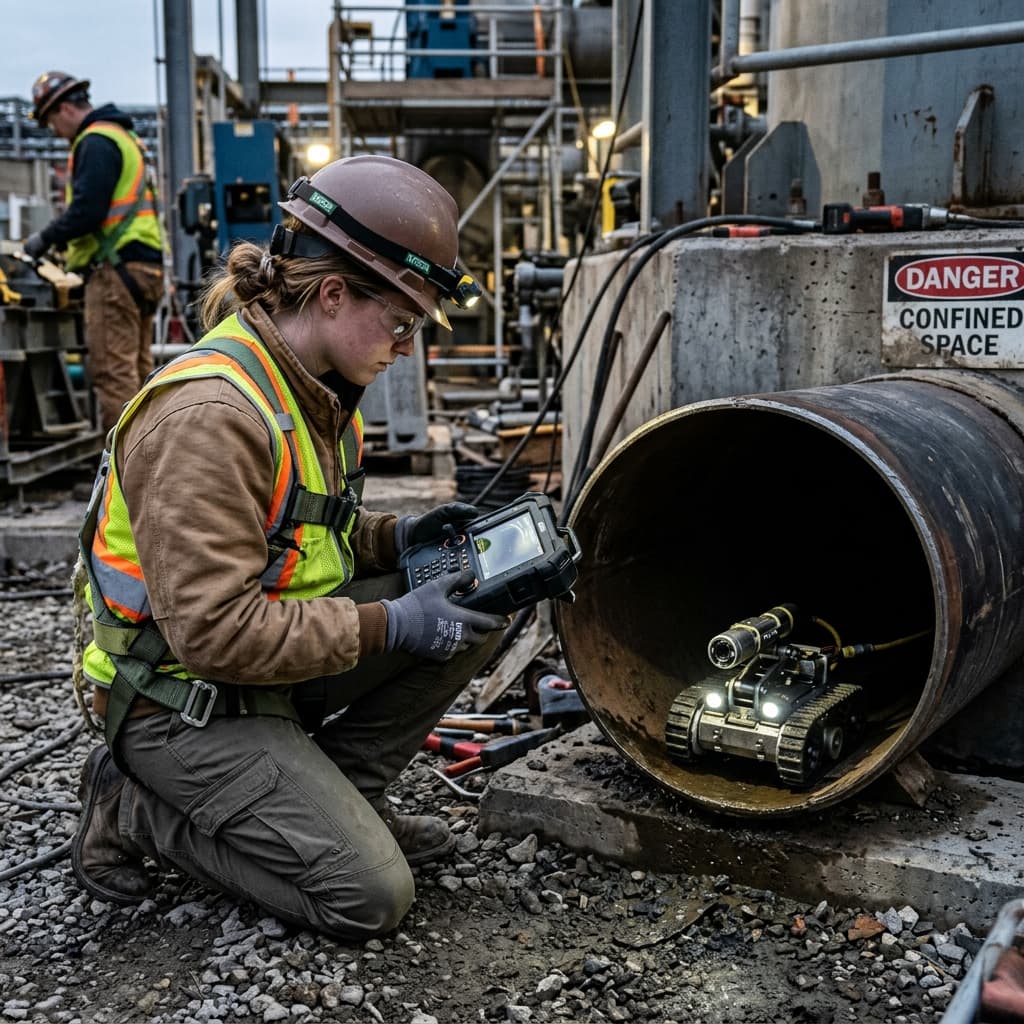
The fiber-optic tether is the absolute solution to SubT latency and signal loss. Using a physical wire guarantees unjammable, zero-latency, immensely high-bandwidth communication—capable of pushing multiple uncompressed 4K video feeds and precise driving telemetry smoothly over massive distances. However, the tether replaces an RF networking problem with an incredibly unforgiving mechanical engineering problem. A tactical SubT tether is usually an ultra-fine, Kevlar-reinforced fiber-optic cable, often thinner than a shoelace to minimize weight and friction over thousands of feet.
Tether management dictates the maximum range. If the operator attempts to drag the fiber by pulling it manually from the entrance, friction against the tunnel floor and sharp concrete corners will snap the delicate cable within the first hundred yards. Advanced SubT robots carry the spool internally, actively paying the fiber out behind them as they drive. This ensures the fiber lays perfectly static on the ground, eliminating dragging friction. The robotic spool mechanism must precisely match the payout speed to the driving speed; if the spool turns too slowly, the fiber snaps; if it turns too fast, the fiber tangles in the tracks.
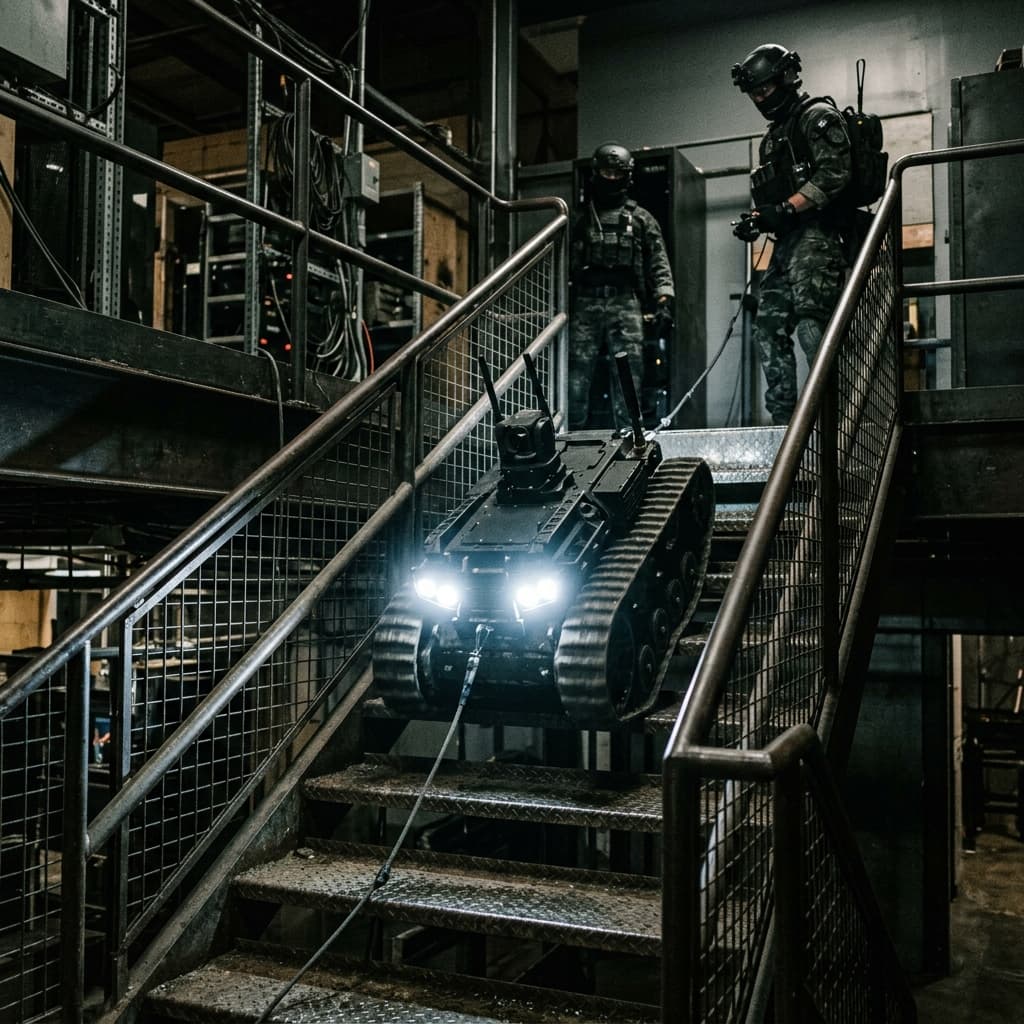
Reversing poses the greatest danger to a tethered robot. A robot can drive forward autonomously dropping fiber for miles, but backing out is complex. The robot cannot simply drive in reverse, driving over and crushing its own delicate lifeline. The robotic spool system must actively retract and neatly rewind the tether under precise tension as the robot backs up. Without an active retrieval winch, an operator must execute wide pivot turns to manually pull the slack, a maneuver often impossible in tight sewer pipes.
'Breadcrumb' relay drops offer a hybrid wireless alternative when a physical tether is tactically unviable due to extreme snags. As the robot drives deeper into the tunnel and its primary RF link begins to degrade, it physically ejects a small, ruggedized mesh-network repeater node onto the tunnel floor. This node acts as a bridge, forwarding the signal back to the entrance. By sequentially dropping these breadcrumbs just before signal loss at every sharp turn, the robot builds a custom communication pipeline behind it. The engineering challenge is miniaturizing the high-power repeating nodes to fit dozens inside the robot's payload bay.
Low-frequency (LF) signalling provides a specialty, non-line-of-sight capability for extreme penetration, specifically in mine rescue operations. Unlike high-frequency Wi-Fi waves that bounce and attenuate, low-frequency electromagnetic waves can physically penetrate through hundreds of feet of solid rock. The tradeoff is bandwidth; LF systems can punch a signal straight through a mountain, but the data rate is so agonizingly slow it can only transmit tiny text commands or slow framing telemetry, making live video streaming impossible.
Autonomy serves as the ultimate fallback in SubT operations. Whether tethered or utilizing breadcrumbs, the link will eventually sever due to a snagged cable or a crushed node. The robot must possess the onboard intelligence to recognize the severed connection and execute a 'blind retro-traverse.' Using its internal LiDAR map—generated on the inbound journey—the robot autonomously turns around and navigates the complex maze back toward the surface until it reacquires the operator signal, preventing the total loss of the asset in the dark.
We facilitate small-group sessions for customers and prospects without requiring a slide deck, focused on your stack, constraints, and the decisions you need to make next.