Insights · Article · Parachute Systems · Apr 2026
Understanding and managing reserve parachute repack cycles: the physiochemical basis for repack intervals, the inspection content required at each repack, documentation requirements, delegation of authority, and oversight of reserve parachute fleet compliance.
The reserve parachute repack cycle is mandated for exactly the same reason that aviation maintenance inspections are mandated: critical safety systems that are not periodically inspected by a qualified person will eventually contain undetected defects that cause failures at the worst possible time. The reserve parachute is unique among safety-critical aviation components because it is designed to be used only once, at the moment when every other system has already failed. If the reserve fails when it is needed, there is no second chance. The repack cycle is the primary mechanism for maintaining the reserve's readiness throughout its service life.
The physiochemical basis for repack intervals involves the slow degradation processes that occur in a packed parachute regardless of usage. Nylon fabrics and lines respond to the persistent mechanical stress of being compressed in a packed configuration by developing set, which is a permanent deformation that slightly changes the deployment characteristics. Closing loops made from natural materials like hemp undergo moisture absorption and drying cycles that weaken the material over time. Synthetic closing loops experience creep under the sustained compression of the closing pin. Contamination from lubricants, perspiration, and environmental moisture accumulates and can promote microbial growth that degrades fabric strength. The repack cycle interval is set to ensure these processes are detected before they compromise deployment reliability.
The inspection content at each repack covers every component of the reserve system: the canopy fabric and seams, the suspension lines for wear and damage, the deployment bag for condition and compatibility with the container, the pilot chute for spring tension and fabric condition, the closing loop for wear and strength, the freebag or deployment bag for compatibility with the container volume, the container fabric and hardware for condition, and the automatic activation device for battery life and calibration if applicable. Each of these elements should be assessed against written criteria, not against the inspector's memory of what is acceptable.
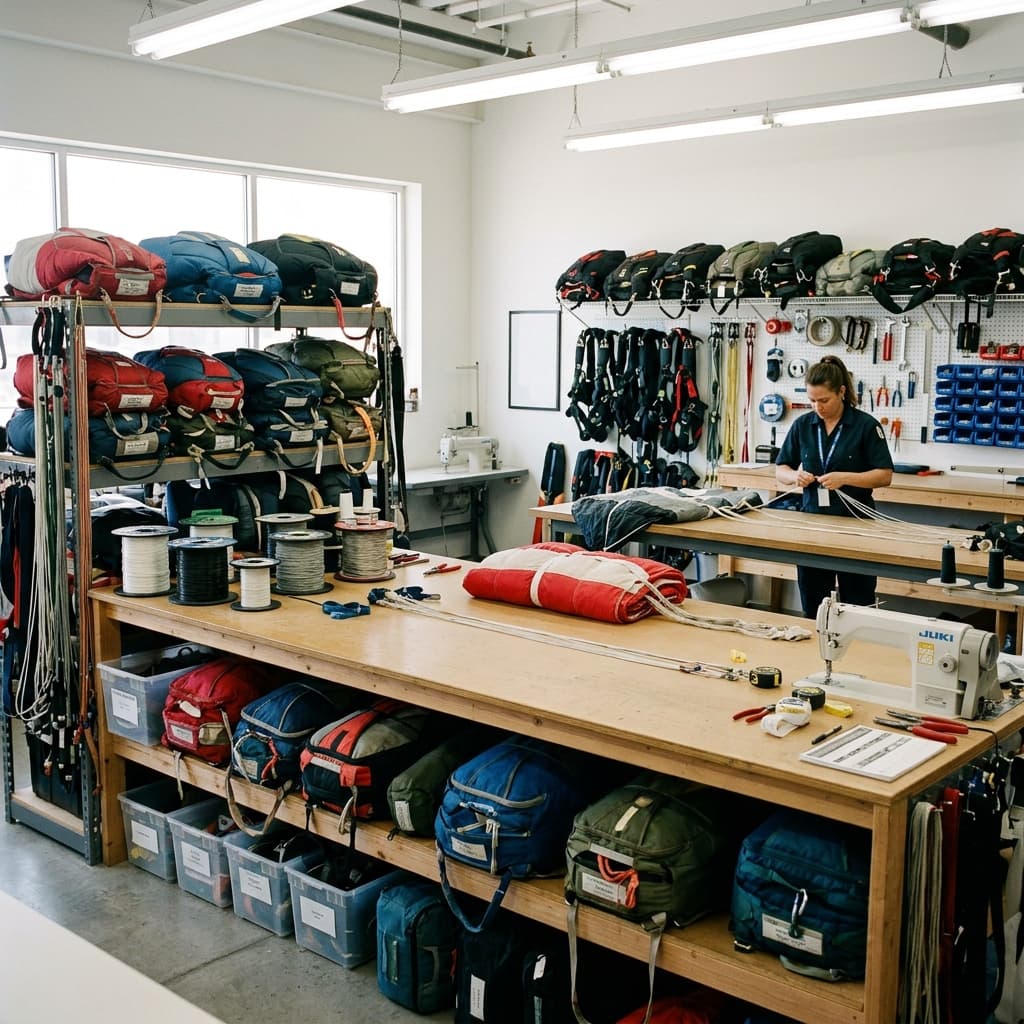
Closing loop replacement is a definitive outcome of many repack inspections because closing loops approach or exceed their service life within the repack interval. The closing loop material should be inspected for condition including surface abrasion and fiber separation, and measured against the minimum acceptable strength for the container design. Many programs require closing loop replacement at every repack regardless of apparent condition, particularly for reserve containers that will be used in high-physical-demand applications where closing loop failure has the most severe consequence.
Automatic activation device management during repack is a specific responsibility that requires the rigger to verify the device's battery expiration date, the calibration expiration date if applicable, the unit's service history, and the correct installation configuration for the specific container. The AAD manufacturer publishes installation instructions that specify the routing of the cutter cable, the positioning of the control unit, and the testing procedure to verify that the manual override function operates correctly after installation. These instructions should be in the loft and consulted during every repack rather than followed from memory.
Reserve repack authority in most regulatory frameworks is limited to certified or licensed riggers with specific reserve repack endorsement. The endorsement is not transferable between different regulatory jurisdictions, and a rigger who is authorized to repack reserves under one national authority may not be authorized under another. Programs that operate across jurisdictions should verify the applicable authority requirements for each deployment location and ensure that the rigger performing the repack has the appropriate authorization for that location. Documentation of the rigger's authorization should be retained alongside the repack record.
Traceability requirements for reserve repack records should be understood as a legal obligation in addition to an engineering practice. The repack record must identify the reserve by its serial number, the container serial number, the canopy serial number, the closing loop replacement details, the AAD serial number and service dates, the inspection findings, the packing date, the repack due date, and the rigger's signature and certification number. Many regulatory frameworks require these records to be retained for the life of the equipment. Electronic records systems can simplify retrieval but must meet the same completeness and retention requirements as paper records.

Fleet compliance monitoring for reserve repack cycles requires a system that identifies units approaching their due date in advance of the due date, allowing scheduling of repack appointments before the unit becomes overdue. A unit that is overdue for repack is not authorized for deployment, which means a jump that could not be delayed by the repack schedule is either cancelled or executed with reduced reserve readiness. Programs that manage repack scheduling reactively rather than proactively experience operational disruptions that are entirely preventable with a simple advance notification system.
Quality audits of reserve repack operations should be conducted at a defined interval, reviewing a sample of completed repack records against the applicable procedure requirements. The audit should verify that every required element of the inspection was completed and documented, that the closing loop installation meets the specification, that the AAD configuration is correct, and that the packing record is complete and legible. Audits that identify deficiencies in any of these areas should produce corrective actions that address both the specific deficiency and the process weakness that allowed it to occur.
Reserve activation analysis should occur whenever a reserve is deployed in service, even in training or development scenarios where the deployment was expected. The analysis should assess whether the deployment occurred within the expected time and force envelope, what the canopy condition is after deployment, whether any component failure contributed to the reserve deployment event, and what actions are required before the reserve is returned to service. A reserve that deployed correctly with no anomalies may be eligible for repack and return to service after a full inspection. A reserve that deployed with any anomaly should receive an engineering review before any repack decision is made.
We facilitate small-group sessions for customers and prospects without requiring a slide deck, focused on your stack, constraints, and the decisions you need to make next.