Insights · Article · Parachute Systems · Apr 2026
The quality assurance framework for parachute packing operations: workspace standards, tool calibration and control, packing procedure compliance, independent inspection requirements, and the records system that closes each packing event with traceable accountability.
Parachute packing quality assurance rests on the premise that a packing error cannot be detected by the person for whom the parachute is packed. The user receives the packed system and trusts that it has been prepared correctly. This trust is the social and legal contract between a rigger and the person who depends on the equipment. Quality assurance is the engineering and procedural structure that makes that trust defensible rather than merely assumed. When quality assurance fails, packing errors reach deployment conditions without detection, and the consequence is measured in lives rather than in production delays.
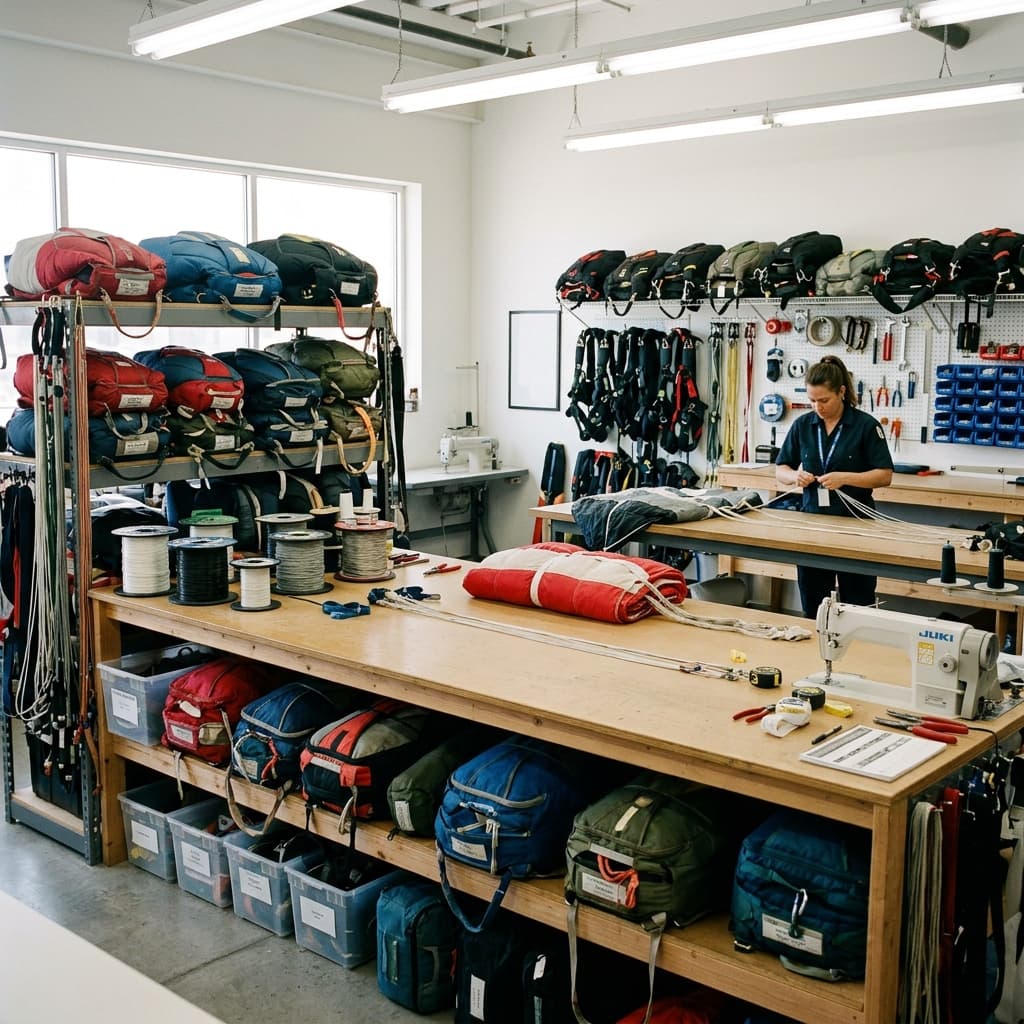
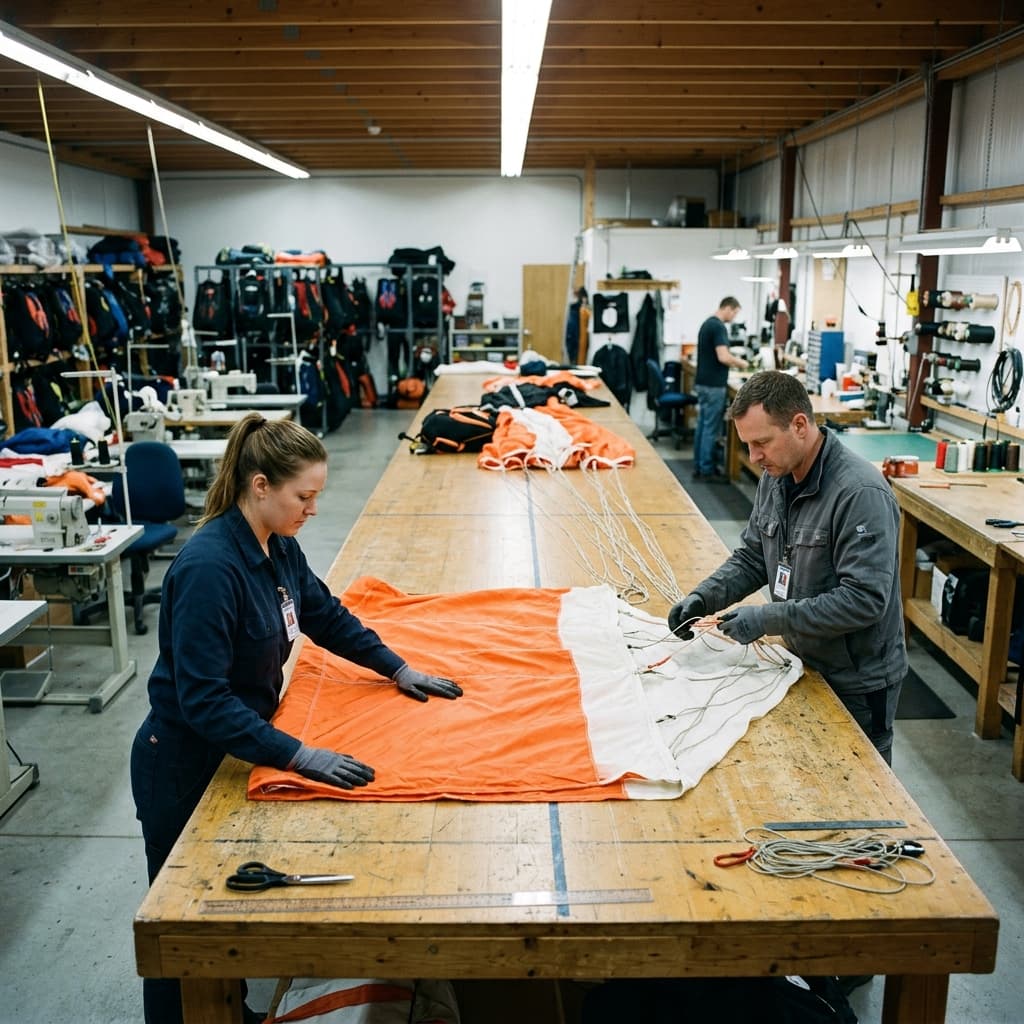
Workspace standards are the environmental foundation of packing quality. The packing table must be long enough to accommodate the full cord length of the canopy being packed without folding over the edge, clean enough that small debris cannot become entangled in suspension lines or stow pockets, and lit well enough for the rigger to read identification tags, inspect fabric for damage, and verify line condition without supplemental lighting. Temperature and humidity should be within ranges that keep nylon fabric and lines supple; extremely low humidity causes static that attracts debris to fabrics, and high humidity promotes the mildew growth that degrades canopy material.
Tool control is important in packing operations because a tool left inside a container can cause a deployment failure or injure the user. Packing tools should be inventoried before and after each packing session, with any discrepancy investigated and resolved before the packed unit is sealed. Tools that are specific to the packing procedure, such as closing loop gauges, pilot chute spring plungers, and pin covers, should be stored in a dedicated location that is empty at the start of packing and restored to full inventory at the end. The inventory check should be documented in the packing record.
Procedure compliance verification is the in-process quality check that confirms the packing is being performed according to the applicable task card or procedure, not from memory or informal adaptation. The procedure should be version-controlled, with the current revision clearly identified on the task card used by the rigger. Each step that has a measurable parameter, such as closing loop length, pin protection depth, or pilot chute attachment force, should have the measurement recorded on the task card as the step is completed. Riggers who work from memory, however experienced, introduce variability that defeats the reproducibility that quality assurance is designed to achieve.
Independent inspection is the second-person check that occurs at defined hold points in the packing procedure. The inspection should be performed by a qualified person who did not perform the packing work, using the completed task card as the verification baseline. Each hold point should have an explicit checklist of what the independent inspector is required to verify, the acceptable condition for each item, and a signature block that documents the inspector's assessment. A verbal sign-off that is not recorded provides no evidence after the fact and cannot be used to close nonconformance investigations.
Closing checks are the final quality gate before the packed unit is sealed and released. The closing check verifies that the closing pin is correctly positioned and routed, that the closing loop is the correct length with no visible damage or degradation, that the reserve closing flap covers the pin correctly, that all protective covers are in place, and that the container closure is secure. The closing check should be performed by the packer and independently verified by a second qualified person. Both signatures should appear on the packing record before the unit is released from the packing area.
Nonconformance management in packing operations should create a culture where discovering and reporting a packing error is rewarded rather than penalized. A rigger who identifies a packing error at the closing check, before the unit leaves the packing area, has provided a valuable service. A rigger who conceals a packing error to avoid embarrassment has created a latent safety defect that will be discovered under far more adverse conditions. The nonconformance reporting system should allow riggers to report their own errors without disproportionate consequence, with the primary response being a process analysis to determine whether the error was an individual failure or a systemic one that will recur.
Records retention for packing operations should allow the complete packing history of any packed unit to be reconstructed from the records system without reference to the memory of any individual. The packing record should include the unit serial number, the canopy and reserve serial numbers, the component configuration, the task card revision used, the rigger identity and qualification level, the independent inspector identity, the date and location of packing, and the repack due date. These records should be retained for the life of the unit plus a defined period afterward, as they may be needed in litigation or investigation proceedings well after the unit has been retired.
Repack cycle compliance tracking must be integrated with the operational scheduling system so that units approaching their repack due date are identified and pulled from deployment inventory before they become overdue. A unit that has exceeded its repack due date is not authorized for deployment regardless of its apparent external condition. The repack due date represents the boundary of the manufacturer's assurance that the closing loop has not degraded to an unacceptable condition and that the packed configuration has not been adversely affected by extended storage in the packed state.
Quality system audits of packing operations, conducted at least annually by a qualified person independent of the packing operation, verify that workspace standards are being maintained, that procedure revisions have been correctly implemented, that tool inventories are being conducted and recorded, that independent inspection hold points are being fully executed, and that packing records are complete and readily accessible. The audit report identifies deficiencies and assigns corrective actions with completion deadlines. Packing operations that have never been audited externally tend to accumulate informal adaptations that individually seem harmless but collectively represent a departure from the designed quality system.
We facilitate small-group sessions for customers and prospects without requiring a slide deck, focused on your stack, constraints, and the decisions you need to make next.