Insights · Article · Parachute Systems · Apr 2026
How to evaluate parachute canopy damage, determine whether a repair is feasible, select the correct repair procedure, execute and document the repair, and conduct the serviceability assessment that returns a repaired canopy to active inventory.
Parachute canopy repair is a specialized fabric and structural engineering activity that requires the rigger to evaluate not only what is visible about the damage but what the damage implies about the load path, the remaining structural margin, and the integrity of the repair material and technique. A repair that looks cosmetically correct but was executed with incorrect material, wrong stitch type, or inadequate reinforcement may fail at landing loads well below the design safety factor. Serviceability assessment must evaluate the engineering basis of the repair, not only its appearance.
Initial damage assessment establishes whether repair is feasible and which repair category applies. The assessment should document the damage type, the location relative to structural features including radial seams and suspension line attachment points, the extent of the damage, and the condition of the surrounding fabric. Damage in the low-stress gore body away from seams is generally more repairable than equivalent damage adjacent to a radial seam or within the vent band, where the fabric must carry higher distributed loads. The initial assessment should produce a written damage report that captures all of this information before any repair work begins.
Repair material selection is a critical engineering control. The replacement fabric must be the same material type as the original or a documented approved substitute. Using a heavier fabric to repair a lightweight canopy changes the local weight distribution and may affect the symmetry of the deployed canopy. Using a lighter fabric in a repair zone that must carry structural loads creates a weak point that will fail before the surrounding material. Thread selection for repair stitching must match the original thread type, size, and construction, because different thread constructions have different elastic recovery and load distribution characteristics.
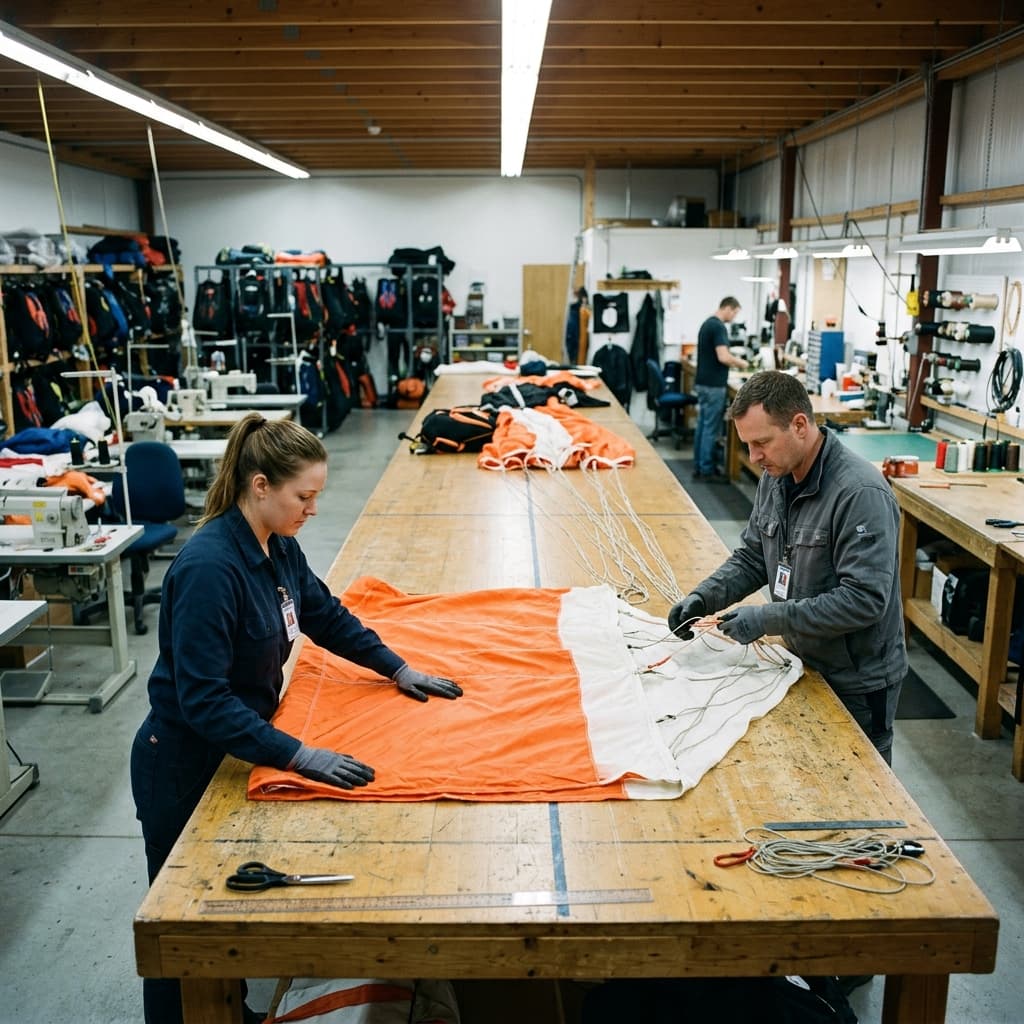
Approved repair procedures should be referenced for every canopy repair rather than improvised from first principles. Manufacturers publish repair procedures for their canopy designs that account for the fabric construction, the seam architecture, and the structural load path of that specific design. Using an approved manufacturer procedure ensures that the material removal, patching, and stitching are consistent with the design intent. Using a generic repair approach that was not developed for the specific canopy type introduces uncertainty about whether the repair restores the original design margin.
Stitch type and stitch density for parachute fabric repairs are specified in the applicable procedure because they determine how the repair distributes load across the repair zone. A straight stitch in a location that experiences bending and shear loads will fail at lower loads than a zigzag stitch pattern that distributes load more evenly. Stitch density that is too low fails to engage enough fabric filaments in the load path. Stitch density that is too high perforates the fabric at the stitch line and creates a tear initiation zone. The procedure specifies the correct stitch type, stitch length, and stitch density for each repair zone, and these specifications should be verified against the machine settings before sewing begins.
Quality control during the repair includes verification of the cutting dimensions before any fabric is removed, confirmation of patch dimensions before sewing, a tension check of the sewing machine before beginning the repair stitching, and a visual verification of stitch quality at a defined interval during the repair. For repairs at or near structural seams, an independent inspection by a second qualified rigger at a defined hold point in the procedure provides two-person verification of the critical elements. The hold points and the independent inspection sign-off should both be recorded on the repair work order.
Post-repair inspection verifies that the completed repair meets the dimensional and quality requirements of the applicable procedure. The inspection should confirm that the patch covers the required area with the specified overlap, that the stitching is continuous without skipped stitches or thread breakage, that the repair fabric lies flat without puckering or gathering, and that the surrounding fabric has not been unnecessarily damaged during the repair process. A repair that passes the post-repair inspection according to the procedure should be documented with the inspector's identity, qualification, and the procedure revision used.
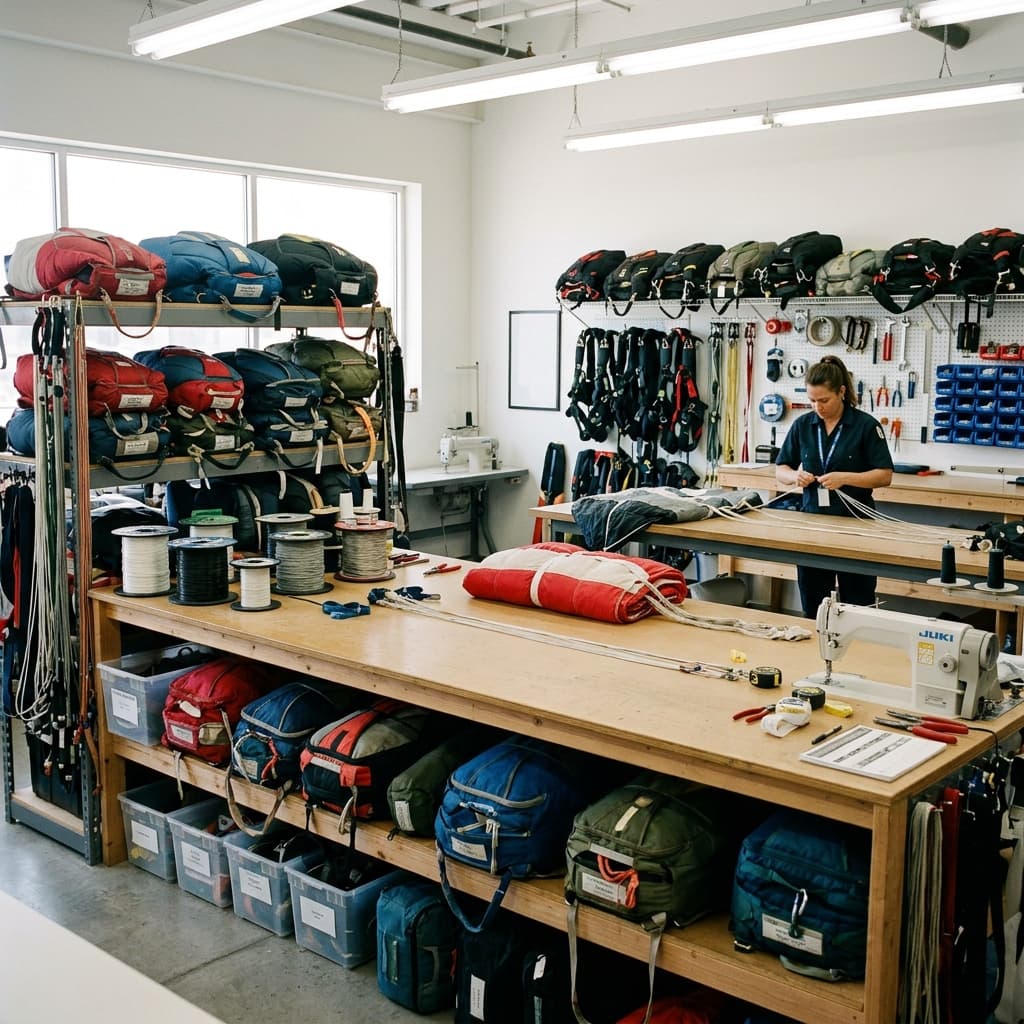
Serviceability assessment after repair involves evaluating the repaired canopy against the return-to-service criteria specified in the maintenance manual or program technical documentation. This assessment is distinct from the post-repair inspection. The post-repair inspection verifies that the repair was executed correctly. The serviceability assessment determines whether the repaired canopy meets the requirements for return to active service. The assessment considers the number and aggregate area of all repairs currently on the canopy, not only the most recent repair, relative to any maximum repair limit specified by the manufacturer or the program.
Configuration control of repaired canopies should track each repair event in the permanent record with the repair date, the damage description, the procedure used, the materials used, the rigger identity, the inspector identity, and the serviceability determination. This cumulative record allows the next rigger who inspects the canopy to understand the full repair history and to assess whether the canopy is approaching any accumulation limit. A canopy with multiple repairs in different areas that were each individually within limits may still be approaching the aggregate limit that defines end of service life.
Canopies that cannot be returned to full serviceability through an approved repair procedure may still be suitable for training use under a restricted serviceability determination, depending on the program and applicable regulations. A restricted determination documents the limitation applied to the canopy, such as minimum deployment altitude increase or exclusion from specific mission types, and the basis for the limitation. It should not be issued informally; it requires the same engineering documentation and authorization as other serviceability determinations. A restricted canopy used outside its restriction is an airworthiness violation regardless of the apparent condition of the repair.
We facilitate small-group sessions for customers and prospects without requiring a slide deck, focused on your stack, constraints, and the decisions you need to make next.