Insights · Article · Shelter Systems · Apr 2026
Engineering collective protection (ColPro) in soft-wall structures: creating toxic free areas using NBC filtration units, achieving required overpressure, managing airlocks, and verifying structural envelope sealing.
Integrating Nuclear, Biological, and Chemical (NBC) filtration into a soft-wall expeditionary shelter transforms a standard tent into a Collective Protection (ColPro) system. The objective is to create a Toxic Free Area (TFA) where personnel can operate without individual protective equipment in a contaminated environment. This is an engineering challenge of the highest order, as it requires maintaining a continuous, measurable positive pressure inside a fabric envelope that is inherently flexible, porous at its seams, and subject to continuous aerodynamic deformation.
The core principle of ColPro is overpressure. The NBC filtration unit draws in contaminated outside air, forces it through high-efficiency particulate air (HEPA) and carbon adsorption filter beds, and injects the purified air into the shelter. This continuous injection must create an internal pressure higher than the external atmospheric pressure, forcing air out through any microscopic leaks in the fabric or seams, thereby preventing contaminated external air from infiltrating. The required overpressure is typically specified in pascals; if the pressure drops below the minimum threshold, the TFA is considered breached.
Sealing the structural envelope is the prerequisite for achieving overpressure. A standard expedition shelter will leak too much air to allow the NBC unit to pressurize it. ColPro shelters require a specialized, chemically resistant inner liner that serves as the primary barrier. Every seam on this liner must be welded or heavily taped. Cable penetrations for power and data must pass through dedicated, sealed transit glands, never simply routed under the skirt. Zippers, which are notorious air leaks, must be backed by heavy, overlapping containment flaps or replaced entirely with specialized gas-tight track closures.
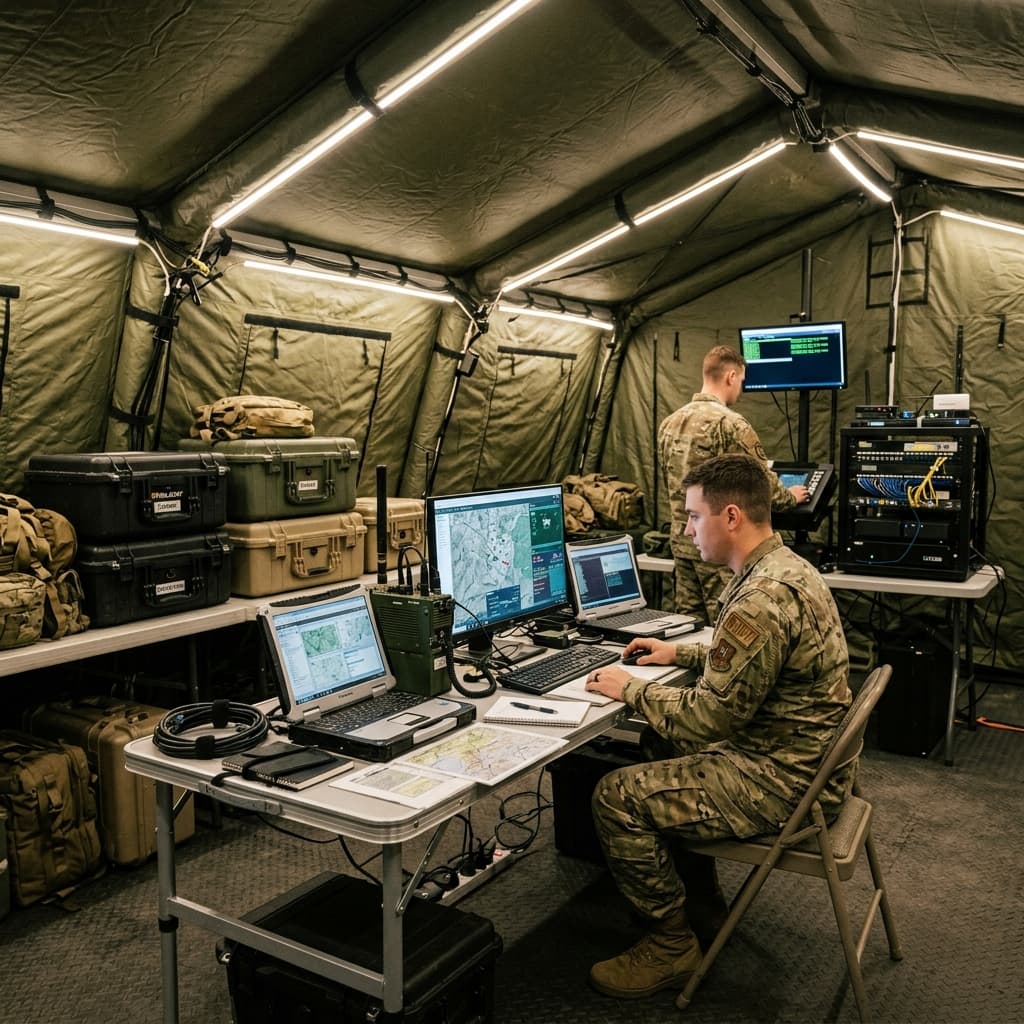
Airlock integration manages personnel transition into and out of the TFA. An airlock is a dedicated transitional shelter module attached to the main TFA, featuring its own set of sealed doors and a specific ventilation profile. Personnel enter the airlock from the contaminated exterior, perform decontamination procedures, and then pass into the TFA. The NBC system's airflow must be engineered so that clean air constantly flows from the TFA, through the airlock, and out to the environment, sweeping contaminants away from the clean zone. If both airlock doors are opened simultaneously, the overpressure collapses instantly.
Filter unit sizing depends on both the volume of the shelter and the allowable leakage rate. Because soft-wall structures will always leak slightly, the NBC unit must supply a continuous high volume of makeup air just to maintain pressure, in addition to the air required for personnel respiration and cooling. If the unit is undersized, or if the field assembly leaves too many leaks, the blower will run at maximum capacity without ever achieving the target overpressure. The specification must match the NBC unit's performance curve to the tested leakage rate of the specific shelter design.
Environmental control (heating and cooling) must be seamlessly integrated with the toxic filtration. Pumping unconditioned, purified air into a shelter in extreme climates will render the TFA uninhabitable within hours. However, standard ECUs cannot be used because they pull in outside air without NBC filtration. The solution is either a combined NBC/ECU system that conditions the air post-filtration, or a closed-loop ECU that recirculates and conditions only the internal air within the TFA, relying on a strictly separated NBC unit to provide the minimal pressurized makeup air.
Filter life management is a critical logistical and operational consideration. The carbon filters used to adsorb chemical agents have a finite capacity. In heavily contaminated environments, or environments with high ambient dust or smoke that clogs the pre-filters, the system's airflow drops quickly, jeopardizing the overpressure. Programs must utilize differential pressure gauges across the filter banks to monitor loading in real time, and establish protocols for safely swapping contaminated filter elements while the shelter remains occupied.
Wind loading dramatically affects ColPro integrity. A high wind striking the broad side of a shelter exerts tremendous dynamic pressure. If the external wind pressure momentarily exceeds the internal NBC overpressure, the airflow direction reverses through the shelter seams on the windward side, pulling contamination directly into the TFA. ColPro shelter designs must either specify a high enough baseline overpressure to overcome expected maximum wind gusts or incorporate aerodynamic shapes and structural stiffening to reduce the localized wind pressure effects.
System validation testing must be conducted upon every field deployment before declaring the TFA operational. This requires sealing the shelter, powering the NBC unit, and measuring the internal pressure using a calibrated manometer. Following the pressure test, a qualitative fit test using an irritant smoke or specialized tracer gas around the exterior perimeter verifies that all egress points, cable glands, and seams are pushing air outward rather than drawing it in. An unverified ColPro system offers only psychological protection.
Training for ColPro operations emphasizes discipline. The most advanced NBC filtration system is neutralized if personnel fail to observe airlock protocols, prop doors open for convenience, or puncture the inner liner by carelessly mounting equipment to the frame. The operational culture within a TFA must treat the structural envelope with the same respect as a submarine hull; a breach is a threat to the survival of everyone inside.
We facilitate small-group sessions for customers and prospects without requiring a slide deck, focused on your stack, constraints, and the decisions you need to make next.