Insights · Article · UAV Systems · Apr 2026
Practical methods for inspecting multirotor UAV airframes between missions: what to look for in carbon fiber arms, aluminum motor mounts, central plates, and landing gear, with assessment criteria and documentation for sustained program reliability.
Multirotor UAV airframes accumulate stress with every flight cycle. Unlike fixed-wing aircraft where bending loads are distributed across a continuous spar, multirotors concentrate vibration and impact loads at specific joints: the motor mount to arm interface, the arm to central plate clamp, and the landing gear attachment points. These joints are also the locations most exposed to damage during landing, transport, and handling. A disciplined structural inspection program identifies fatigue and damage before it progresses to in-flight structural failure.
Carbon fiber composite arms are the primary structural element on most commercial and defense-adjacent multirotors. Carbon fiber is strong and light but its failure mode is different from aluminum. An aluminum arm that is overloaded bends visibly before failing. A carbon fiber arm can appear undamaged while carrying a crack that significantly reduces its residual strength. Visual inspection alone is insufficient for carbon arms that have sustained impact. The inspection program should specify which impact events trigger a more detailed assessment, what that assessment includes, and what the discard criteria are.
Visual inspection of carbon fiber arms should be conducted under good lighting, with the surface cleaned of dust and oil. Look for delamination, which appears as a surface blister or a region that produces a dull sound when tapped lightly with a coin. Look for impact marks that show multiple concentric surface fractures, which indicate a through-the-fiber impact rather than a surface scratch. Look for stress whitening near clamp areas, which indicates that the fiber layers are separating under repeated clamping loads. Any of these observations should trigger removal from service pending a more detailed assessment.
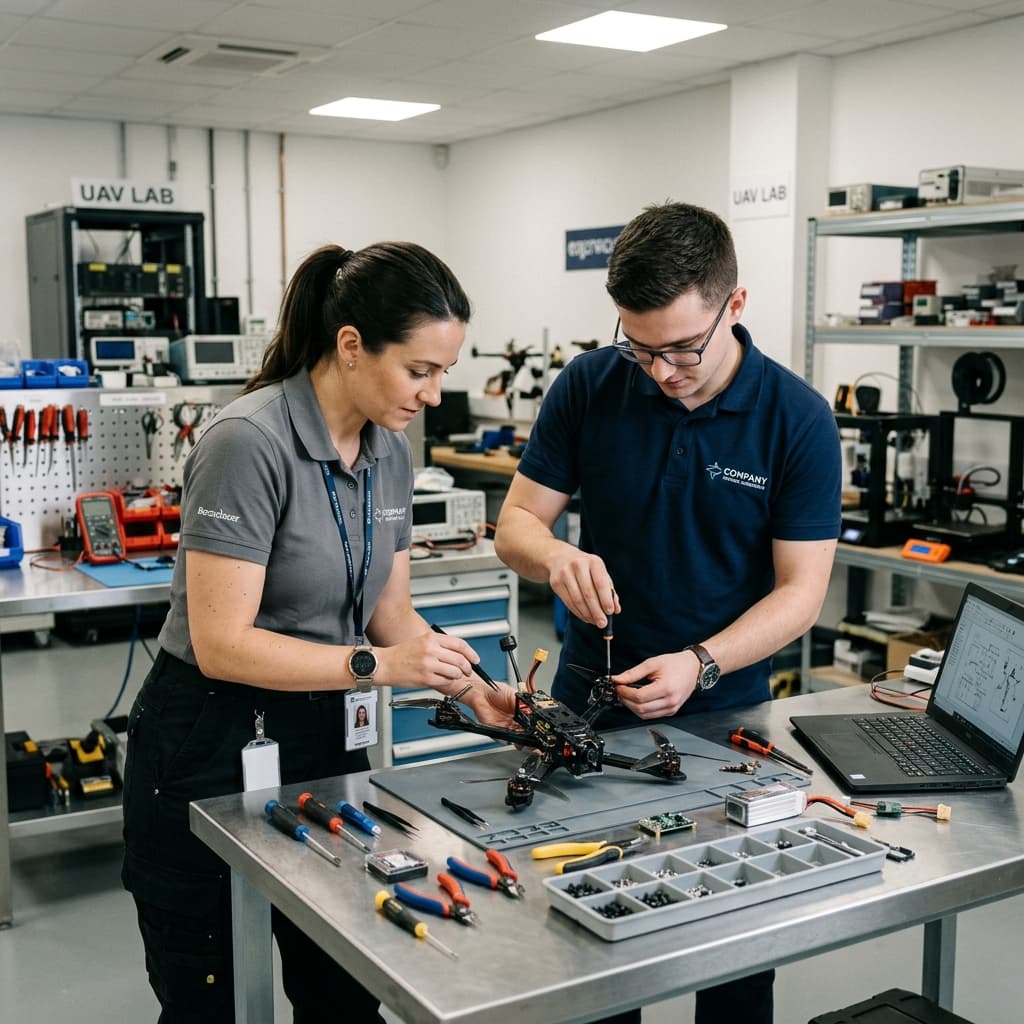
Motor mount inspection focuses on two failure modes: fatigue cracking in the mount material and loosening of the fasteners that connect the motor to the mount and the mount to the arm. Vibration from propeller imbalance and motor cogging accelerates fastener loosening. Fasteners that are not retained with thread-locking compound or mechanical lock features can back out completely during flight. The inspection procedure should specify the torque value for each fastener type and require a calibrated torque check at defined intervals. Any fastener found below the minimum torque value should be documented, the fastener replaced if there is evidence of deformation, and the thread condition in the mount examined before reassembly.
Central plate inspection covers the main hub that connects all arms and supports the avionics and battery bay. Central plates on high-cycle platforms develop wear at arm clamp interfaces, particularly when the arms are removed and reinstalled frequently. The clamp bore diameter should be measured periodically with a bore gauge and compared to the arm outer diameter tolerance; excessive clearance means the arm can rock under load, concentrating stress at the clamp edge rather than distributing it across the clamping surface. Vibration-isolated mounting points for flight computers and IMUs should also be inspected for elastomer degradation, which manifests as cracking or permanent set that reduces isolation effectiveness.
Landing gear inspection is often treated as cosmetic but it is structurally significant. Landing gear that absorbs impact energy during hard landings protects the central plate and avionics from the same impulse load. Gear that has been bent and straightened, or that has sustained repeated hard landings, has different energy absorption characteristics than new gear even if it appears straight. Programs that operate from unprepared surfaces should set a landing gear replacement interval based on landing event logging rather than simply visual condition.

Propeller inspection is part of the structural assessment because propeller damage transfers directly into vibration loads on the motor, motor mount, and arm. A propeller with a nick, crack, or delamination at the tip creates an imbalance that the motor shaft bearing and the arm must absorb every revolution. The inspection should include a propeller balance check at every scheduled service interval and a visual examination under magnification at the tip and leading edge, which are the regions most likely to show impact damage from debris ingestion.
Documentation of structural inspection findings should be retained in the aircraft logbook alongside flight hours, cycle counts, and maintenance actions. When a structural concern is noted but the aircraft is approved to continue flying pending further investigation, the logbook entry should clearly state the observed condition, the reasoning for the continued-flight decision, and the conditions under which the aircraft will be grounded. This record protects the program in the event of a subsequent failure and gives the safety investigation team a timeline of observed structural health.
Inspection intervals should be defined in the maintenance program as a combination of flight hours and calendar time, whichever comes first. A platform that completes many short flights accumulates more landing cycles per flight hour than a long-endurance platform, and its landing gear and motor mount fasteners should be inspected at a shorter flight-hour interval. A platform stored for extended periods without flying should be inspected at calendar intervals because elastomers, coatings, and fastener lubrication change over time even without mechanical cycling.
Return-to-service criteria after structural maintenance or repair should be documented in an engineering disposition for each specific event. A disposition documents the damage found, the repair action taken, an assessment of whether the repair restores full structural capability or creates a limitation on the operating envelope, and the authority signature that approves the aircraft for flight. Programs that allow verbal return-to-service approvals without written dispositions lose the audit trail that would be essential after any subsequent in-flight event.
We facilitate small-group sessions for customers and prospects without requiring a slide deck, focused on your stack, constraints, and the decisions you need to make next.