Insights · Article · Field Robotics · Apr 2026
Evaluating sensor modalities for robot autonomy in visually degraded environments: the failure points of photogrammetry, the laser scattering limitations of LiDAR, and the necessity of sensor fusion.
Autonomous navigation relies entirely on a robot's ability to build an accurate, real-time map of its surroundings. In a pristine laboratory, a wide array of sensors can achieve this. However, tactical field robots operate in environments saturated with what engineers term 'visual obscurants'—smoke from a structure fire, dust kicked up by a rotor wash, deep fog, or snow squalls. When the environment is visually degraded, relying on a single sensor modality like a high-definition camera or a pulsing laser will invariably cause the autonomous system to go blind, resulting in catastrophic collisions or total paralysis.
Vision systems (RGB cameras and stereoscopic photogrammetry) are the primary navigation sensors for commercial autonomy. They are inexpensive, consume minimal power, and provide incredibly rich semantic data (identifying a door versus a wall). However, vision is a passive sensor; it relies entirely on ambient light bouncing off objects and returning to the lens. In complete darkness, a standard camera is useless. More importantly, in thick smoke or blowing dust, the tiny particulate matter scatters the ambient light. The camera sees only a solid, blinding white wall of illuminated particulate, completely obscuring the lethal drop-off ten feet ahead of the robot.
LiDAR (Light Detection and Ranging) provides the geometric precision that cameras lack. By rapidly firing millions of invisible laser pulses and measuring the time it takes for the reflections to return, a LiDAR scanner builds a millimeter-perfect, 3D point cloud of the environment, regardless of ambient lighting. For avoiding complex obstacles in pitch darkness, LiDAR is historically unmatched. Yet, LiDAR is not immune to obscurants. A laser beam interacting with heavy dust or thick smoke will reflect off the particles themselves. The LiDAR interprets these thousands of reflections as a solid, impenetrable wall immediately in front of the robot, causing the navigation algorithm to freeze, 'trapped' by a ghost obstacle made of smoke.
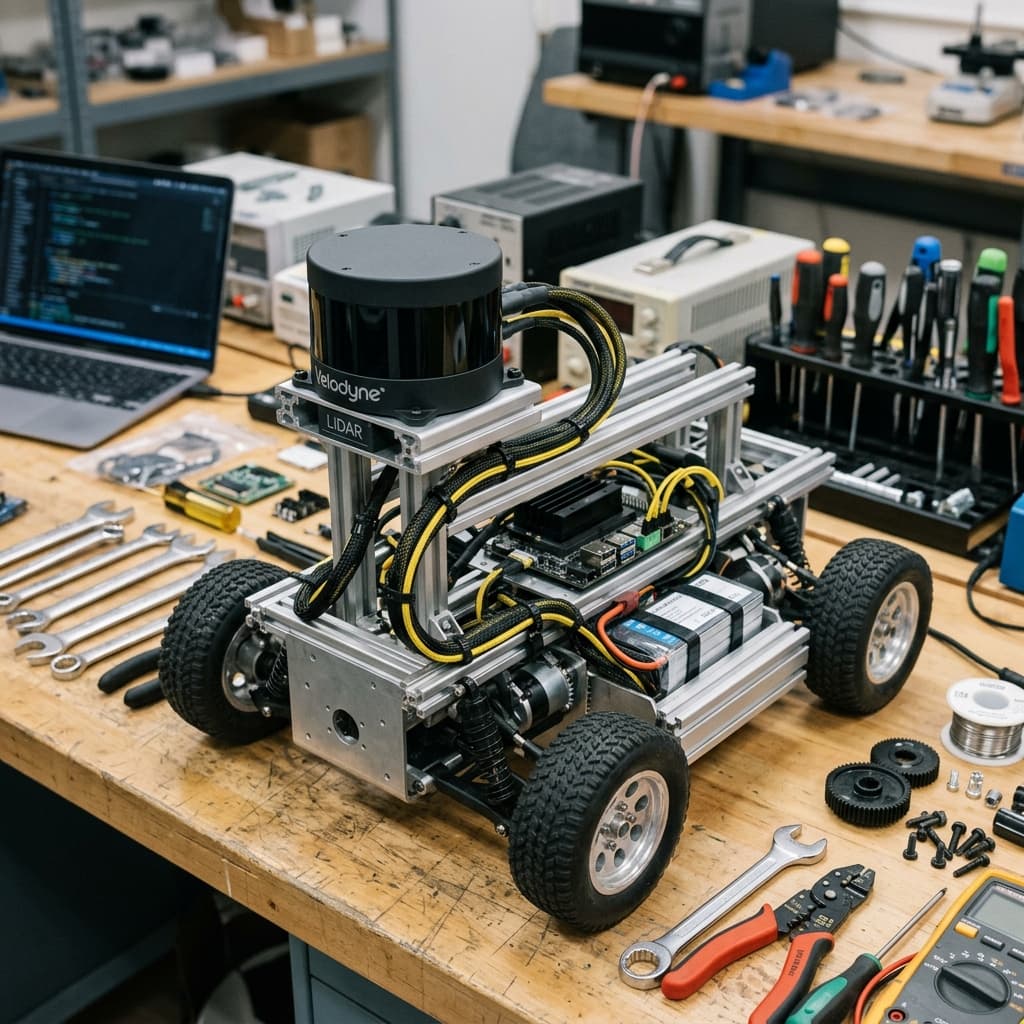
Algorithm filtering is the first line of defense for LiDAR in degraded environments. Not all laser pulses striking a dust cloud are perfectly reflected; some penetrate the cloud and hit the hard wall behind it. An advanced LiDAR often registers multiple 'returns' from a single pulse—the first weak return from the dust, and the last strong return from the solid wall. Sophisticated firmware mapping algorithms must be dynamically tuned to discard the chaotic, low-intensity first returns from the particulate and build the map based purely on the high-intensity last returns. When executed correctly, the robot can essentially 'see through' light smoke.
Thermal Imaging (Long-Wave Infrared) bridges the gap when both vision and LiDAR fail. Thermal cameras do not rely on visible light or active lasers; they passively detect temperature differentials. Heavy smoke and thick dust are often transparent to long-wave infrared energy. A thermal camera can easily see the sharp, hot outline of a vehicle hidden behind a smokescreen that totally blinds an RGB camera and scatters a LiDAR beam. Integrating continuous thermal feeds into the autonomous navigation stack provides the critical contrast required for path planning when the primary geometric sensors are confused.
Radar (Radio Detection and Ranging) represents the heavy-duty fallback modality. Radar utilizes millimeter-wave radio frequencies rather than light. Radar waves blast straight through smoke, dust, fog, and rain entirely unbothered by the particulate. While radar lacks the sharp edge-definition and ultra-high resolution of LiDAR (a radar image looks blurry and generalized), it provides absolutely reliable distance-to-target data in zero-visibility conditions. Placed as a forward-looking sensor, radar serves as the ultimate collision-avoidance failsafe when the high-resolution sensors are blinded.
Sensor Fusion is the mandatory paradigm for rugged autonomy. Relying on a single sensor guarantees failure. A tactical robot's navigation stack must ingest data from RGB cameras, LiDAR point clouds, thermal arrays, and radar streams simultaneously. The autonomy engine continuously evaluates the 'confidence' of each sensor. If the vision stack reports zero confidence due to darkness, and the LiDAR reports massive noise due to smoke, the autonomy engine seamlessly down-weights those inputs and relies heavily on the thermal and radar data to continue safe transit without operator intervention.
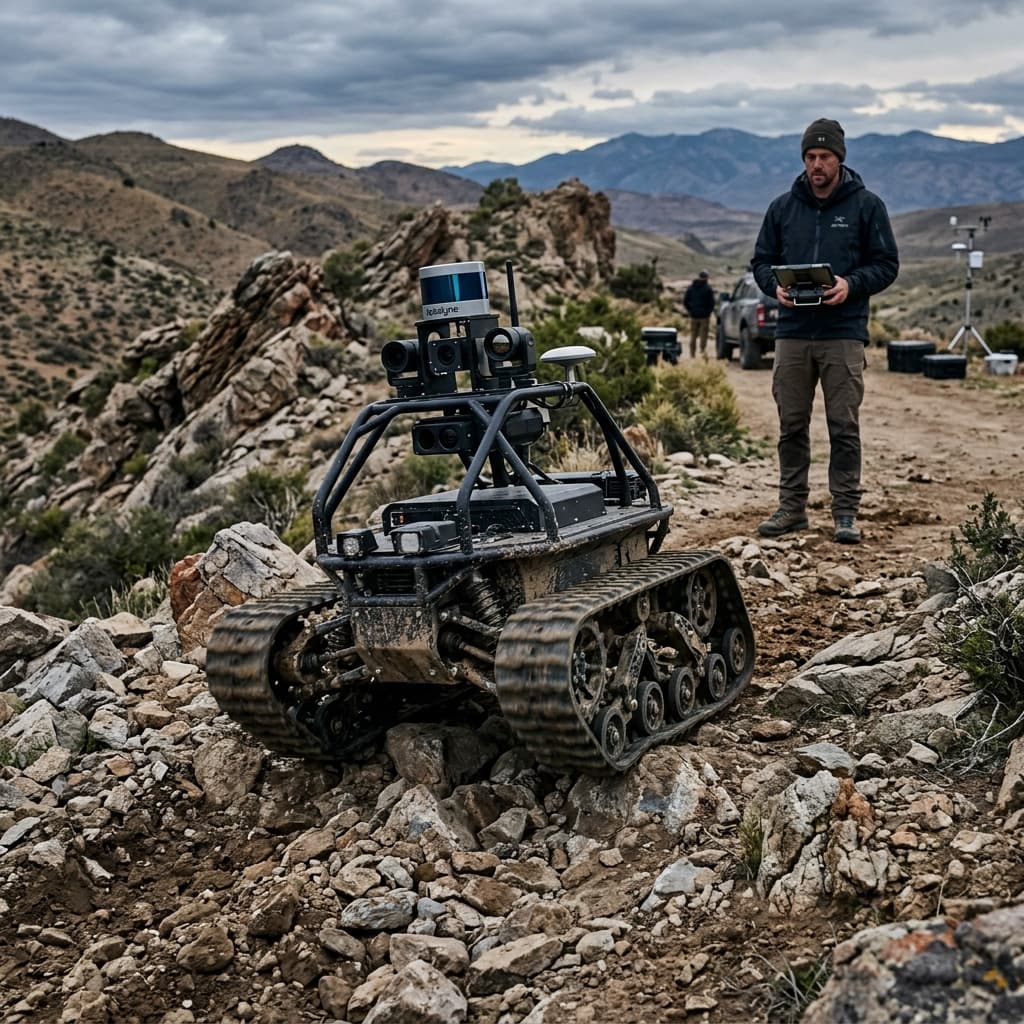
The hardware penalty of sensor diversity is significant. Integrating an industrial LiDAR, a cooled thermal core, and a millimeter-wave radar pushes the cost, weight, and power consumption of the robot drastically higher. These complex sensors also require massive local compute power—GPUs residing directly on the robot—to process the fused data streams in real time. The engineering debate for field robotics is constantly balancing the necessity of unstoppable autonomy against the tactical reality of battery life and payload capacity.
We facilitate small-group sessions for customers and prospects without requiring a slide deck, focused on your stack, constraints, and the decisions you need to make next.