Insights · Article · Field Robotics · Apr 2026
Transitioning from splash-proof to entirely submersible architectures: managing dynamic seal pressure differentials, potting electronics for hydrostatic resistance, and mitigating saltwater galvanic corrosion on propulsion shafts.
Designing a robot to survive heavy rain on the tarmac is vastly different from engineering a platform that can drive off a beach, plunge into the surf zone, and traverse the ocean floor. The moment a chassis transitions from terrestrial to fully submersible, the environmental forces shift from atmospheric exposure to relentless hydrostatic pressure. A standard IP67 rating, which verifies survival at one meter for thirty minutes, is completely inadequate for sustained amphibious operations or deep-water inspection.
Hydrostatic pressure scales linearly with depth. At 10 meters (roughly 33 feet), an enclosure endures one atmosphere of external pressure squeezing inward on every square inch of the chassis. Under this uniform force, large, flat aluminum panels will bow inward. If the chassis deforms slightly under pressure, the geometry of the primary seals is compromised. Traditional flat silicone gaskets fail as the metal pulls away. Amphibious enclosures must be milled from thick billets to resist deformation and rely entirely on radial O-rings—where the pressure forces the rubber tightly into a machined groove—rather than face seals.
Dynamic shaft seals are the Achilles' heel of marine robotics. A static enclosure is relatively simple to seal; sealing a rapidly spinning propulsion shaft that penetrates that enclosure while submerged is incredibly complex. Standard lip seals used heavily in automotive applications will rapidly burn out or allow water ingress under deep hydrostatic pressure. Amphibious robots require specialized marine packing glands, complex mechanical face seals, or magnetic couplings where the internal motor transfers torque magnetically through a solid, un-penetrated titanium or ceramic bulkhead to the external propeller.
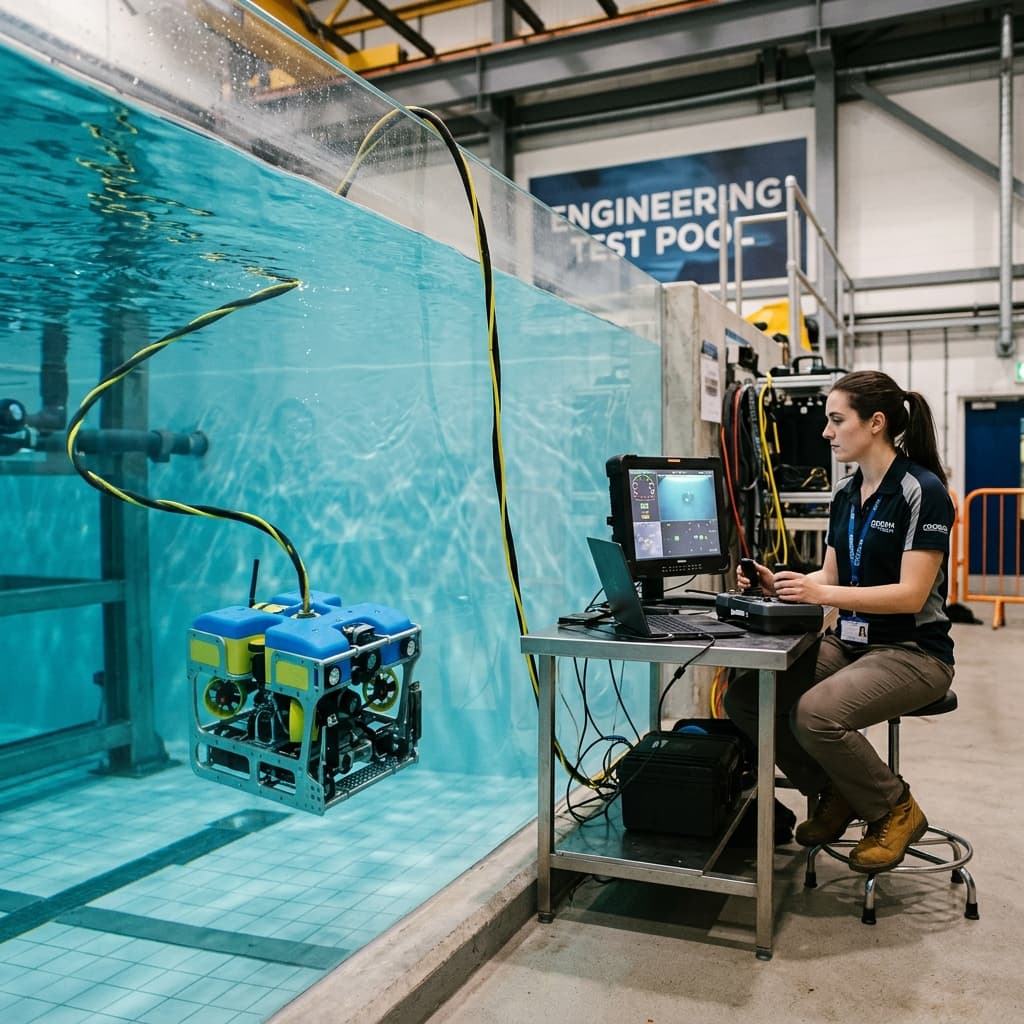
Thermal cycling creates extreme internal vacuum forces. An amphibious robot may bake on a hot deck at 40°C, expanding the air inside its sealed chassis. When dropped rapidly into cold ocean water, the internal air temperature plummets instantly. The resulting internal vacuum aggressively sucks water forcefully against every seal attempting to equalize the pressure. An architecture that relies merely on tight tolerances will be breached immediately. Deep-water designs often heavily over-pressurize the enclosure with dry nitrogen before sealing, ensuring that even under severe cooling, the internal pressure remains positive, pushing back against the water.
Potting and encapsulation replace air with solid mass. The ultimate defense against water ingress is eliminating the void entirely. For critical motor controllers, sensor processing boards, or battery modules that do not require field maintenance, the entire electronic assembly is cast into a solid block of thermally conductive epoxy or soft polyurethane potting compound. Even if the outer titanium chassis fractures under an extreme depth pressure spike, the electronics remain completely encased, waterproof, and operational.
Galvanic corrosion accelerates aggressively in saltwater. When an amphibious robot uses a mix of materials—such as an aluminum chassis, stainless steel fasteners, and a bronze propeller—the highly conductive saltwater turns the robot into a giant battery. The least noble metal (the aluminum) will rapidly dissolve, destroying the structural integrity of the chassis walls. Essential mitigation requires meticulously isolating dissimilar metals with dielectric sleeves, applying heavy marine-grade anodizing and epoxies, and installing strategically placed sacrificial zinc anodes that corrode cleanly to protect the primary structural metals.
Connector integrity defines the boundary of failure. Deep-water applications cannot use standard circular MIL-spec connectors designed for rain. Submersible robotics demand 'wet-mateable' connectors. These complex, heavy rubber-molded connectors physically wipe their conductive pins clean of water and establish an insulated, watertight seal precisely at the moment of engagement, allowing technicians to plug and unplug critical tether cables or payload sensors even while the junction is entirely submerged.
Designing for the surf zone is physically punishing. The transition zone where breaking waves pound the chassis induces violent, chaotic kinetic energy mixed with abrasive suspended sand. The mechanical joints, tracks, or flippers of an amphibious landing robot must be aggressively hardened against sand intrusion that would instantly grind standard bearings to a halt. Ingress protection in marine robotics is not merely about keeping the water out; it is about surviving the brutal physical environment that the water carries.
We facilitate small-group sessions for customers and prospects without requiring a slide deck, focused on your stack, constraints, and the decisions you need to make next.