Insights · Article · Shelter Systems · Apr 2026
Strategies for achieving strict climate control in soft-wall expedition shelters: environmental control unit sizing, duct routing, insulation layers, and managing the unique thermal dynamics of fabric structures.
Fabric shelters possess almost no inherent thermal mass. Unlike a concrete or wood-frame building that absorbs and slowly releases heat, a soft-wall expedition tent reacts immediately to changes in solar radiation and external temperature. This dynamic demands a rugged and responsive Environmental Control Unit (ECU) paired with careful interior thermal management. Expecting standard residential HVAC equipment or poorly sized military ECUs to maintain a stable interior climate inside a canvas shell inevitably results in extreme temperature swings, excessive fuel consumption, and compromised sensitive equipment.
Calculating the HVAC requirement begins with defining the thermal load, which is vastly different from a rigid structure. The calculation must account for the high thermal transmittance (U-value) of the tent skin, the massive solar gain from direct sunlight on a large roof area, the infiltration rate of outside air through seams and doors, the sensible heat generated by personnel and equipment inside, and the extremes of the external ambient temperature. Simply matching square footage to a commercial BTU rule of thumb will drastically undersize the equipment for an expeditionary fabric shelter.
Insulation liners are the single most effective intervention for reducing the HVAC load. A liner creates a trapped air space between the exterior shell and the interior living volume. Advanced liners incorporate radiant barrier materials to reflect thermal radiation and quilted synthetic batting to slow conductive transfer. A properly installed insulation liner can reduce the cooling or heating requirement by up to forty percent, making it possible to use smaller, lighter ECUs and substantially extending the runtime achievable on a limited generator fuel supply.
Air distribution within the shelter determines the comfort and consistency of the environment. Pumping conditioned air directly from the ECU into one corner creates a freezing blast zone near the unit and a stagnant, stuffy zone at the far end. Fabric air distribution plenums, suspended from the ceiling ridge line, are the standard solution. These perforated fabric tubes evenly distribute the conditioned air across the entire length of the shelter. The plenum must be sized to match the ECU's airflow rate; an undersized plenum creates backpressure that reduces ECU efficiency and can cause evaporator coil freezing.
Ducting connections between the external ECU and the shelter structure require insulated, flexible hoses. If uninsulated ducts are routed across hot sand or through sub-zero air, a massive percentage of the cooling or heating capacity is lost before the air even enters the tent. The connections where the ducts penetrate the shelter wall must be tightly sealed with insulated collars. Air leaks at the duct ports draw external ambient air directly into the conditioned space, undermining the entire thermal management effort.
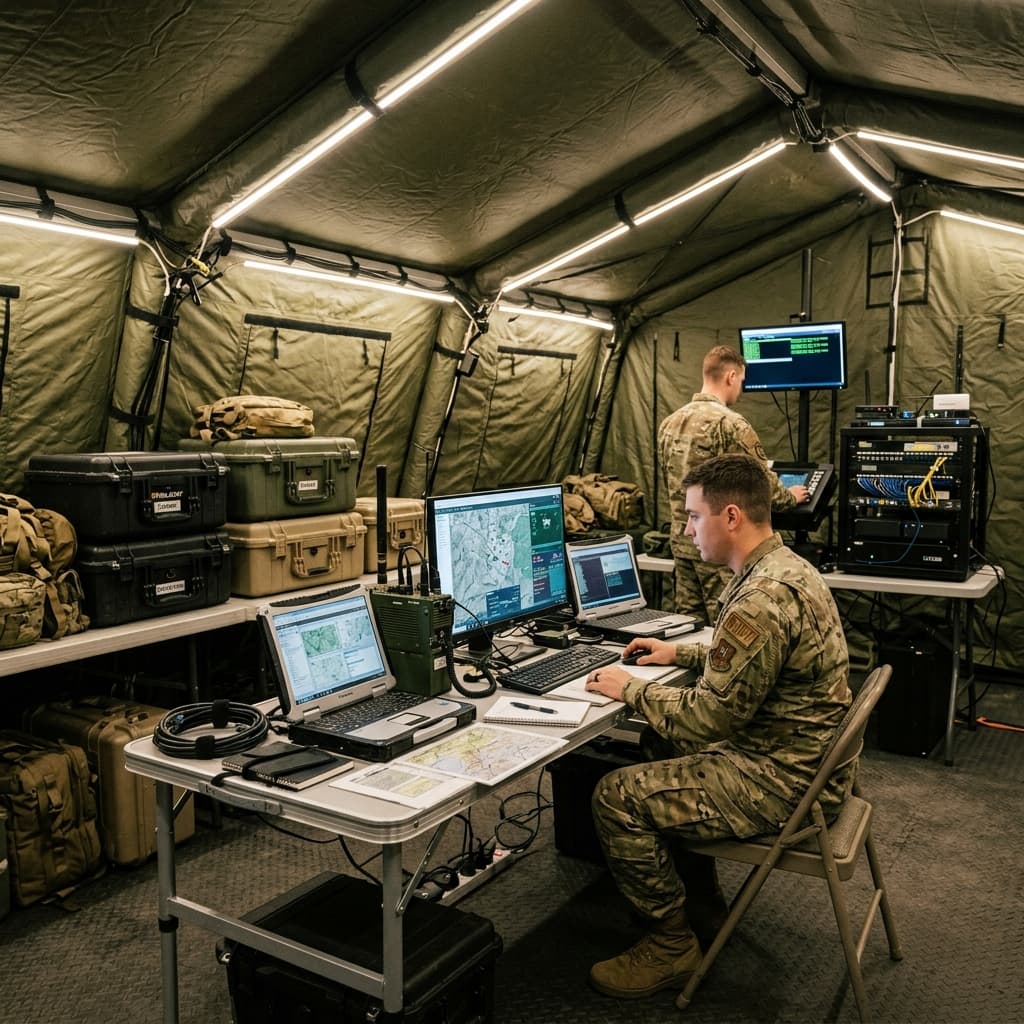
Positive pressure is a crucial strategy for environmental integrity. The ECU should be configured to draw a small percentage of make-up air from the outside, rather than purely recirculating interior air. This creates a slight positive pressure inside the soft-wall shelter. Positive pressure guarantees that when a door is opened or if a small seam leak exists, air pushes out rather than drawing dust, insects, or extreme temperature air into the facility. This is particularly vital for command posts housing sensitive electronics in dusty environments.
Solar gain management on the exterior is just as important as interior insulation. A dark-colored fabric skin absorbs enormous amounts of solar radiation, converting the shelter into an oven. Using light-colored or IR-reflective exterior coatings mitigates the initial heat absorption. In extreme desert environments, deploying a flysheet—a suspended shade cloth a few inches above the main shelter roof—absorbs the solar radiation and allows the hot air to dissipate via natural convection before it conducts into the shelter skin.
ECU placement must consider exhaust heat and intake air quality. The hot air exhaust from the ECU condenser must be directed away from the shelter and not allowed to recirculate back to the unit's intake. The unit should be positioned to avoid drawing in generator exhaust fumes, vehicle dust, or the hot air plume from a neighboring shelter's ECU. Proper placement requires longer, insulated duct runs, but guarantees the unit can reject heat efficiently without straining its compressor.
Condensation management is a hidden challenge in heated fabric shelters operating in cold, wet environments. Human respiration and wet gear generate high humidity inside. When this warm, moist interior air contacts the colder external skin, heavy condensation forms, eventually raining down inside the tent. Operating the ECU with a dehumidification or fresh-air makeup cycle removes this moisture, keeping the interior dry and preventing the saturation of insulation liners, which lose their thermal value when wet.
Maintenance of the thermal envelope is a daily operational task. Deployers must verify that all windows are zipped shut, ground skirts are weighted down to prevent air infiltration underneath, doors are kept closed when not in active use, and insulation layers remain securely attached without sagging gaps. The most sophisticated HVAC system will fail to cool a shelter if the physical envelope is left open to the environment through operator negligence.
We facilitate small-group sessions for customers and prospects without requiring a slide deck, focused on your stack, constraints, and the decisions you need to make next.