Insights · Article · Field Robotics · Apr 2026
Reducing cognitive load and physical fatigue in operator control units (OCUs): transitioning from dual-stick RC controllers to tablet interfaces, managing data saturation, and maintaining operator vigilance during protracted missions.
A highly capable tactical robot is fundamentally hobbled if its operator interface induces rapid fatigue. Operating a complex machine remotely—specifically relying entirely on 2D video feeds to navigate a chaotic 3D environment—exacts an immense cognitive toll. After several hours of staring at a glaring screen while meticulously manipulating miniature joysticks, the operator's situational awareness collapses. Errors in judgment multiply. Redesigning the Human-Machine Interface (HMI) for ergonomics is not about pilot comfort; it is about extending the tactical viability of the robotic asset.
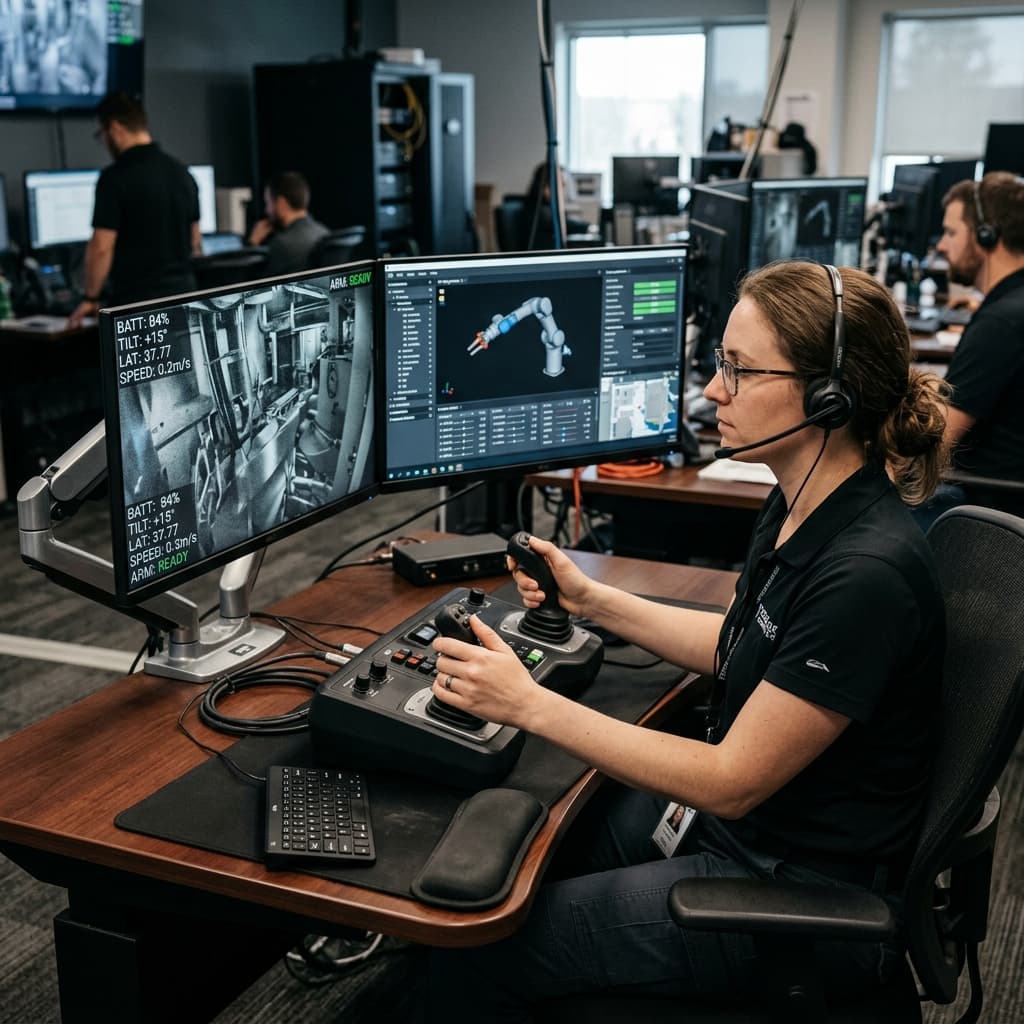
The legacy dual-joystick 'RC controller' paradigm is structurally flawed for long-duration missions. Forcing an operator to manually throttle both tracks independently to negotiate complex terrain requires intense continuous concentration. Modern HMIs transition the driving load to semi-autonomous 'point-and-click' tablet interfaces or simplified unified thumb-sticks, relying on the robot's onboard algorithms to calculate the specific wheel-speed vectors necessary to execute the macro command. If the operator's hands are cramped, the mission tempo slows.
Data saturation is the primary vector for cognitive burnout. A modern EOD or reconnaissance robot generates a massive telemetry stream: four video feeds, thermal overlays, LiDAR maps, battery voltage, RF signal strength, and manipulator joint angles. Plastering all this raw data across a single rugged screen overwhelms the operator. The HMI must relentlessly curate the data. A critical warning—like a failing battery cell or a severed comm link—must be visually dominant, while routine telemetry should be relegated to collapsible menus or subtle peripheral indicators.
Screen glare and physical mounting dictate operational endurance. Asking a soldier to hold a heavy, heat-generating rugged tablet in their hands for a four-hour perimeter sweep guarantees muscular fatigue. The Operator Control Unit (OCU) must integrate securely into chest rigs or be easily deployed onto stable field tripods. Furthermore, the display must genuinely be sunlight-readable; squinting through intense solar glare to identify a tripwire on a low-resolution screen rapidly degrades visual acuity and induces severe headaches.
Latency masking within the UI is critical for fine manipulation tasks. If the RF link is experiencing a 600-millisecond delay, it is nearly impossible for the operator to grasp an object with the manipulator arm smoothly. Advanced HMIs incorporate 'predictive overlays.' When the operator moves the joystick, the UI instantly draws a ghostly wireframe graphic showing where the arm *will* be positioned based on the command, even while the actual video feed catches up. This visual feedback loop allows the operator to execute confident motions without succumbing to jerky pilot-induced oscillation.
Proprioception—the sense of self-movement and body position—is entirely lost during teleoperation. To compensate, HMIs must generate synthetic awareness. Displaying a dynamic 3D avatar of the robot on the screen, matching its real-world pitch, roll, and flipper angles precisely in real-time, allows the operator to instantly comprehend the robot's posture without struggling to interpret an array of numeric inclinometer gauges. If the robot leans dangerously close to tipping over, the avatar dramatically visually reflects the peril.
Haptic feedback is the next evolution in restoring physical intuition. When a robotic gripper closes on a delicate suspect package or a concrete block, the operator feels nothing on a standard joystick. Integrating force-feedback resistance directly into the control sticks—making the sticks stiffer as the gripper applies more pressure—transmits the physical reality of the environment directly back into the operator's hands, allowing for incredibly nuanced manipulation that relies on touch memory rather than purely visual confirmation.
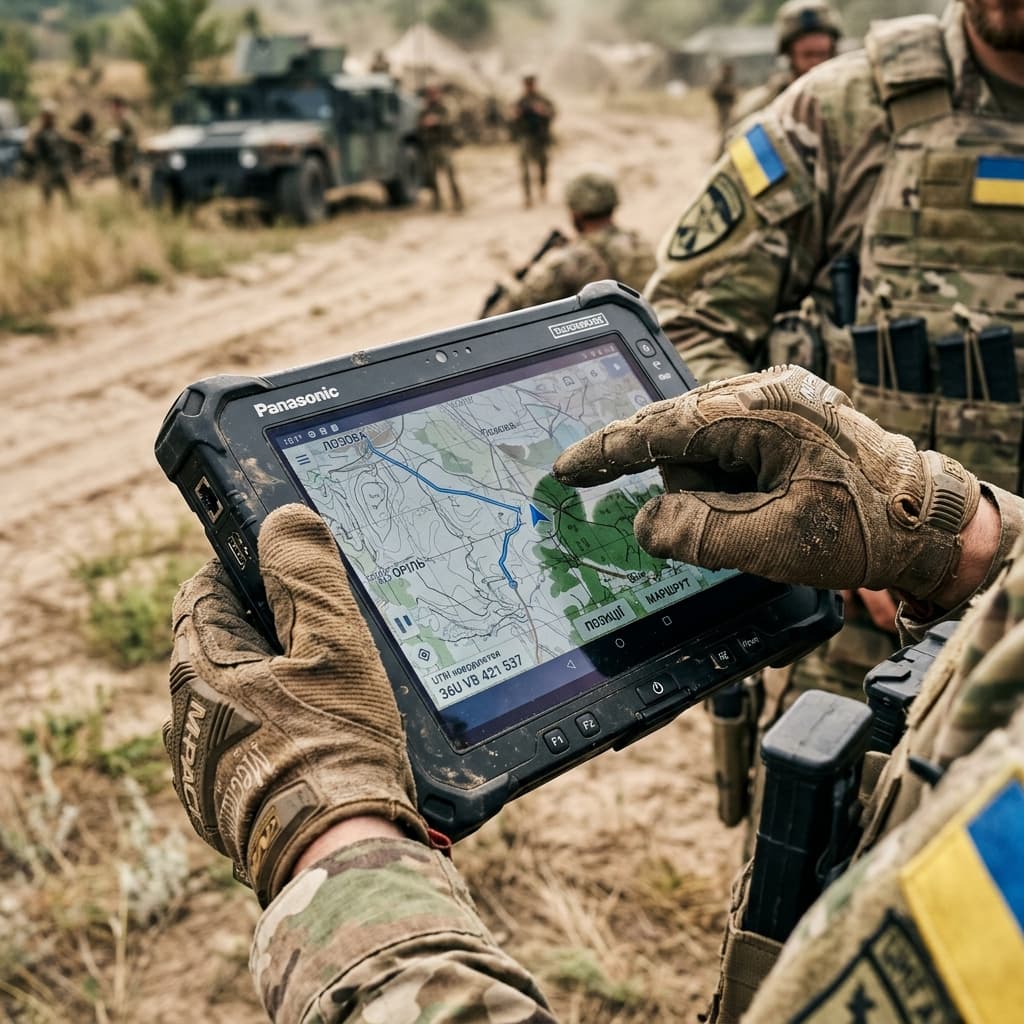
Finally, the transition between autonomous and manual control must be seamless and explicitly clear. During a long patrol, the robot handles the navigation autonomously. When the robot encounters an obstacle it cannot clear, the HMI must decisively alert the operator via auditory and visual cues, instantly presenting the necessary manual override controls. The operator must never be confused regarding whether the machine acting under its own intelligence or waiting for a human command.
We facilitate small-group sessions for customers and prospects without requiring a slide deck, focused on your stack, constraints, and the decisions you need to make next.