Insights · Article · Field Robotics · Apr 2026
Mastering the geometry of urban mobility: how articulated tracked flippers enable robots to scale steep stairs, span deep voids, and actively manage their center of gravity to prevent catastrophic rollovers.
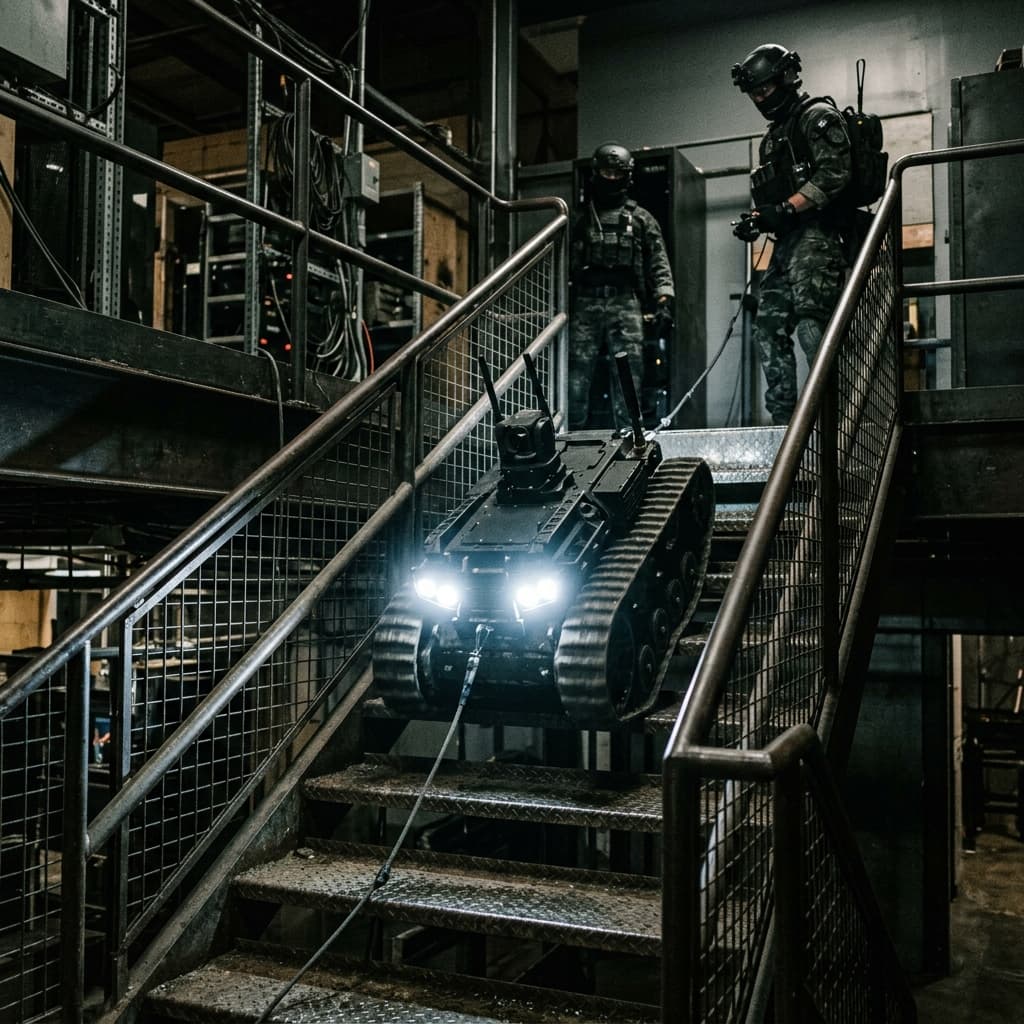
A rigid, rectangular tracked chassis is an excellent platform for crossing muddy terrain, but it fails immediately upon encountering a standard flight of stairs. When the leading edge of a rigid chassis strikes the first steep stair riser, the tracks cannot grip; the chassis simply noses up until it stalls. To conquer vertical urban geometry—stairs, curbs, and deep trenches—engineers incorporate articulated flippers: independent, motorized track extensions mounted to the front (and often rear) of the primary chassis. Mastering the control of these flippers is the essence of advanced urban mobility.
The primary function of front flippers is increasing the approach angle. By rotating the front flippers upward like arms, the robot can address a sheer vertical wall or a steep set of stairs. The track belt running over the leading edge of the raised flipper hooks the lip of the obstacle, pulling the heavy main chassis upward. As the robot climbs, the flippers must be actively lowered to press flat against the stairs, maximizing the track's contact patch across multiple stair nosings and providing immense upward traction.
Center of Gravity (CG) management is the critical safety dynamic during steep ascents. As a heavy robot climbs a 40-degree stairwell, gravity attempts to pull its mass backward, rotating the robot around its rear edge. Without intervention, the robot will flip backward down the stairs, resulting in catastrophic damage. By extending the heavy front flippers straight out forward, the operator artificially shifts the entire CG away from the rear pivot point, anchoring the nose of the robot down against the stairs and preventing the backward roll.
Gap crossing (trenching) is the secondary vital function of flipper dynamics. A rigid robot cannot cross a gap wider than exactly half its length; if it drives further, it tips nose-first into the void. By rotating the front flippers out perfectly flat and locking them rigidly in line with the main chassis, the robot effectively doubles its wheelbase. The extended flippers bridge the gap, resting securely on the far side before the main heavy chassis leaves the near edge, allowing smooth transit across wide rubble voids.
Rear flippers exponentially increase maneuverability and stabilization. A four-flipper robot (two front, two rear) can raise itself entirely off its main chassis, balancing purely on the tips of the extended flippers. This raises the sensor mast high over obstacles for superior reconnaissance. More importantly, during perilous stair descent, extending the rear flippers backward acts as a rigid anchor, preventing the heavy robot from pitching forward into a tumbling dive over the steep stair precipice.
Motor torque requirements for flipper joints are immense. The joint connecting the flipper to the main chassis acts as a fulcrum. When a 100-pound robot uses its front flipper to press down and lift its own chassis over an obstacle, the torque exerted on that tiny actuator joint is colossal. The gearboxes driving these flippers must be heavily over-engineered, often utilizing high-ratio harmonic or planetary drives. If the flipper actuator is back-drivable (allowing it to be forced down under load), the flipper will gracefully collapse just as the robot commits to the climb, causing a disaster.
Automated flipper control is rapidly replacing manual joy-sticking. Asking an operator to simultaneously drive the main tracks precisely, manage multiple camera feeds, and constantly adjust four independent flipper angles to maintain the CG on a complex rubble pile induces massive cognitive overload. Modern platforms utilize inertial measurement units (IMUs) and predictive algorithms to sense the pitch and roll of the chassis. The software automatically micro-adjusts the flipper angles in real time, keeping the robot glued to the stairs and allowing the operator to focus solely on the mission objective.
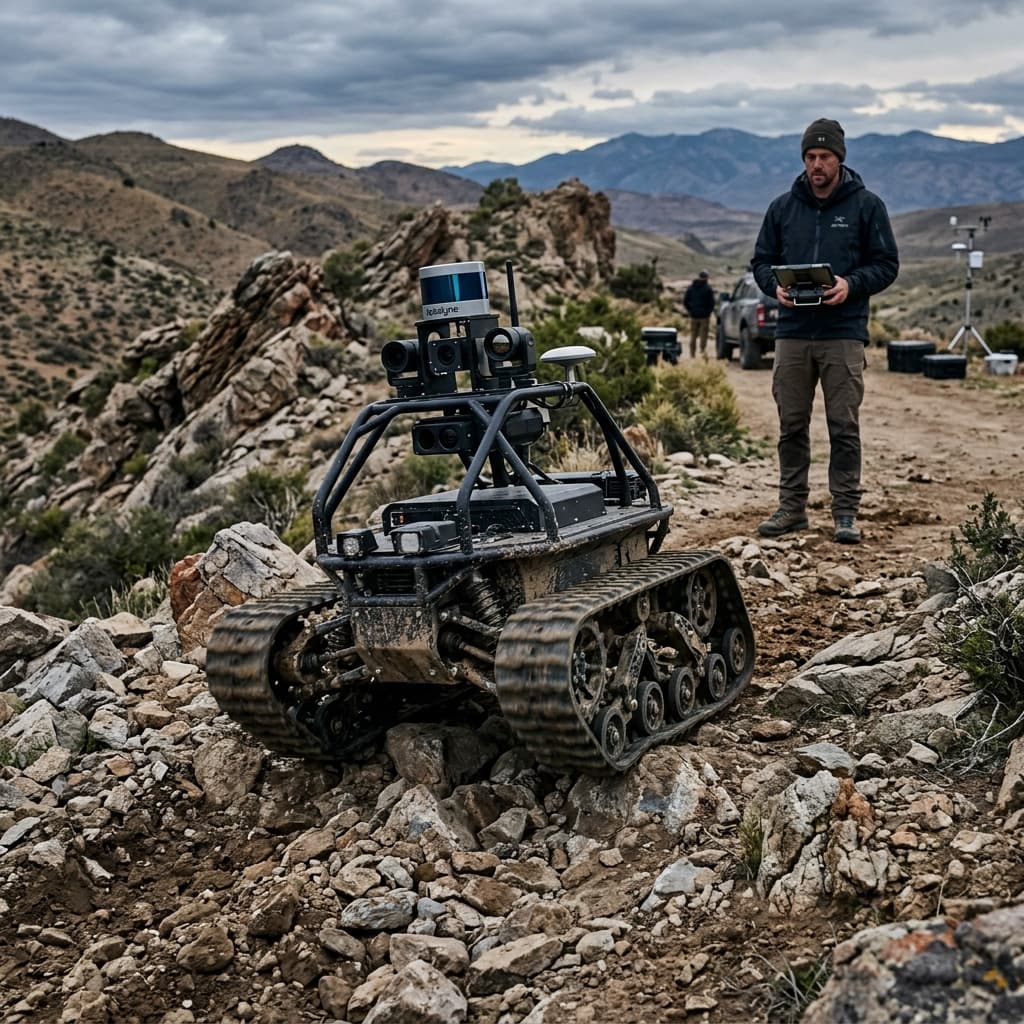
Track tensioning across articulated joints requires complex geometry. The continuous rubber track must wrap tightly around the main chassis and flow seamlessly out over the articulating flipper. As the flipper rotates 360 degrees, the required circumference path for the track constantly changes. Engineers must design eccentric pivot points or dynamic spring-loaded idler wheels within the flipper housing that automatically take up the slack when the flipper is folded back, preventing the track from derailing or snapping tight and burning out the drive motor.
We facilitate small-group sessions for customers and prospects without requiring a slide deck, focused on your stack, constraints, and the decisions you need to make next.