Insights · Article · UAV Systems · Apr 2026
How to define, test, and qualify the transition corridor for fixed-wing VTOL UAVs: identifying critical airspeed and attitude limits, structuring flight test campaigns, managing risk during envelope expansion, and documenting the qualified envelope for operational use.
The transition flight phase, where a fixed-wing VTOL aircraft changes from multirotor hover mode to aerodynamic forward flight or vice versa, is the highest-risk segment in most VTOL UAV operations. It is the phase where both lift systems are simultaneously active, where aerodynamic and rotor forces interact in ways that vary with airspeed and attitude, and where the control authority of either system alone would be insufficient to rescue a developing upset. A poorly bounded transition envelope produces accidents that are difficult to reconstruct because the vehicle was operating in a region that was never formally characterized.
Envelope definition begins before the first transition flight test. The aerodynamics team should produce estimates of the stall speed of the fixed wing at the expected takeoff weight, the minimum airspeed at which aerodynamic lift begins to unload the rotors meaningfully, and the maximum pitch attitude at which aerodynamic drag does not overwhelm the forward thrust available from the pusher or tractor propulsion. These estimates define the initial safe corridor within which transitions are attempted. The test campaign then expands or contracts this corridor based on observed behavior.
Ground-based testing before transition flight tests validates the control law behavior in steady-state conditions at each end of the transition. In multirotor mode, the aircraft should demonstrate stable hover at all wind conditions within the anticipated test day envelope. In fixed-wing mode, the aircraft should demonstrate controlled flight at airspeeds from minimum sustainable to cruise. Failures observed in these baseline modes should be resolved before transition testing begins; attempting a transition with a known fixed-wing control law deficiency adds an unacceptable variable to an already demanding test point.

Transition test campaign structure should progress from minimum-risk conditions to the intended operational envelope boundary. The first transition tests should be conducted in near-zero wind, at minimum takeoff weight, with a chase crew and a safety pilot authorized to command immediate abort at any point. Each test point should be documented with the airspeed at initiation, the airspeed at completion, the pitch and roll attitudes throughout the transition, the motor and control surface activity, and any observed oscillations or departures from the commanded trajectory.
Wind conditions have a significant effect on VTOL transition behavior that is often not fully predicted by simulation. A headwind during a front-to-back transition reduces the effective groundspeed at which aerodynamic lift develops, extending the time the aircraft spends in the mixed-lift regime and increasing the rotor power demand. A tailwind does the opposite, potentially causing an earlier than expected nose pitch-up if the aerodynamic lift develops faster than the control law anticipates. Both directions should be explicitly tested within the qualified envelope rather than extrapolated from calm-wind data.
Weight and center-of-gravity sensitivity should be evaluated across the expected loading range. A VTOL aircraft loaded at maximum gross weight with payload positioned at the forward center-of-gravity limit has a different pitch response during transition than the same aircraft loaded light with payload at the aft limit. If the operational program requires flight at both extremes, both must appear in the test matrix. Qualifying only at the nominal configuration and then operating at extremes that were never tested is a common source of in-service anomalies.
Abort criteria and abort procedures must be defined before any transition test flight. The abort procedure specifies the crew action that returns the aircraft to a stable hover if the transition exhibits an unsafe characteristic during the test. This typically means reversing to multirotor mode at the airspeed and attitude observed at the point of abort. The action must be executable in the time available between anomaly detection and loss of control margin. Simulation of abort scenarios before live test helps the safety pilot develop the response that will be needed if a test point goes outside the expected corridor.
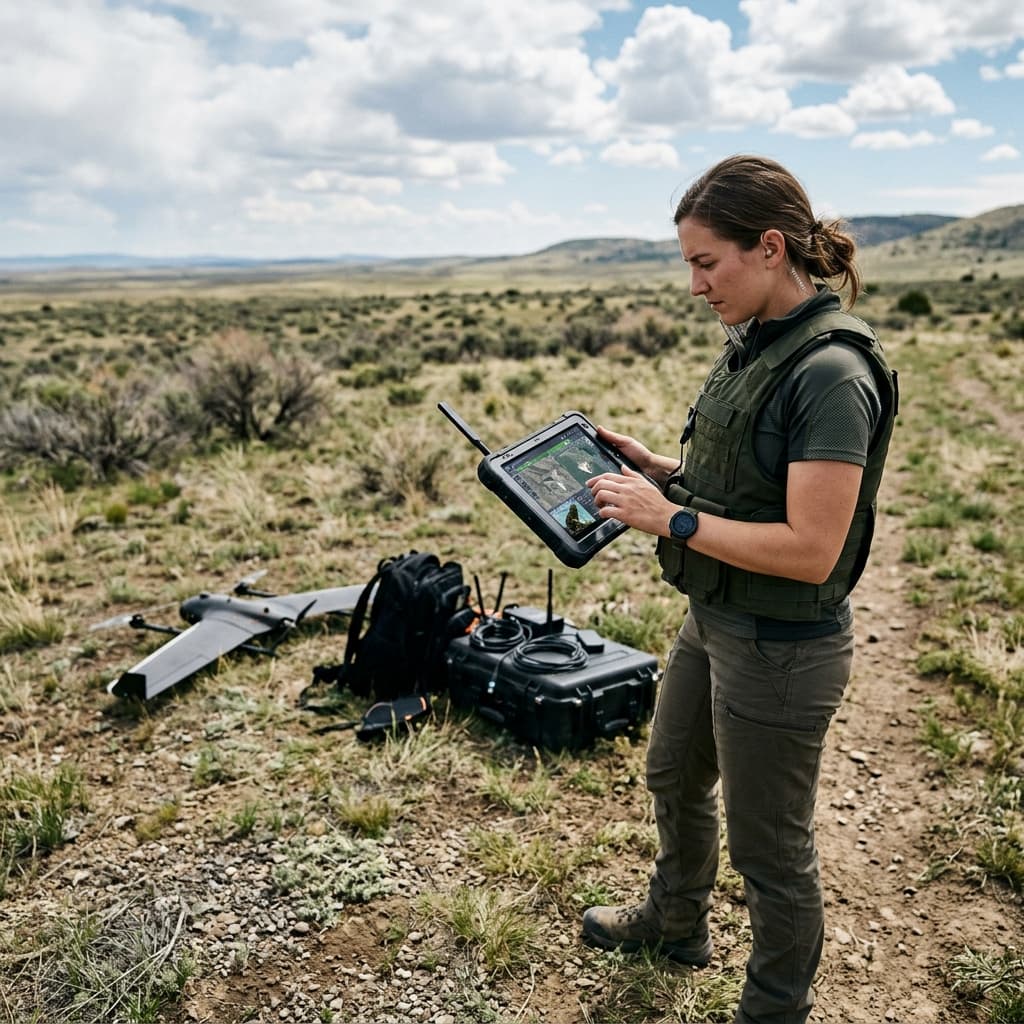
Documentation of the qualified transition envelope should specify all the parameters that characterize the boundary conditions: minimum and maximum initiation airspeed, minimum and maximum wind speed at each heading, weight limits, center-of-gravity limits, and maximum bank angle at initiation. The documentation should also specify the degraded conditions under which transitions are not authorized, including specific sensor failures or battery state-of-charge levels below which the rotor system cannot maintain an adequate power reserve during the transition phase.
Post-test data analysis should compare the observed transition behavior against the pre-test predictions, regardless of whether the test was successful. Points where the observed behavior differed from predictions, even within the safe corridor, indicate gaps in the simulation model that should be corrected before the next test campaign increment. A VTOL transition model that accurately predicts behavior inside the tested envelope gives greater confidence that extrapolation toward the envelope boundary is correctly bounded.
Operational procedures derived from the test campaign should be incorporated into the flight manual and the GCS configuration. Operators should know the initiation conditions required before executing a transition, the expected duration of the transition phase, the airspeed and attitude indications that confirm a successful transition, and the recovery action if a transition does not self-complete within the expected time window. Training that includes transition abort scenarios in a simulator before live operations ensures the operator has rehearsed the time-critical response.
We facilitate small-group sessions for customers and prospects without requiring a slide deck, focused on your stack, constraints, and the decisions you need to make next.