Insights · Article · Rugged Hardware · Apr 2026
Engineering rugged displays for high ambient light environments: analyzing the limitations of high-brightness backlights, the physics of optical bonding, and managing thermal loads in direct sunlight.
A rugged tactical computer is functionally useless if the operator cannot read the screen. In a dimly lit command post, a standard 300-nit commercial display is blindingly bright. Under direct midday desert sun (which can exceed 100,000 lux), that same screen appears completely black due to surface reflections overpowering the backlight. Engineering a display for true sunlight readability requires mitigating internal and external reflections while driving the LCD backlight to extreme levels without melting the liquid crystals.
The brute-force approach to sunlight readability is increasing the backlight brightness, typically pushing the LED array to 1,000 or even 1,500 nits. While this improves contrast against solar glare, it introduces severe thermal and power penalties. A 1,500-nit backlight draws massive current, draining battery packs rapidly and generating enormous heat directly behind the LCD panel. If this heat is not aggressively managed via conduction pathways to the chassis, the LCD fluid will boil, resulting in an irreversible black 'solar clearing' spot in the center of the screen.
Optical bonding is the most elegant and necessary solution for sunlight readability. In a standard display, there is an air gap between the LCD panel and the outer protective touch glass. Air has a different refractive index than glass. When sunlight hits the screen, it reflects off the front of the touch glass, passes through, hits the back of the touch glass, passes through the air gap, and reflects again off the front of the LCD panel. These internal reflections wash out the image contrast completely. Optical bonding fills this air gap with a specialized, index-matched liquid optically clear adhesive (LOCA), eliminating the internal refractive boundaries and dramatically reducing reflection.
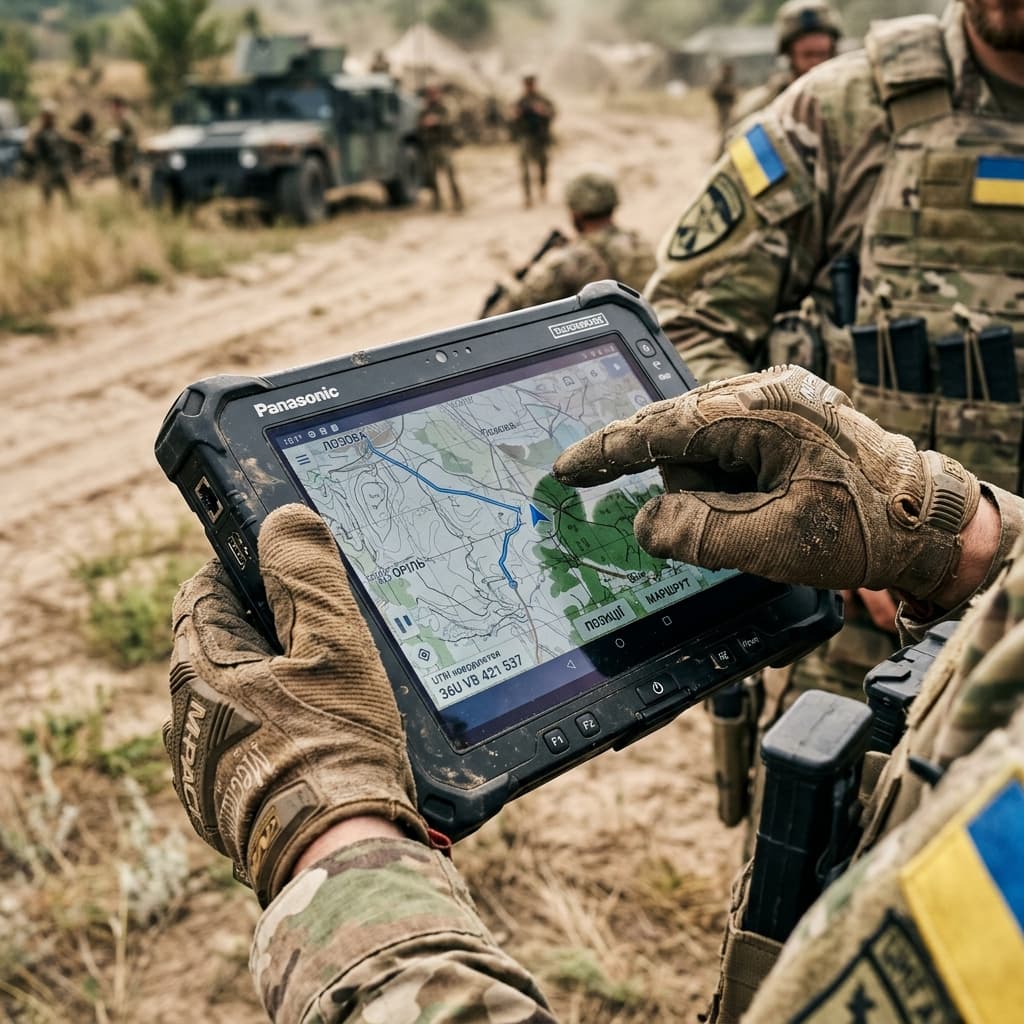
Anti-Reflective (AR) and Anti-Glare (AG) coatings address the external surface reflection. An AR coating uses microscopic interference layers to cancel out reflected light waves, preserving sharp image clarity. However, AR coatings act as fingerprint magnets and can wear off under harsh field cleaning. An AG coating involves etching the surface of the glass to scatter the reflected light, eliminating sharp mirror-like reflections. While highly durable, AG etching slightly blurs the underlying pixel structure. The optimal rugged solution is often a hybrid approach layered with an oleophobic (anti-smudge) topcoat.
Transflective display technology offers an alternative to high-brightness backlights by actually utilizing the ambient sunlight. A transflective LCD incorporates a partial reflector behind the pixels. It uses a weak backlight in dark environments (transmissive mode) but relies on reflected sunlight passing twice through the liquid crystal layer in bright environments (reflective mode). The brighter the sun, the brighter the screen. While highly power-efficient, transflective displays historically sacrifice color saturation and viewing angles compared to standard transmissive LCDs.
Night Vision Imaging System (NVIS) compatibility is the inverse challenge of sunlight readability. A display engineered for 1,500 nits must also be capable of dimming to less than 1 nit for covert nighttime operations, without flickering or shifting color. Furthermore, the light emitted in 'covert mode' must not contain infrared wavelengths that would bloom or blind the operator's night vision goggles (NVGs). Achieving both NVIS compliance and sunlight readability requires sophisticated dual-backlight systems or massive pulse-width modulation (PWM) control ranges.
Thermal load from direct solar radiation is often underestimated. Even if the internal LED backlight heat is managed, a black-bezeled display facing the midday sun absorbs massive radiant thermal energy. The surface temperature of the touch glass can easily exceed 85°C. If the operator is wearing gloves, the touch controller must be tuned to register inputs through thick material while ignoring the false touches generated by extreme heat and sweat on the glass surface.

Verification testing for sunlight readability requires a specialized photometer and a controlled ambient light source mimicking the solar spectrum. The contrast ratio is measured under 100,000 lux of direct illumination and 10,000 foot-lamberts of diffuse glare. A display that achieves a high contrast ratio in a dark room but falls below a 5:1 ratio under solar simulation is not tactically viable. True readability is defined by contrast, not merely nits.
We facilitate small-group sessions for customers and prospects without requiring a slide deck, focused on your stack, constraints, and the decisions you need to make next.