Insights · Article · Rugged Hardware · Apr 2026
Protecting printed circuit boards from humidity, salt fog, and conductive dust: evaluating acrylic, silicone, polyurethane, and parylene conformal coatings for military and aerospace applications.
A rugged metal chassis cannot guarantee absolute environmental isolation. Connectors wear out, seals degrade, and thermal cycling inevitably pumps trace amounts of humid air or conductive dust into the enclosure over years of deployment. When these contaminants settle on a bare printed circuit board (PCB), dendritic growth causes electrical shorts, rendering the multi-million-dollar system useless. Conformal coating—a thin, polymeric film applied directly over the PCB—is the last, critical line of defense, but selecting the wrong chemistry can be worse than applying no coating at all.
Acrylic coatings (Type AR) are the most common in commercial electronics and light rugged applications. They dry rapidly, are relatively inexpensive, and offer excellent resistance to humidity. Crucially, they are easily dissolved by organic solvents, making rework and component replacement simple for depot-level maintenance. However, acrylics are brittle at extreme cold temperatures and offer very poor resistance to chemical attack; a fuel or hydraulic fluid spill that breaches the chassis will strip the acrylic coating instantly.
Silicone coatings (Type SR) provide exceptional flexibility and thermal stability. While an acrylic coating might crack and flake off a flexing PCB under high vibration, rubbery silicone moves with the board without breaking its seal. Silicone also withstands much higher operating temperatures, making it the preferred choice for engine-mounted controllers or high-power RF amplifiers. The primary drawback is poor abrasion resistance and extreme difficulty in rework; stripping silicone requires highly aggressive chemical solvents that often damage the underlying components.
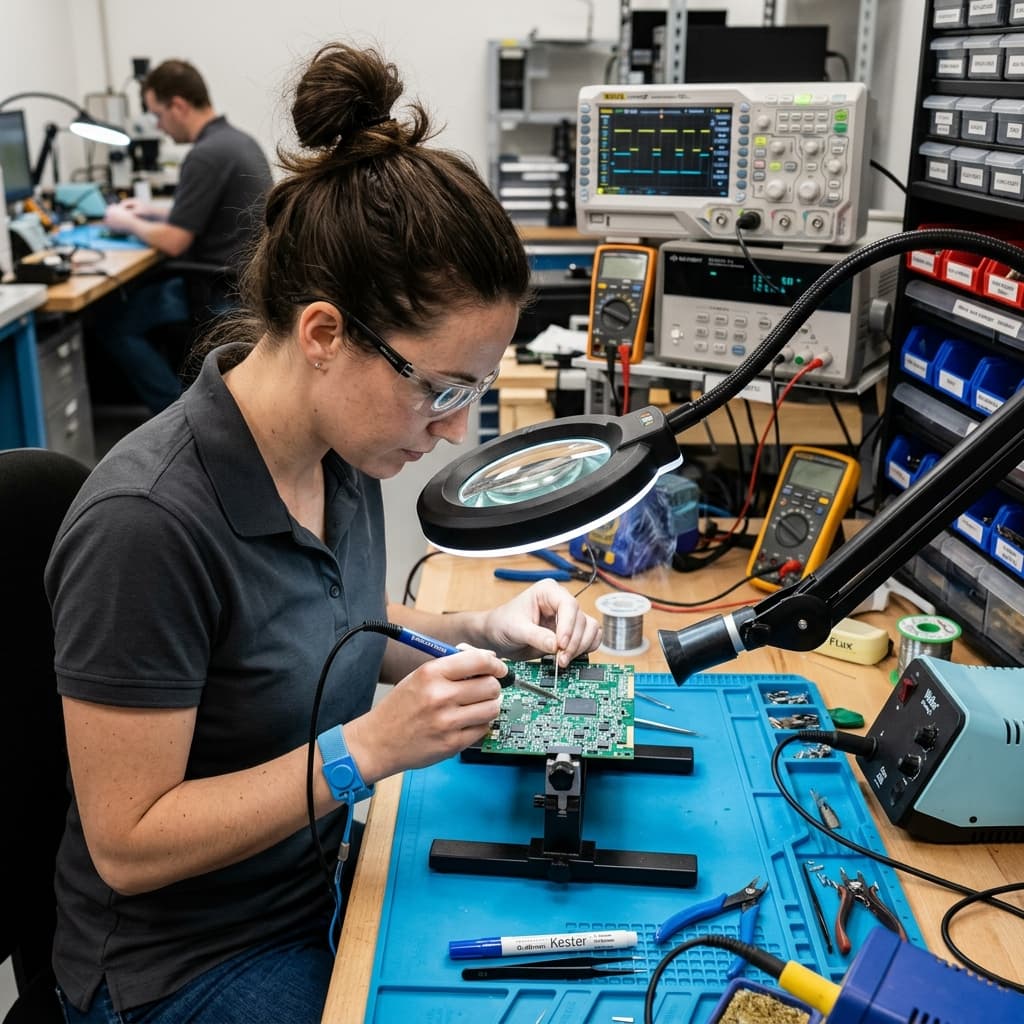
Polyurethane coatings (Type UR) are specified when chemical and abrasion resistance are paramount. A polyurethane-coated board can survive direct exposure to JP-8 jet fuel, salt spray, and solvent baths. This makes it ideal for electronics exposed to the elements or mounted in unsealed vehicle bays. The tradeoff for this chemical invulnerability is reworkability. Polyurethane is nearly impossible to remove chemically without destroying the board; repair typically requires precise, thermal micro-abrasion to dig through the coating selectively to access a failed component.
Parylene (Type XY) represents the pinnacle of conformal coating technology. Unlike the other liquid coatings which are sprayed or dipped, Parylene is applied via chemical vapor deposition in a vacuum chamber. The resulting film is microscopically thin, pinhole-free, and perfectly conforms to the sharpest edges and underneath low-clearance components (like BGA packages) where liquid coatings cannot reach. It offers unmatched dielectric strength and chemical resistance. However, Parylene requires expensive batch processing, masking the board is highly labor-intensive, and rework is effectively impossible outside of a specialized laboratory.
The failure mode of 'tin whiskers' is uniquely mitigated by dense conformal coatings. In lead-free solder environments, pure tin finishes can spontaneously grow microscopic conductive whiskers that bridge adjacent pins and cause shorts. While thin acrylics can sometimes be punctured by these growing whiskers, hard polyurethanes or tough Parylene coatings suppress their growth entirely, securing long-term reliability in legacy systems.
Application methodology dictates success as much as the chemical selection. Spraying a coating over a board that has not been ultrasonically cleaned of all flux residue traps ionic contaminants beneath the protective layer. When minimal moisture inevitably diffuses through the coating, it activates the trapped flux, causing aggressive corrosion under the film where it cannot be seen or cleaned. Cleanliness verification before coating is a mandatory QA step.
Masking is the most labor-intensive part of the coating process. Conformal coatings are excellent insulators. If they are accidentally applied to connector pins, switches, or test points, the board is electrically dead. The engineering drawings must explicitly define 'keep-out' zones, and these zones must be protected with precision-cut masking tape or temporary liquid latex boots before the coating is sprayed or vapor-deposited.
Inspection of the finished coating usually requires ultraviolet (UV) light. Most military-grade conformal coatings contain a UV tracer dye. A technician passes the board under a blacklight to visually verify continuous coverage. Any spots that do not glow blue indicate areas where the coating pooled or pulled away from a sharp component edge (known as 'dewetting'), leaving a localized vulnerability that must be touched up manually.
Ultimately, the choice of conformal coating is a systemic engineering tradeoff. The program manager must balance the operational threat—is the primary risk salt fog, high vibration, or fuel exposure?—against the logistical reality of whether the boards are intended to be disposable items or repairable assets slated for a twenty-year service life.
We facilitate small-group sessions for customers and prospects without requiring a slide deck, focused on your stack, constraints, and the decisions you need to make next.