Insights · Report · Industry · May 2026
Meter mesh networks, head end hardening, usage inference risks, and public transparency when advanced metering supports conservation and leak detection.

Advanced metering infrastructure is transforming how water utilities manage distribution networks, detect leaks, and enforce conservation mandates. Deployments across North America now exceed sixty million endpoints, with municipal and investor-owned utilities alike accelerating rollouts to meet drought resilience targets. Yet the same granular, interval-level consumption data that powers these programs also creates security and privacy obligations that many utilities have not fully addressed in procurement or operations.
This report provides a structured security and privacy framework for water utility AMI programs. It separates engineering telemetry from customer-facing data flows, identifies threat vectors unique to water distribution environments, and offers procurement language that embeds cybersecurity requirements into vendor contracts from the outset. The guidance reflects field assessments conducted across twelve municipal and regional water authorities during the first quarter of 2026.
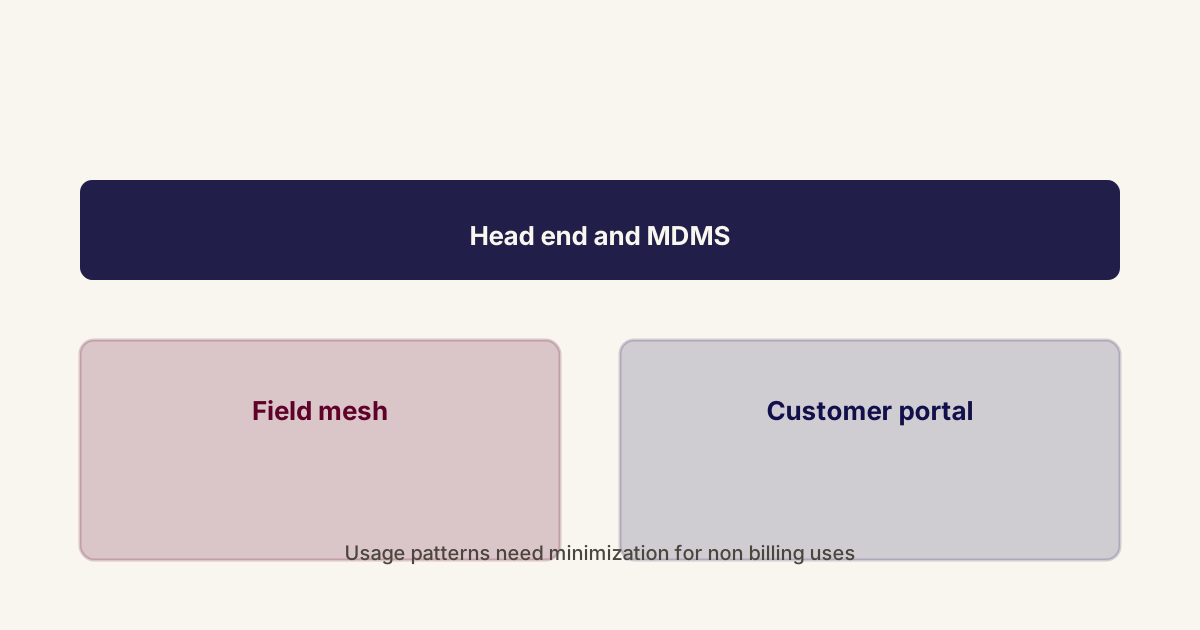
A typical water AMI deployment comprises four zones: field devices including meters and repeaters, a radio frequency mesh or cellular transport layer, a head-end system that aggregates and validates reads, and a meter data management system that feeds billing, analytics, and customer portals. Each zone operates under different trust assumptions, patching cadences, and physical access risks. Security architecture must reflect these differences rather than applying a single perimeter model.
Field meters represent the largest and most physically exposed attack surface. Devices installed in below-grade pits or remote easements are vulnerable to tampering, firmware extraction, and radio replay attacks. Utilities should require hardware tamper detection, signed firmware updates, and encrypted radio payloads as baseline procurement criteria. Devices that accept unsigned over-the-air updates present an unacceptable risk posture regardless of other compensating controls in place upstream.
We can present findings in a working session, map recommendations to your portfolio and risk register, and help you prioritize next steps with clear owners and timelines.
Mesh radio technologies vary significantly by vendor. Some utilities deploy proprietary 900 MHz mesh networks, while others use cellular LTE-M or NB-IoT backhaul. Procurement should require interoperable standards where feasible, documented sunset timelines for proprietary stacks, and contractual commitments to firmware security patches for at least ten years. Vendor consolidation in the metering industry makes long-term support commitments especially important as product lines merge or reach end of life.
Head-end systems serve as the aggregation point for all field data and represent the highest-value target in the AMI architecture. Compromise of the head end can enable mass meter manipulation, billing fraud, or denial of service across the entire metering estate. Hardening measures should include role-based access control with multifactor authentication, encrypted database storage, network segmentation from corporate IT, and continuous log forwarding to a security information and event management platform.
Encryption and key management deserve particular attention in water AMI environments. Transport layer encryption protects data in transit between meters and the head end, but keys stored in field devices must withstand physical extraction attempts. Hardware security modules at the head end and secure enclaves in meter chipsets provide defense-in-depth. Key rotation schedules should align with firmware update cycles, and revocation procedures must account for meters that may be offline for extended periods.
Vendor remote access is a persistent risk vector. Most AMI vendors require remote connectivity to head-end systems for diagnostics, firmware staging, and performance monitoring. Utilities should enforce jump-host architectures with session recording, time-limited access tokens, and explicit approval workflows for each remote session. Persistent VPN tunnels that grant vendors always-on access to production systems violate the principle of least privilege and have been implicated in multiple utility security incidents nationwide.
Cyber-physical risks escalate when AMI integrates with supervisory control and data acquisition systems. Some utilities connect AMI data to pressure management, pump scheduling, or automated valve control. A compromised AMI head end that feeds erroneous consumption data into SCADA-driven pressure algorithms could trigger water hammer events or mask genuine leak signatures. Threat models must explicitly address ransomware scenarios where encrypted head-end databases leave field devices broadcasting into a void.
Privacy risks from granular water consumption data are less widely discussed than their electric utility counterparts but equally consequential. Fifteen-minute interval reads can reveal occupancy patterns, vacation schedules, and household routines. Research has demonstrated that high-resolution water data can infer the number of occupants, the presence of medical equipment, and even dietary habits through irrigation and cooking signatures. These inference risks persist even when customer names are stripped from datasets.
Customer communication programs should explain the purpose and scope of high-resolution data collection in plain language. Opt-in consent mechanisms belong in the same technical system that enforces sampling intervals, ensuring that a customer who declines enhanced monitoring actually receives reduced-frequency reads rather than merely a marketing flag in a CRM system. Transparency reports that disclose data sharing with third parties, including municipal planning departments and conservation program administrators, build public trust.
Municipal procurement of AMI systems creates tension with public records law. Usage data collected by a government entity may be subject to freedom of information requests, yet releasing granular consumption records could compromise individual privacy. Utilities should proactively define aggregation thresholds that satisfy public transparency obligations without enabling re-identification. Common approaches include publishing block-level or pressure-zone-level summaries with a minimum household count of fifteen per aggregate unit.
Data retention policies require explicit alignment between operational needs, regulatory mandates, and privacy commitments. Utilities often retain interval data for five to seven years to support rate case analysis and infrastructure planning, but customer-facing privacy notices may promise shorter retention windows. Reconciling these timelines requires a data classification framework that distinguishes operational telemetry from personally attributable consumption records and applies different retention rules to each class.
Workforce cybersecurity training must extend beyond the network operations center to include field technicians who carry laptops and handheld devices that bridge IT and OT networks. A compromised field laptop connected to both the mesh radio programming interface and the corporate Wi-Fi network creates a lateral movement path that bypasses perimeter controls entirely. Technician credentials are high-value targets, and multifactor authentication should be mandatory for all field tools that access head-end or SCADA systems.
Incident response planning for water AMI must account for the unique characteristics of metering infrastructure. Unlike IT systems that can be quickly isolated and reimaged, field meters cannot be mass-updated in minutes. A coordinated attack that corrupts meter firmware could require physical truck rolls to thousands of endpoints. Tabletop exercises should simulate scenarios involving simultaneous head-end encryption, field device bricking, and public disclosure of customer data to test response coordination across IT, operations, and communications teams.
Regulatory landscapes are evolving rapidly. Several state public utility commissions have issued cybersecurity guidelines specific to water AMI, and the EPA's updated America's Water Infrastructure Act requirements now reference NIST Cybersecurity Framework alignment for utilities serving more than 3,300 customers. Utilities that have not yet mapped their AMI controls to NIST CSF categories should prioritize this exercise, as it provides a common language for communicating risk posture to regulators, boards, and insurance underwriters.
Insurance underwriters are increasingly scrutinizing AMI security posture during cyber liability policy renewals. Utilities that can demonstrate network segmentation, encrypted field communications, vendor access governance, and incident response testing often qualify for more favorable premium structures. Conversely, utilities relying on flat network architectures with unencrypted meter communications face coverage limitations or exclusions that leave significant residual risk on municipal balance sheets.
Looking ahead, water utility AMI programs will face new challenges as meter density increases and integration with smart city platforms expands. Utilities that invest now in zone-based security architecture, privacy-by-design data governance, and workforce training across IT and OT disciplines will be positioned to capture the full operational value of advanced metering without exposing ratepayers to unnecessary risk. The appendices of this report include sample security clauses for AMI RFPs, a data classification template, and benchmark metrics for outage mean time to restore by region.