Insights · Report · Research · Apr 2026
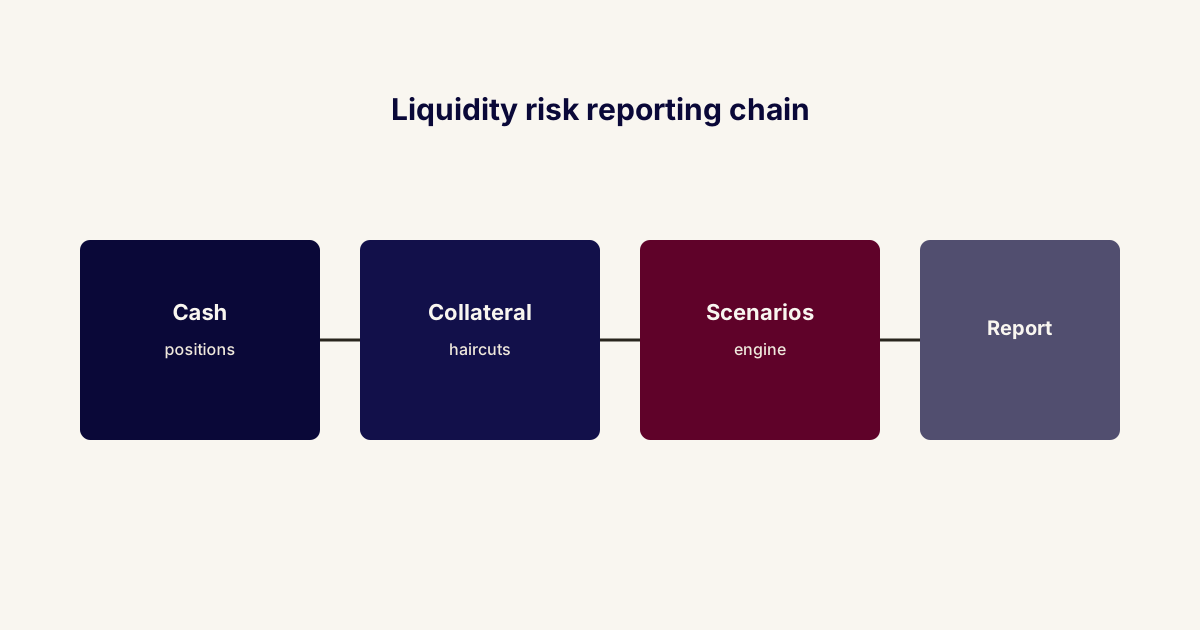
Data lineage for cash and collateral, scenario engines, board reporting cadence, and controls that satisfy prudential reviewers without paralyzing daily treasury ops.

Liquidity risk reporting broke in many firms when product complexity outpaced spreadsheet governance. Collateralized funding programs, contingent credit facilities, and multi-currency cash pools introduced dependencies that manual consolidation could not track reliably. Modern treasury technology programs address this gap by unifying cash positions, encumbrances, and contingent liquidity lines into governed data pipelines that apply the same rigor as regulatory capital reporting. This report examines the architecture, controls, and organizational practices that underpin defensible liquidity risk programs.
Regulatory expectations have sharpened considerably since the global financial crisis. The Liquidity Coverage Ratio and Net Stable Funding Ratio introduced quantitative floors, while supervisory review processes probe the assumptions behind reported numbers. Prudential authorities now expect firms to demonstrate full traceability from each reported cell back to its source system, including any manual adjustments or overrides applied along the way. Firms that cannot satisfy this expectation face remediation orders and heightened supervisory scrutiny that constrains strategic flexibility.
Building a reliable liquidity data foundation begins with source system mapping. Treasury workstations, core banking platforms, securities settlement engines, collateral management systems, and manual adjustment logs each contribute data elements that feed downstream stress calculations. Every feed requires an assigned owner, a documented reconciliation rule, and a materiality threshold for exception escalation. Without this foundational discipline, downstream analytics inherit errors that compound through aggregation layers and produce misleading outputs at the board reporting level.
Data lineage must extend beyond system-of-record identification to encompass every transformation applied between source extraction and report presentation. Mapping should capture field-level derivation logic, aggregation hierarchies, currency conversion rates and their timing, and any fallback values substituted when upstream feeds fail. Organizations that invest in metadata-driven lineage frameworks gain the ability to regenerate any reported number from its raw inputs, a capability that proves invaluable during regulatory challenge sessions and internal audit inquiries.
We can present findings in a working session, map recommendations to your portfolio and risk register, and help you prioritize next steps with clear owners and timelines.
Stress testing engines require transparent, well-documented assumptions to withstand internal and external scrutiny. Shock parameters, collateral haircuts, deposit runoff rates, and behavioral models governing contingent facility drawdowns should all be versioned with formal approval records. Black-box implementations frustrate internal audit teams and external examiners alike. When model assumptions live in configuration files under version control with clear change histories, reviewers can trace every scenario outcome back to its calibration inputs without relying on oral explanations from individual analysts.
Scenario calibration deserves particular attention. Historical replay scenarios anchored to events like the 2008 credit freeze or the 2020 dash for cash provide empirical grounding, but they cannot capture emerging risks such as concentrated digital asset exposures or novel sanctions regimes. Hypothetical scenarios designed by treasury risk committees fill this gap by stress-testing assumptions that history has not yet validated. Reverse stress testing, which identifies the conditions that would render the firm non-viable, completes the scenario toolkit and satisfies supervisory expectations for comprehensive coverage.
Model governance for stress testing parallels the frameworks applied to credit risk and market risk models. Independent validation teams should review scenario construction logic, assess parameter sensitivity, and confirm that model outputs respond appropriately to incremental input changes. Backtesting reported stress outcomes against subsequent actual experience provides feedback that improves calibration over time. Documentation standards should enable a knowledgeable reviewer unfamiliar with the specific model to understand its mechanics, limitations, and intended use without supplementary briefings.
Intraday liquidity monitoring has become a critical dimension of treasury technology strategy as payments modernization accelerates. Real-time gross settlement participation, instant payment scheme membership, and central counterparty margin calls all generate liquidity demands that batch-only visibility cannot capture. Firms operating in multiple payment jurisdictions face overlapping settlement windows that create peak funding requirements invisible in end-of-day snapshots. Technology platforms must refresh intraday liquidity positions continuously, incorporating pending payment queues and projected settlement obligations.
Delivering reliable intraday visibility requires direct feeds from payment gateways, nostro account monitoring services, and collateral management platforms. Dashboard interfaces should present current available liquidity alongside projected positions at configurable time horizons, highlighting threshold breaches before they become urgent. Alert mechanisms should escalate to treasury operations teams when projected positions approach predefined buffers, allowing preemptive action through interbank borrowing, collateral substitution, or payment scheduling adjustments rather than reactive crisis management.
Board and senior management reporting must communicate liquidity risk positions with clarity and appropriate caveats. If certain currencies, subsidiaries, or time zones lag the consolidation cycle, the report should disclose this explicitly. Surprises delivered in committee rooms damage credibility far more than imperfect coverage acknowledged early. Effective board packs present key metrics, trend analysis, and scenario outcomes alongside a narrative that explains what changed since the prior period, what drove the change, and what management actions are underway or planned.
Engaging constructively with prudential reviewers requires preparation that extends beyond producing the correct numbers. Supervisors increasingly evaluate the quality of challenge applied within the firm itself. Demonstrating that scenario assumptions were debated, that model limitations were documented before examination, and that management actions were tested for feasibility under stress conditions signals a mature risk culture. Firms that treat regulatory engagement as a compliance exercise rather than a governance opportunity miss valuable external perspective on their frameworks.

The control framework surrounding liquidity risk technology mirrors expectations applied to broader financial reporting environments. Access controls must enforce segregation between model developers, production operators, and reporting consumers. Change management processes should require documented testing and approval before any modification reaches the production environment. Automated reconciliation routines that compare upstream source totals against downstream report outputs provide continuous assurance that data integrity is maintained through every processing stage. Periodic independent testing validates that controls operate as designed.
Cloud migration introduces new considerations without removing existing control expectations. Hosting stress testing engines in cloud environments offers elastic compute capacity for running large scenario sets and faster provisioning of development environments for model enhancements. However, data residency requirements, encryption standards for data at rest and in transit, and access logging obligations persist regardless of deployment model. Organizations should map regulatory control requirements to cloud-native equivalents before migration rather than retrofitting compliance after the fact.
Integration between treasury liquidity systems and asset-liability management and funds transfer pricing platforms deserves deliberate architectural attention. When treasury, finance, and risk functions draw liquidity data from independent sources, reconciliation disputes consume analyst time and erode confidence in reported numbers. A shared data layer with clearly defined ownership, common reference data, and synchronized snapshot timing ensures that all three functions speak from reconciled positions. Divergent spreadsheets produce political disputes rather than analytical insights.
Vendor selection for stress testing platforms should prioritize auditability, configurability, and integration openness over raw computational speed. A fast engine that produces results reviewers cannot trace provides no regulatory benefit. Evaluation criteria should include scenario definition flexibility, assumption version control, output drill-down capability, and the availability of documented APIs for upstream data ingestion and downstream report distribution. Reference checks should specifically probe the vendor's track record during regulatory examinations and supervisory challenge sessions.
Key performance indicators for the liquidity risk technology program itself merit explicit definition and periodic review. Metrics such as data feed timeliness, reconciliation break rates, scenario execution duration, report production cycle time, and exception resolution speed provide objective measures of operational health. Tracking these indicators over time reveals degradation trends before they manifest as reporting failures, enabling proactive remediation that preserves stakeholder confidence and regulatory standing. Appendices to this report provide sample KPI templates and measurement guidance.
Treasury liquidity risk technology is evolving from a compliance necessity into a strategic capability that informs funding decisions, collateral optimization, and contingency planning. Organizations that invest in governed data pipelines, transparent stress engines, continuous intraday monitoring, and integrated reporting frameworks position themselves to satisfy regulatory expectations while extracting genuine operational value. Speed without auditability remains a false economy, but auditability without operational relevance represents a missed opportunity to strengthen the treasury function's contribution to enterprise resilience.