Insights · Report · Industry · Apr 2026
Slice design, SLA enforcement, security isolation, and commercial models for carriers selling deterministic wireless to industry and public sector buyers.

Network slicing represents the most commercially significant capability in the 5G standards portfolio. By partitioning a single physical radio, transport, and core network into logically independent virtual networks, carriers can offer differentiated performance guarantees to enterprise buyers who have historically relied on dedicated circuits or best-effort wireless. The promise is compelling: deterministic latency, guaranteed throughput, and failure isolation delivered over shared spectrum. Yet the gap between standards-body specifications and production-ready carrier offerings remains substantial, and enterprises evaluating slicing need frameworks that separate marketing claims from contractual commitments.
Market readiness varies significantly by region and carrier maturity. Tier-one operators in South Korea, Japan, and parts of Western Europe have launched commercial slice offerings targeting manufacturing, logistics, and healthcare verticals. North American carriers trail by roughly twelve to eighteen months, with most enterprise slice programs still in controlled trial phases. Public sector buyers, including defense agencies and emergency services, represent a distinct demand category where spectrum priority and hardened isolation requirements exceed what standard commercial slices provide. Procurement teams must assess carrier-specific roadmaps rather than relying on generalized 5G marketing timelines.
The 3GPP specification defines three primary slice types, each mapped to a distinct service category. Enhanced mobile broadband slices deliver high throughput for campus connectivity, video analytics, and augmented reality applications where bandwidth matters more than latency precision. Ultra-reliable low-latency communication slices target robotics, autonomous guided vehicles, and industrial control loops where round-trip times must remain below ten milliseconds with near-zero packet loss. Massive machine-type communication slices serve dense sensor deployments in agriculture, utilities, and smart building environments where thousands of low-power devices transmit small payloads at irregular intervals.
Enterprises should resist the temptation to request ultra-reliable low-latency slices for workloads that do not genuinely require them. Overspecifying slice requirements inflates cost, consumes scarce radio resources, and can delay provisioning timelines. A rigorous application profiling exercise that maps each workload to its actual latency tolerance, throughput envelope, and reliability threshold ensures that slice selection aligns with operational reality rather than aspirational performance targets. This classification discipline also strengthens negotiating leverage by demonstrating technical maturity to the carrier sales engineering team.
We can present findings in a working session, map recommendations to your portfolio and risk register, and help you prioritize next steps with clear owners and timelines.
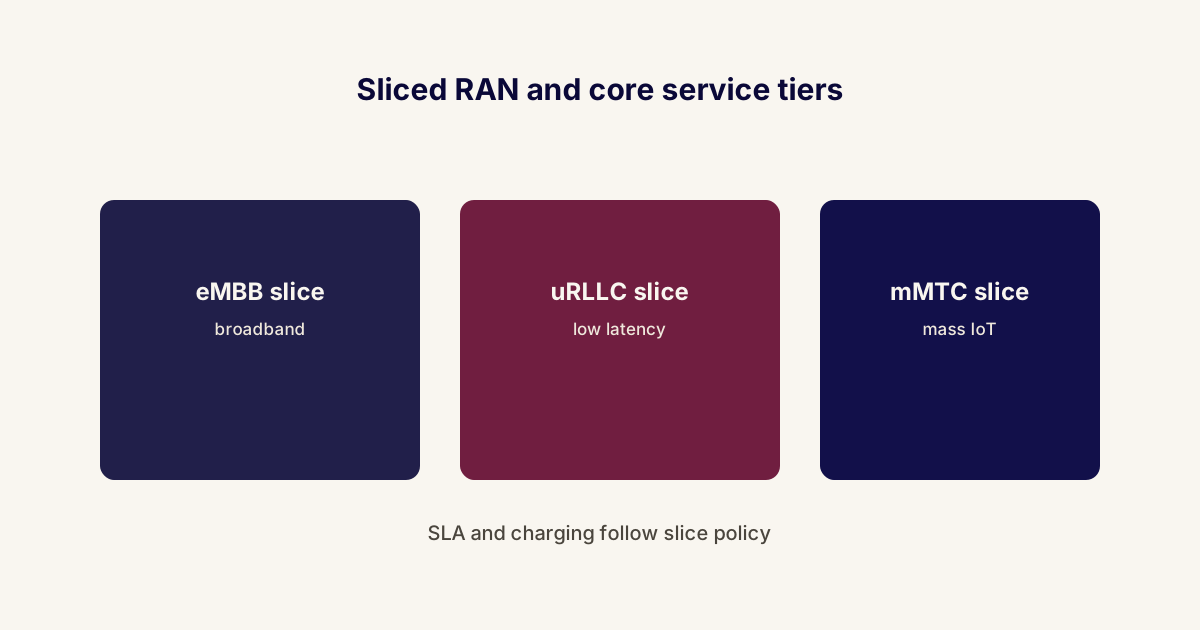
Slice architecture spans three domains that must operate in coordination: the radio access network, the transport network, and the 5G core. At the radio layer, scheduling algorithms allocate resource blocks to specific slices based on configured priorities. Transport networks use segment routing or MPLS tunnels to maintain quality-of-service differentiation across backhaul and midhaul links. The 5G core instantiates dedicated user plane functions and session management functions per slice, ensuring that control plane signaling and data plane forwarding remain logically separated. A failure in any single domain can violate end-to-end slice guarantees, making cross-domain orchestration the critical integration challenge.
SLA enforcement begins with precise measurement. Enterprises and carriers must agree on where latency, jitter, and packet loss are measured, what aggregation windows apply, and how edge cases such as handover events between cells are treated. Vague language referencing average performance across a reporting period masks individual transaction failures that matter to real-time control systems. Contracts should specify percentile-based targets, for example requiring that 99.9 percent of packets within a five-minute window meet the stated latency bound. Measurement probes should be deployed at both the enterprise application endpoint and the carrier user plane function to enable independent verification.
End-to-end observability requires more than carrier-provided dashboards. Enterprise operations teams need visibility into radio conditions at the cell site, transport utilization across backhaul segments, and core network function health indicators. Shared definitions for key metrics prevent disputes rooted in ambiguous terminology. A joint operating model should specify how degradation alerts are generated, who receives them first, and what escalation paths apply when slice performance drops below the contractual threshold. Without this operational clarity, blame shifting between carrier and enterprise network operations centers delays remediation during outages.
Security isolation is a non-negotiable requirement for regulated industries. User plane separation ensures that data traffic from one enterprise slice cannot be intercepted or influenced by another tenant on the same physical infrastructure. Management plane access controls restrict who can modify slice configurations, with role-based policies enforced through the carrier's network orchestration layer. Lawful intercept processes, where regulations mandate them, must be scoped to the individual slice without exposing traffic from adjacent tenants. Enterprises should request written attestations of isolation mechanisms and, where feasible, conduct independent penetration testing against slice boundaries.
Edge computing partnerships introduce additional complexity into slice support models. Many carriers co-locate hyperscaler infrastructure alongside their user plane functions at edge sites to reduce application latency. When an enterprise workload runs on a cloud provider's compute stack but depends on a carrier's slice for connectivity, incident ownership becomes ambiguous. Runbooks must clearly define responsibility boundaries: which party investigates when latency spikes, how data residency commitments are maintained across edge locations, and what happens when a hyperscaler maintenance window conflicts with the carrier's slice availability guarantees. These multi-party operating agreements require explicit documentation before production traffic flows.
Commercial models for network slicing are still maturing, but several pricing constructs have emerged across early deployments. Committed information rate contracts guarantee a minimum bandwidth allocation with burst capacity available at premium rates. Latency-tiered pricing assigns cost based on the stringency of the round-trip target, with sub-five-millisecond slices commanding significant premiums over general-purpose broadband slices. Penalty clauses tied to SLO breaches provide financial recourse when the carrier fails to deliver contracted performance. Enterprises should insist that penalty mechanisms are automatic and measurement-triggered rather than requiring manual claims processes that discourage enforcement.

Billing transparency matters as much as pricing structure. Usage reports should decompose charges by slice, by site, and by time period with sufficient granularity to enable internal cost attribution. Organizations operating multiple slices across different facilities need the ability to map carrier invoices to business unit budgets without manual reconciliation. API-accessible billing data that integrates with enterprise financial systems reduces administrative overhead and improves forecasting accuracy. Carriers that treat billing integration as a premium add-on rather than a baseline capability signal operational immaturity that may extend to other service management areas.
Migration planning must address coexistence with existing wireless infrastructure. Most enterprises operate Wi-Fi networks alongside any 5G deployment, and device handoff between the two technologies requires careful policy configuration to avoid session disruption. Private 5G networks using dedicated spectrum, such as CBRS in the United States, offer an alternative to carrier-managed public slices, but they shift operational responsibility entirely to the enterprise or a managed service provider. The choice between public slices and private 5G depends on the organization's appetite for operational complexity, its regulatory environment, and whether its workloads demand the coverage footprint that only a carrier's macro network provides.
Device certification is a frequently underestimated dependency. Not all 5G-capable devices support the network slicing protocols defined in 3GPP Release 16 and later. Industrial IoT modules, ruggedized handsets, and specialized sensors may lack the URSP (UE Route Selection Policy) capabilities needed to steer traffic onto the correct slice. Enterprises should maintain a certified device registry and require that procurement processes validate slice compatibility before hardware purchase orders are approved. Deploying non-compliant devices onto a sliced network undermines the performance guarantees that justified the investment.
Procurement teams should structure RFP evaluations around five pillars: slice architecture and isolation guarantees, SLA measurement methodology and penalty mechanisms, security attestation and audit rights, edge computing integration and support model clarity, and commercial flexibility including committed rates, burst policies, and billing granularity. Weighted scoring across these pillars normalizes comparison between carriers whose proposals emphasize different strengths. Reference checks with existing enterprise slice customers provide ground-truth validation that complements the written response.
Carriers responding to enterprise RFPs benefit from clarity as well. Detailed technical appendices that describe orchestration platforms, measurement probe placement, and isolation certification results differentiate serious proposals from slide-deck promises. Including sample SLA reports, API documentation for observability feeds, and draft operating model agreements demonstrates operational readiness that procurement evaluators can verify against their own requirements. The carriers that win enterprise slice contracts in 2026 will be those that treat transparency as a competitive advantage rather than a liability.
Looking ahead, network slicing will evolve alongside broader 5G Advanced and eventual 6G standardization efforts. AI-driven slice orchestration, dynamic resource reallocation based on real-time demand signals, and cross-carrier slice federation for multinational enterprises are all active research areas with early commercial prototypes. Enterprises should design their slice consumption architectures with abstraction layers that insulate application logic from carrier-specific orchestration APIs. This portability discipline protects against vendor lock-in and positions the organization to adopt next-generation capabilities as they mature without rearchitecting production workloads.