Insights · Report · Research · Apr 2026
Translating engineering risk into capital planning language: cost of delay, control dependencies, and quarterly refresh rituals that prevent register rot.

Technical debt registers fail when they read like complaint lists. Finance committees allocate capital against trade-offs they can quantify: revenue at risk, regulatory exposure, projected efficiency gains, and credible cost ranges. When engineering teams present registers filled with jargon and vague urgency, the result is predictable: deferred funding, eroded trust, and growing backlogs that compound quietly until an incident forces emergency spending. The gap between engineering reality and boardroom legibility is the central problem this report addresses.
Most organizations maintain some form of technical debt inventory, yet fewer than one in five updates it on a disciplined cadence or ties entries to financial planning cycles. The register becomes a static artifact, referenced only when a team needs justification for a refactoring sprint. This pattern guarantees irrelevance. A register that earns recurring attention from finance leadership must connect every entry to measurable business impact, carry consistent scoring, and refresh on a rhythm aligned with quarterly budget reviews.
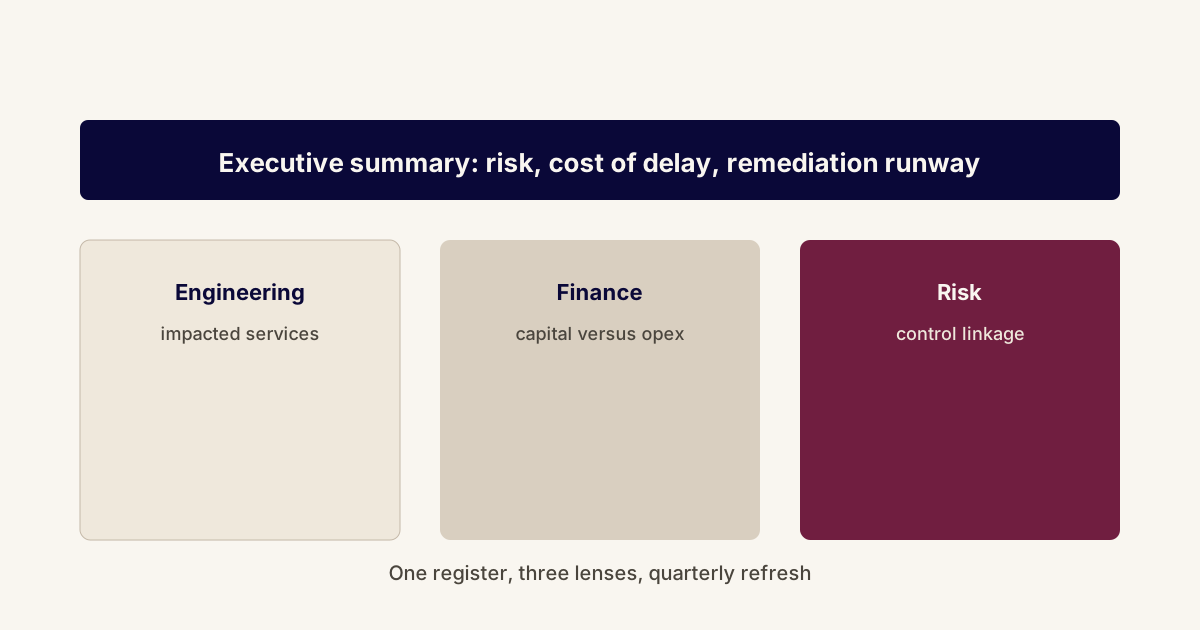
The root cause of register failure is linguistic. Engineers describe debt in terms of code quality, architectural purity, and developer experience. Finance professionals think in terms of capital allocation, operating expense ratios, risk exposure, and return on investment. Neither vocabulary is wrong, but they rarely overlap. Bridging this gap requires a shared schema that maps each debt item to customer journeys, internal service dependencies, control identifiers from your governance, risk, and compliance tooling, and quantified cost of delay estimates.
We propose a register schema built around four mandatory fields per entry: the affected business capability, the quantified cost of delay range, the dependency graph position, and the regulatory or control linkage. Orphan entries that say refactor the monolith without specifying which customer journey degrades, which compliance control weakens, or which platform upgrade is blocked should be pruned during the first quarterly scrub. Discipline in entry quality is what separates a funded register from a forgotten spreadsheet.
We can present findings in a working session, map recommendations to your portfolio and risk register, and help you prioritize next steps with clear owners and timelines.
Cost of delay estimation does not require false precision. Ranges based on incident history, audit findings, projected licensing cost increases, and lost developer productivity hours are sufficient to establish a defensible rank order. A debt item that costs the organization between fifty thousand and one hundred thousand dollars per quarter in delayed feature delivery is actionable even without a single definitive number. The goal is consistent methodology across the portfolio, not decimal-point theater that collapses under scrutiny.
Scoring should follow a lightweight rubric that finance teams can validate independently. We recommend a three-dimensional model: business impact measured in revenue or cost terms, likelihood of escalation within the next four quarters, and remediation complexity expressed as team-weeks with confidence intervals. Multiplying impact by likelihood and dividing by complexity yields a prioritization index that committees can sort, filter, and challenge without needing to understand the underlying codebase.
Calibration sessions are essential to prevent scoring inflation. Left unchecked, every team will rate its own debt as critical. A cross-functional calibration meeting held once per quarter, attended by engineering leads, product managers, and a finance partner, normalizes scores against a common reference set of resolved items. Over two or three cycles, the organization develops institutional memory for what constitutes high, medium, and low severity, reducing the political negotiation that plagues uncalibrated prioritization.
Capital versus operating expense classification matters significantly for regulated firms and publicly traded companies. Remediation efforts that introduce new capability or extend the useful life of a software asset may qualify for capitalization under accounting standards, while routine maintenance remains an operating expense. Structuring remediation into discrete project bundles with clear start dates, deliverables, and acceptance criteria helps auditors see intentional project boundaries rather than an endless stream of maintenance activity that resists clean classification.
Dependency management must be explicit and visual. Some debt items block platform upgrades, security patches, or compliance certifications. Other items are isolated quality concerns with no downstream impact. Graphing critical path dependencies reveals the true priority structure that a flat ranked list obscures. Portfolio committees can then avoid the common mistake of funding low-impact polish work while a single outdated library blocks an entire compliance deadline across multiple product lines.
Dependency graphs also expose compounding risk. When three debt items share a common root cause, remediating the root once eliminates all three. Without explicit dependency mapping, teams address symptoms individually, tripling effort and leaving the underlying vulnerability intact. The register should capture both direct dependencies and shared root causes, enabling finance committees to fund high-leverage interventions that resolve clusters of debt in a single remediation cycle.
Behavioral alignment between product and engineering leadership is the most underestimated success factor. Product managers who view debt reduction as competing with feature delivery will always deprioritize it. Reframing debt remediation as feature enablement changes the dynamic. When reducing a specific debt item demonstrably unlocks faster release cycles, lowers incident frequency, or removes a blocker for a revenue-generating capability, product leaders become advocates rather than obstacles. Shared objectives and key results that span both teams reinforce this alignment.
Engineering teams should present debt items with explicit velocity projections. If retiring a legacy authentication module reduces average feature delivery time by fifteen percent over the following two quarters, that projection belongs in the register entry alongside the cost estimate. Finance committees respond to investment narratives: spend a known amount now to unlock a quantified return over a defined period. Framing debt in those terms transforms the conversation from apology to opportunity.

Governance requires a single accountable owner per business domain who approves additions, validates retirements, and certifies quarterly refreshes. Distributed ownership without clear accountability leads to registers that grow without bound, accumulating stale entries that erode credibility. The domain owner is not necessarily the person who fixes the debt; they are the person who ensures the register reflects current reality and that every entry meets the quality bar for finance committee review.
The quarterly refresh ritual is the operational heartbeat of a healthy register. In the first two weeks of each quarter, domain owners review entries for accuracy, retire resolved items, and propose new additions. During week three, the cross-functional calibration session normalizes scores. In week four, the finance committee receives a curated summary: the top ten funded items, the top five unfunded items with their cost of delay, and a trend analysis showing how total debt exposure is moving relative to prior quarters.
Version history on the register itself creates audit evidence without introducing another heavyweight governance tool. Every change to an entry, whether a score adjustment, a dependency update, or a retirement, should carry a timestamp, an author, and a brief rationale. Over time this history demonstrates that the organization manages technical debt with the same rigor it applies to financial risk, a narrative that resonates with auditors, regulators, and board members during periodic reviews.
Tooling choices should follow process maturity, not lead it. Organizations in the early stages of register adoption benefit from a structured spreadsheet or lightweight database with controlled access. Premature investment in specialized technical debt management platforms introduces adoption friction and configuration overhead before the underlying scoring methodology has stabilized. Once the quarterly cadence, calibration process, and finance committee integration are functioning smoothly, migrating to a purpose-built tool delivers genuine efficiency gains.
Communication cadence extends beyond the quarterly committee meeting. Monthly status updates to engineering leadership, brief enough to read in five minutes, maintain visibility and accountability between formal reviews. These updates highlight items approaching their cost of delay threshold, remediation efforts that are ahead or behind schedule, and newly identified debt that may require emergency funding before the next quarterly cycle. Consistent communication prevents the register from disappearing between formal governance checkpoints.
Appendices to this report include sample committee presentation slides, a scoring rubric template, and redacted register entries from anonymized client engagements. Use these materials as tone references so your register narrative carries the seriousness and financial precision that earns committee attention. Organizations that adopt the schema, cadence, and calibration practices outlined here consistently report improved funding outcomes, reduced emergency remediation spending, and stronger alignment between engineering investment and business strategy within three to four quarterly cycles.