Insights · Report · Research · May 2026
Vendor model documentation, adverse impact testing, human override patterns, and audit evidence that satisfies regulators reviewing automated hiring tools.

Automated hiring tools have moved from early-adopter curiosity to mainstream procurement in under five years. Resume ranking algorithms, video interview scoring engines, gamified cognitive assessments, and chatbot pre-screens now touch millions of applicants each quarter. Vendors position these products as efficiency multipliers that compress time to hire and surface stronger candidates. Employers, however, bear the regulatory and reputational consequences when those tools produce discriminatory outcomes, obscure their decision criteria, or exclude candidates with disabilities from equitable consideration.
This report provides a structured audit framework for organizations deploying AI-powered screening in talent acquisition. The framework addresses five domains: vendor model documentation, adverse impact testing, human override governance, disability accommodation design, and regulatory notice and appeal infrastructure. Each domain maps to specific deliverables, evidence artifacts, and review cadences that internal audit, legal, and people analytics teams can operationalize without relying solely on vendor assurances.
The regulatory landscape has shifted materially since 2024. New York City Local Law 144 established mandatory bias audits for automated employment decision tools. The European Union AI Act classifies hiring algorithms as high-risk systems subject to conformity assessments, transparency obligations, and human oversight requirements. The U.S. Equal Employment Opportunity Commission has issued updated technical guidance clarifying that employers cannot delegate liability for discriminatory screening to third-party vendors. Illinois, Maryland, and Colorado have enacted or proposed complementary statutes addressing video analysis and biometric data collection during recruitment.
Organizations that treat compliance as an afterthought face compounding risk. Regulatory enforcement actions attract media scrutiny, which amplifies candidate distrust and employer brand damage. Proactive audit programs, by contrast, create defensible evidence of good faith effort and continuous improvement. The cost of building audit infrastructure is modest relative to the reputational and legal exposure of unmonitored automated screening at scale.
We can present findings in a working session, map recommendations to your portfolio and risk register, and help you prioritize next steps with clear owners and timelines.
Vendor model documentation forms the foundation of any credible audit. Every AI screening tool should be accompanied by a model card that describes the training data composition, feature engineering approach, optimization objective, and known limitations. Organizations should require vendors to disclose whether training data was collected from historical hiring decisions, which inherently encode prior bias, or from independently validated competency benchmarks. Model cards should be versioned and updated with each material change to the scoring algorithm.
Training data provenance deserves particular scrutiny. If a vendor trained its resume ranking model on successful hires from a narrow set of employers or industries, the resulting scores may penalize non-traditional career paths, gaps in employment, or credential patterns common in underrepresented groups. Audit teams should request representative samples of training data distributions and compare them against the demographic composition of the applicant pool the tool will actually serve. Significant mismatches signal elevated adverse impact risk.
Adverse impact testing remains the most direct measure of fairness in automated screening. The four-fifths rule, long established in EEOC uniform guidelines, compares selection rates across demographic groups. When the selection rate for a protected group falls below eighty percent of the rate for the highest-performing group, the tool triggers a presumption of adverse impact. Organizations should compute selection rate ratios at each stage of the screening funnel, not only at the final hiring decision, because early-stage filtering compounds disparities downstream.
Statistical testing should extend beyond the four-fifths rule to include standardized mean differences, conditional demographic parity, and intersectional analysis across multiple protected characteristics. A tool may pass the four-fifths threshold for gender and race independently yet produce significant adverse impact at the intersection of gender and race. Audit protocols that examine only single-axis comparisons miss these compounding effects. Reporting should include confidence intervals, sample sizes, and significance thresholds so that decision-makers can distinguish meaningful disparities from statistical noise.
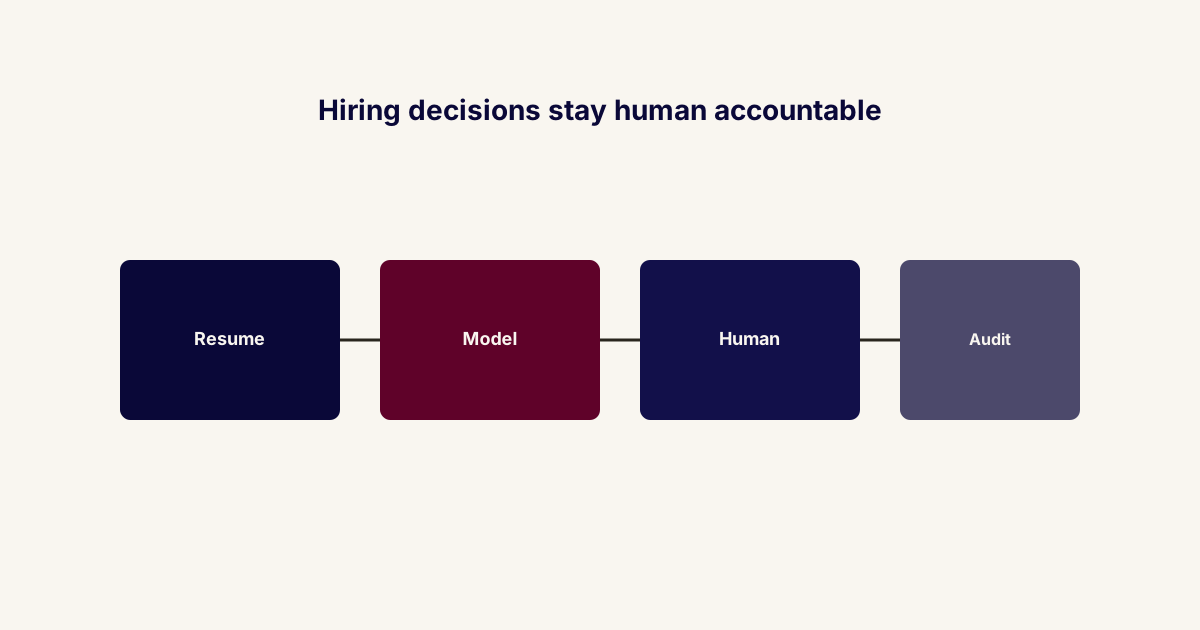
Human override governance determines whether automated recommendations function as decision support or decision replacement. When recruiters and hiring managers consistently accept model scores without independent evaluation, the organization has functionally delegated hiring authority to an algorithm regardless of its nominal advisory role. Override rate monitoring, tracked by tool, requisition type, and reviewer identity, reveals whether human judgment is genuinely active in the process or reduced to performative confirmation.
Effective override programs require that human reviewers receive interpretable model rationales rather than opaque numerical scores. A recruiter told only that a candidate scored 72 out of 100 has no basis for meaningful challenge. A recruiter shown that the model weighted years of experience heavily and penalized a career gap can apply contextual judgment about whether the gap reflects a caregiving period, military service, or other protected circumstance. Interpretability is not a technical luxury; it is a precondition for the human oversight that regulators increasingly mandate.
Training programs for reviewers should address automation bias directly. Research consistently demonstrates that humans anchor on algorithmic recommendations even when instructed to exercise independent judgment. Calibration exercises, blind review sessions where model scores are withheld, and periodic audits of override quality help counteract this tendency. Organizations should track not only override frequency but also downstream outcomes for overridden candidates to validate that human judgment adds measurable predictive value beyond the model alone.
Disability accommodation design must be integrated into the screening tool lifecycle from the outset, not retrofitted as an exception path. Timed gamified assessments, video interview platforms that evaluate facial expressions or vocal tone, and chatbots that penalize non-standard interaction patterns all risk excluding candidates with cognitive, sensory, or motor disabilities. Universal design principles, such as providing untimed alternatives, text-based interaction options, and screen-reader-compatible interfaces, reduce the need for individual accommodation requests and minimize candidate friction.

When individual accommodations remain necessary, the request and fulfillment process must operate within the same service level expectations as the standard screening path. Candidates who wait days for an accommodation while their peers advance through automated stages face a de facto disadvantage that undermines the organization's equal opportunity commitment. Procurement contracts should specify vendor response time obligations for accommodation requests and define escalation protocols when those obligations are not met.
Regulatory notice and consent infrastructure represents an often-overlooked compliance requirement. Multiple jurisdictions now mandate that candidates receive clear, specific disclosure before an automated tool materially influences their application outcome. Disclosures must explain what data the tool collects, how the tool evaluates that data, and what recourse the candidate has if they believe the evaluation was unfair. Generic privacy policy language does not satisfy these requirements. Organizations should build notice delivery, consent capture, and alternative pathway routing into their applicant tracking system workflows.
Appeal and reconsideration mechanisms close the accountability loop. Candidates who are screened out by an automated tool should have a clear, low-friction path to request human reconsideration. The appeal process should be staffed by reviewers who have access to the model rationale and the authority to override the automated decision. Appeal volume, resolution time, and outcome distributions by demographic group serve as valuable audit metrics that surface systemic issues the primary screening analysis may miss.
Procurement plays a critical governance role that many organizations underutilize. Vendor contracts should require cooperation with internal bias audits and regulator inquiries, including export of scoring logs, model version histories, and training data descriptions in standard, machine-readable formats. Vendors that refuse audit cooperation or restrict log access through proprietary platform constraints introduce unacceptable compliance risk. Contract renewal decisions should weigh audit cooperation track record alongside feature capability and pricing.
Ongoing monitoring cadences transform point-in-time audits into continuous assurance programs. Selection rate ratios, override rates, accommodation request volumes, appeal outcomes, and candidate complaint themes should be reported monthly and reviewed quarterly by a cross-functional committee spanning talent acquisition, legal, diversity and inclusion, and internal audit. Trend analysis across reporting periods surfaces gradual drift in model behavior that single audits would miss. Threshold-based alerts that trigger investigation when metrics cross predefined boundaries accelerate response time.
Closing metrics for the audit program should include selection rate ratios by protected group at each funnel stage, time to hire segmented by cohort and screening tool, override rates by reviewer and requisition category, accommodation request fulfillment time, appeal volume and resolution outcomes, and candidate complaint themes mapped to specific tools and process stages. These metrics, tracked longitudinally and benchmarked against industry peers where data is available, provide the evidentiary foundation for both regulatory defense and continuous improvement of fair, effective AI-assisted hiring.