Insights · Report · Strategy · Apr 2026
Embodied carbon in laptops and servers, vendor takeback programs, and disclosure-friendly metrics that connect asset management to ESG reporting.

Sustainability in enterprise IT has concentrated almost exclusively on operational energy consumption and datacenter power usage effectiveness. While those metrics matter, they overlook a substantial and growing source of environmental impact: the embodied carbon locked into the manufacturing, transport, and disposal of physical hardware. For distributed organizations that maintain thousands of laptops, monitors, networking appliances, and edge servers, the hardware footprint frequently rivals or exceeds the energy footprint. Procurement and IT asset management teams must expand their lens accordingly.
Embodied carbon refers to the total greenhouse gas emissions generated across a product's supply chain before it reaches the end user. For a typical enterprise laptop, manufacturing accounts for roughly seventy to eighty percent of lifetime emissions, with usage contributing the remainder. Server hardware follows a similar pattern when amortized over standard refresh cycles. These ratios mean that buying decisions, not power management policies, represent the highest-leverage intervention available to technology leaders pursuing credible emissions reduction targets.
Despite this reality, most procurement frameworks evaluate hardware on price, performance, and warranty terms alone. Environmental criteria, when present, typically appear as a weighted afterthought scored on vague vendor self-declarations. This report argues for a structural shift: embedding carbon budgets into procurement at the category level, requiring manufacturer-verified embodied carbon disclosures, and evaluating total cost of ownership alongside total carbon cost of ownership for every significant hardware purchase.
Asset-class carbon budgets provide a practical mechanism for operationalizing this shift. Instead of setting a single enterprise-wide carbon target that procurement cannot act on, organizations should assign carbon envelopes to each hardware category aligned with its refresh cycle. Laptops on a four-year cycle, servers on a five-year cycle, and networking equipment on a six-year cycle each receive a per-unit carbon budget derived from industry benchmarks and adjusted annually as manufacturer data improves. This granularity makes the abstract commitment to net zero tangible for sourcing managers writing purchase orders.
We can present findings in a working session, map recommendations to your portfolio and risk register, and help you prioritize next steps with clear owners and timelines.
Manufacturer-provided embodied carbon estimates are becoming more available, but quality varies considerably. Some vendors publish product carbon footprint documents compliant with ISO 14067, while others offer only marketing-grade sustainability summaries without verifiable methodology. Procurement teams should require that hardware suppliers deliver product-level carbon data based on recognized lifecycle assessment standards and specify the system boundaries, allocation methods, and data sources used. Without this rigor, comparisons between competing bids remain meaningless.
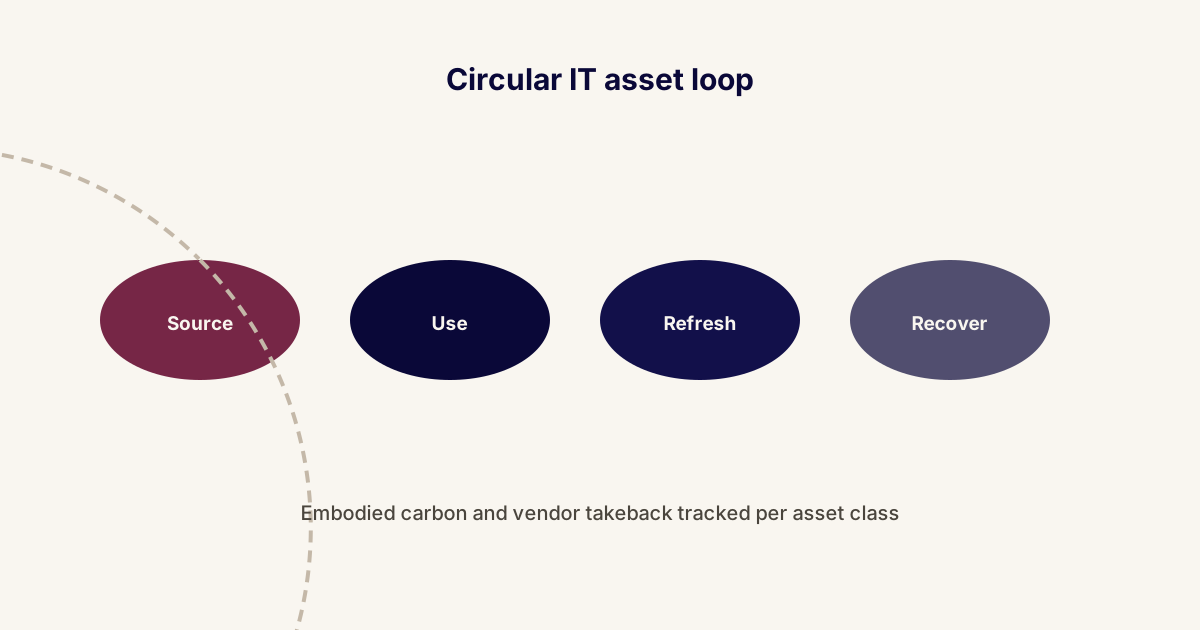
Vendor takeback programs form the second pillar of a circular hardware strategy. Leading manufacturers now offer contractual commitments to accept end-of-life equipment, refurbish viable units, recover rare materials, and certify responsible recycling for the remainder. However, takeback terms differ dramatically in scope and enforceability. Some programs apply only to specific product lines or geographies. Others impose volume thresholds or charge reverse logistics fees that erode their economic attractiveness. Sourcing leaders should negotiate takeback commitments as binding contract clauses rather than accepting optional program brochures.
Refurbishment and internal redeployment deserve explicit, enforceable policies rather than ad hoc decisions made at the point of device collection. A robust secondary lifecycle program defines clear criteria for which assets qualify for refurbishment, what testing and certification each unit must pass before reissue, and how firmware trust chains are maintained across ownership transfers. Organizations that skip these details often discover that retired devices enter unofficial resale channels, creating security exposure and undermining the traceability that ESG disclosures demand.
Security wiping, firmware integrity verification, and spare parts availability are the three practical constraints that determine whether a secondary lifecycle is realistic. Cryptographic erasure tools certified to recognized standards such as NIST 800-88 provide auditable proof of data destruction. Firmware trust must be re-established through vendor-supported re-provisioning rather than informal reimaging. Spare parts availability, particularly batteries, screens, and storage modules, determines whether a refurbished unit can serve reliably through a second deployment cycle or will generate disproportionate support tickets.
Cloud migration changes the shape of hardware responsibility but does not eliminate it. Organizations that shift workloads to hyperscale providers transfer the operational carbon burden but retain accountability for understanding and reporting their share of upstream infrastructure emissions. Scope three reporting under frameworks such as the Greenhouse Gas Protocol requires enterprises to account for purchased cloud services. Ask hyperscalers and colocation partners for region-level power usage effectiveness data, renewable energy procurement certificates, and server refresh schedules that support your own disclosure narratives.
Shared infrastructure models, including virtual desktop farms, hot-desking laptop pools, and multi-tenant edge deployments, offer meaningful embodied carbon savings by increasing hardware utilization rates. A virtual desktop environment serving three hundred users from fifty server nodes achieves a fundamentally different carbon profile than issuing three hundred individual workstations. However, the savings are only credible when utilization metrics are tracked continuously and reported alongside carbon claims. Idle shared hardware provides no environmental advantage over idle personal devices.
Finance teams play a critical gatekeeper role that sustainability advocates frequently underestimate. Longer refresh cycles reduce embodied carbon by deferring new purchases, but they can increase support costs, warranty gaps, and security exposure from aging firmware. This report includes break-even worksheets that allow finance and sustainability stakeholders to model the point at which extended lifecycle savings are offset by rising operational risk costs. The goal is not to maximize device age, but to find the refresh cadence that optimizes across carbon, cost, and security dimensions simultaneously.

ESG reporting teams need a reliable bridge from asset management databases to disclosure line items. The most common failure point is inconsistent serial number and asset tag hygiene. When procurement systems, configuration management databases, and disposal certificates use different identifier formats or allow free-text overrides, traceability breaks down quickly. Organizations should treat hardware identifiers with the same rigor applied to financial account numbers, enforcing validation rules at entry, reconciling across systems quarterly, and flagging orphaned records that lack a complete chain of custody.
Mapping asset data to disclosure frameworks such as the Global Reporting Initiative, the Carbon Disclosure Project, and the European Corporate Sustainability Reporting Directive requires a translation layer that most ITAM tools do not provide natively. This report provides a reference mapping from common asset lifecycle events, including purchase, deployment, transfer, refurbishment, and disposal, to the corresponding disclosure indicators. The mapping allows reporting teams to automate data extraction rather than relying on manual spreadsheet reconciliation that introduces errors and delays each reporting cycle.
Certification schemes provide a useful but imperfect proxy for sustainability performance. EPEAT, TCO Certified, and Energy Star each cover different dimensions of product sustainability, from materials sourcing and hazardous substance restrictions to energy efficiency and end-of-life management. Procurement teams should understand what each certification does and does not guarantee rather than treating any single label as comprehensive assurance. A device carrying an energy efficiency certification may still score poorly on repairability and materials recovery.
Greenwashing in hardware marketing is pervasive and increasingly sophisticated. Common signals include carbon neutral claims backed by offset purchases rather than supply chain reductions, recyclability percentages that count theoretical material recovery rather than actual recycling rates, and sustainability reports that omit Scope three manufacturing emissions entirely. Sourcing leaders equipped with a structured evaluation framework can distinguish genuine environmental leadership from promotional positioning. This report includes a vendor assessment checklist covering data transparency, third-party verification, and commitment specificity.
Organizational readiness is the final prerequisite for a successful sustainable procurement program. Procurement, IT operations, finance, legal, and sustainability functions must align on shared definitions, reporting cadences, and escalation paths. A cross-functional steering committee that meets quarterly to review carbon budget performance, takeback compliance, and vendor sustainability ratings creates the accountability loop necessary to sustain progress beyond initial enthusiasm. Without this governance structure, sustainable procurement remains a policy document rather than an operational practice.
Closing recommendations center on three executive-level dashboards. The first tracks percentage of active assets covered by certified takeback agreements, providing visibility into end-of-life readiness. The second reports estimated tons of electronic waste diverted from landfill through refurbishment, recovery, and certified recycling, connecting operational activity to tangible environmental outcomes. The third monitors energy-adjusted utilization rates for shared infrastructure pools such as virtual desktop farms and multi-tenant edge nodes, ensuring that consolidation strategies deliver the carbon efficiencies they promise rather than merely shifting costs between budget lines.