Insights · Report · Research · Mar 2026
Survey-backed benchmarks on internal developer platforms, golden paths, and FinOps alignment across regulated enterprises.

This report synthesizes findings from structured interviews with platform engineering leads at 120 global organizations spanning banking, insurance, pharmaceuticals, energy, and industrial manufacturing. Respondents represent enterprises with annual technology budgets exceeding fifty million dollars and developer populations ranging from five hundred to twelve thousand. The research examines how internal developer platforms have matured from grassroots experiments into funded product lines with measurable business outcomes.
Platform engineering has crossed the threshold from emerging practice to organizational imperative. Eighty-two percent of surveyed enterprises now operate a dedicated platform team, up from forty-six percent in our 2024 cohort. More significantly, sixty-one percent of those teams report directly to a VP of Engineering or CTO rather than being embedded within infrastructure operations. This structural elevation signals that leadership recognizes developer productivity as a strategic differentiator, not merely an operational convenience.
The defining characteristic of high-performing platform organizations is product thinking applied to internal tooling. Teams that treat their internal developer platform as a product, complete with roadmaps, user research, adoption metrics, and deprecation cycles, consistently outperform those that treat it as a shared services function. Product-managed platforms reported thirty-five percent higher developer satisfaction scores and twenty-eight percent faster median time from commit to production deployment across our survey population.
Golden paths emerged as the single most impactful pattern for reducing cognitive load on application teams. A golden path provides an opinionated, pre-configured route through infrastructure provisioning, CI/CD pipeline setup, observability instrumentation, and security scanning. Unlike rigid mandates, golden paths allow deviation when justified, but they make the default choice the best choice. Organizations with mature golden paths reported forty percent fewer support tickets to platform teams and measurably lower onboarding times for new engineers.
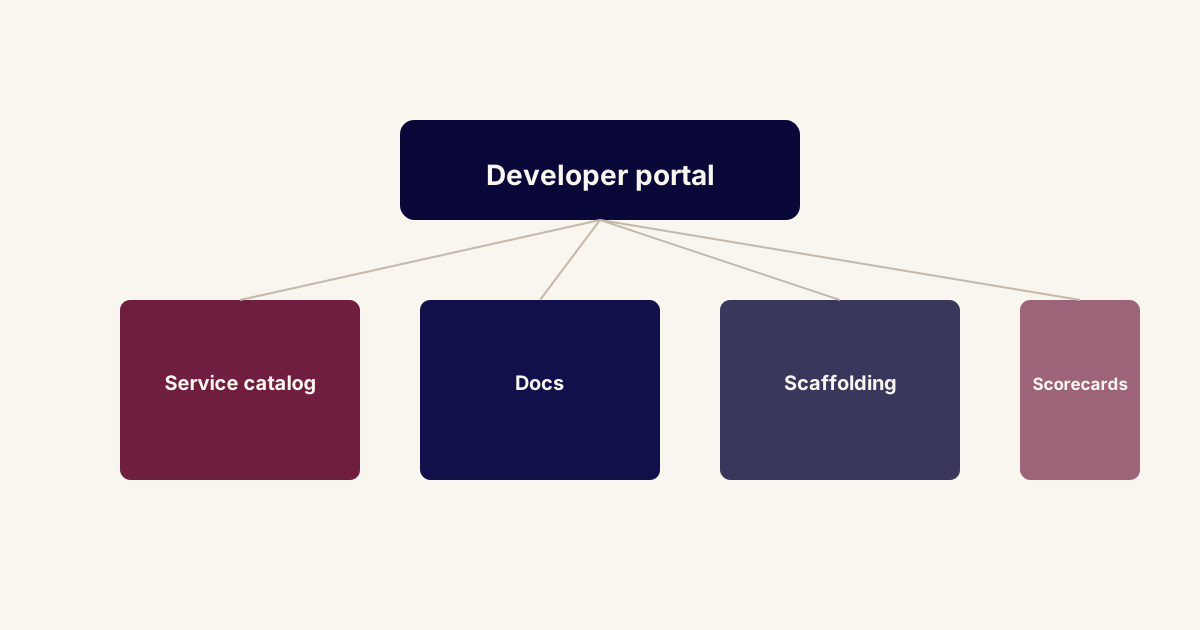
Self-service infrastructure remains the north star capability for platform teams, yet execution varies dramatically. Leading organizations expose infrastructure provisioning through internal developer portals built on Backstage, Port, or custom frameworks. These portals abstract Terraform modules, Kubernetes namespace creation, database provisioning, and secrets injection behind declarative service catalogs. The critical success factor is not the portal technology itself but the depth of automation beneath it. Portals that generate pull requests requiring manual approval negate the velocity gains self-service promises.
We can present findings in a working session, map recommendations to your portfolio and risk register, and help you prioritize next steps with clear owners and timelines.
Guardrails consistently outperformed unbounded choice in our dataset. Teams offered a curated set of compute, storage, and networking primitives with sensible defaults shipped production workloads faster than those given full access to raw cloud provider consoles. This finding challenges the assumption that developer empowerment requires unrestricted access. Instead, the most productive developers in our survey described their ideal platform as one where the safe path is also the fast path, with escape hatches reserved for genuinely novel requirements.
FinOps alignment has become a non-negotiable pillar of platform engineering strategy. Sixty-seven percent of respondents reported that cloud cost visibility is now a formal responsibility of the platform team, up from twenty-nine percent two years ago. Mature organizations embed cost attribution tags at the point of resource provisioning, ensuring that every workload is traceable to a product team, cost center, and business service. This tagging discipline transforms cloud billing from an opaque monthly invoice into an actionable feedback loop for engineering leadership.
The convergence of platform engineering and FinOps manifests most clearly in resource right-sizing automation. Platform teams that integrate continuous profiling data with provisioning policies can recommend or enforce compute adjustments based on actual utilization patterns. Our survey found that organizations practicing automated right-sizing reduced compute waste by an average of thirty-one percent without degrading application performance. The savings compound quickly in regulated industries where conservative initial provisioning is the norm.
Security and compliance integration within internal developer platforms has shifted from afterthought to foundational requirement. Regulated enterprises demand that every golden path include automated vulnerability scanning, software composition analysis, container image signing, and policy-as-code enforcement before any artifact reaches production. Platform teams that bolt security on as a late-stage gate create friction that developers route around. Those that embed compliance checks into the development workflow, surfacing findings in the IDE and pull request review, achieve both higher compliance rates and faster delivery cadence.
Supply chain security received significant investment across our respondent base following high-profile incidents in recent years. Seventy-three percent of surveyed organizations now require signed build provenance for all production artifacts. Platform teams facilitate this by integrating Sigstore, SLSA framework attestations, and software bill of materials generation into their standard CI/CD pipelines. The goal is to make supply chain security invisible to application developers while satisfying auditors and regulators with verifiable, tamper-evident build records.
Observability platform consolidation is another dominant trend. Organizations are moving away from fragmented monitoring stacks toward unified telemetry pipelines built on OpenTelemetry. Platform teams that provide pre-instrumented application templates with distributed tracing, structured logging, and metrics export enabled by default dramatically reduce the time required for new services to reach operational readiness. The best-performing platforms in our study achieved less than fifteen minutes from service scaffold to full observability coverage.
Reliability engineering practices are increasingly codified within platform golden paths. Service level objectives, error budgets, and automated rollback triggers are no longer the exclusive domain of dedicated site reliability teams. Instead, platform teams embed these constructs into deployment pipelines so that every application team inherits baseline reliability controls. Progressive delivery mechanisms such as canary releases and feature flags are offered as platform primitives, lowering the barrier to safe, incremental rollouts across the organization.

Secrets management emerged as a persistent pain point in our interviews. Despite mature solutions from HashiCorp Vault, AWS Secrets Manager, and Azure Key Vault, inconsistent adoption across application teams creates compliance gaps. High-maturity platform organizations solve this by injecting secrets at the platform layer, removing the need for individual teams to integrate directly with a vault client. Workload identity federation, where services authenticate using platform-issued tokens rather than long-lived credentials, is the trajectory that leading enterprises are pursuing.
Cost allocation models that survive external audit remain elusive for many organizations. The challenge lies in attributing shared platform costs, such as Kubernetes control plane overhead, observability infrastructure, and networking egress, fairly across consuming teams. Our research identified three viable models: proportional allocation based on resource consumption metrics, tiered subscription pricing anchored to service level tiers, and a hybrid approach that combines a fixed platform tax with variable usage charges. Each model has trade-offs in accuracy, simplicity, and incentive alignment.
Developer experience measurement is maturing beyond anecdotal satisfaction surveys. Leading platform teams track quantitative metrics including time from repository creation to first production deployment, mean time to recover from a failed deployment, percentage of teams using the golden path without deviation, and the ratio of self-service provisioning to manual requests. These metrics feed quarterly platform roadmap prioritization, ensuring that investment flows toward the capabilities that deliver the greatest developer productivity gains.
Organizational design patterns for platform teams vary by enterprise size and regulatory context. Smaller organizations succeed with a single cross-functional platform team combining infrastructure, security, and developer experience expertise. Larger enterprises typically adopt a federated model where a central platform core team maintains shared primitives while embedded platform engineers in business units customize golden paths for domain-specific requirements. The federated model scales more gracefully but demands strong architectural governance to prevent fragmentation.
Talent acquisition and retention for platform engineering roles present a significant challenge. The discipline requires a rare combination of infrastructure depth, software engineering rigor, product management sensibility, and empathy for developer workflows. Organizations that invest in internal rotation programs, allowing application developers to spend six-month tours on the platform team, build institutional knowledge and create advocates who return to product teams as platform champions. This rotation model also provides a natural feedback mechanism for platform roadmap priorities.
Looking ahead, platform engineering will converge further with AI-assisted development workflows. As code generation tools become standard in enterprise environments, platform teams will need to ensure that generated code adheres to organizational standards, passes security scans, and deploys through approved pipelines. The platform layer is the natural enforcement point for these guardrails. Organizations that position their internal developer platform as the trusted interface between AI-generated artifacts and production infrastructure will capture the productivity benefits of generative AI without sacrificing governance or reliability.