Insights · Report · Industry · May 2026
League blackout rules, CDN policy enforcement, VPN circumvention, and subscriber communications when local rights holders conflict with national DTC apps.

Sports streaming has become one of the most technically demanding segments in digital media. Platforms must enforce intricate territory and blackout matrices across millions of concurrent viewers while delivering frictionless, high-definition experiences on every device category. Rights holders audit compliance with increasing rigor, yet subscribers resent false positives that block legitimate local viewers from watching their home teams. This report examines the policy, infrastructure, and operational strategies that separate reliable rights enforcement from costly subscriber churn.
The complexity of modern sports media rights begins at the contractual layer. League agreements, regional sports network deals, national broadcast windows, and international sublicenses each impose distinct territory restrictions, time-based exclusivity periods, and device-class limitations. A single NFL game, for example, can be subject to local broadcast exclusivity, a national simulcast window, and an international streaming license simultaneously. Each contractual clause must translate into enforceable technical policy without introducing contradictions or coverage gaps.
Translating contractual rights into CDN enforcement rules requires a policy engine that ingests structured rights metadata and produces edge-level access decisions in real time. The rights data model must capture territory polygons, time windows down to the minute, device entitlement classes, and exception carve-outs for authenticated subscribers with verified billing addresses inside the home market. Without a rigorous data model, engineering teams resort to hard-coded rules that become unmaintainable as rights portfolios expand across leagues and seasons.
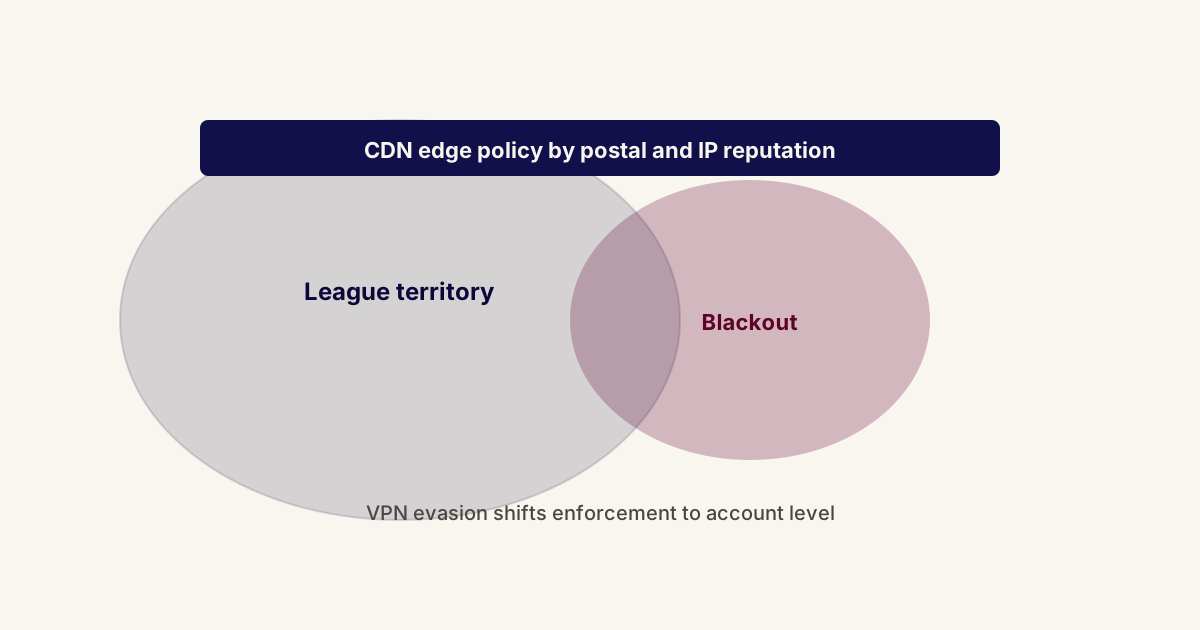
Geofencing accuracy is foundational to the entire enforcement architecture. IP-based geolocation provides a reasonable baseline but introduces significant false-positive risk when subscribers use corporate VPNs, travel frequently, or connect through mobile carrier networks that route traffic through distant gateways. Leading platforms supplement IP signals with billing ZIP code verification, device GPS when available, and historical access pattern analysis to build a composite location confidence score rather than relying on any single data point.
We can present findings in a working session, map recommendations to your portfolio and risk register, and help you prioritize next steps with clear owners and timelines.
VPN and DNS proxy circumvention has evolved from a niche concern into a material compliance risk. Sophisticated proxy services rotate IP addresses, mimic residential traffic patterns, and exploit split-tunneling configurations to evade simple IP blocklists. Edge-only enforcement is no longer sufficient. Platforms must layer account-level velocity checks, session anomaly detection, and behavioral heuristics that flag improbable geographic transitions, such as a subscriber appearing in two cities within minutes, to identify and respond to circumvention attempts without degrading the experience for legitimate users.
The tension between enforcement rigor and subscriber satisfaction demands carefully calibrated escalation paths. Hard blocking a viewer mid-game based on a marginal location signal generates intense negative sentiment and support ticket volume. Best practice involves a tiered response model: soft warnings for ambiguous signals, temporary access grants pending verification, and hard blocks reserved for high-confidence circumvention scenarios. Each tier should map to a distinct customer communication template that explains the restriction, offers a resolution path, and preserves brand trust.
Latency and cache time-to-live decisions interact directly with live rights windows. A stale edge rule that fails to activate a blackout at kickoff, or that persists minutes after a national window closes, creates accidental out-of-market exposure that triggers contractual penalties. Rights policy propagation must operate on a separate, low-latency control plane that updates edge nodes within seconds of a schedule change. Coupling policy distribution to content cache refresh cycles introduces unacceptable drift for live event enforcement.
Live event scheduling itself introduces operational volatility that static configuration cannot absorb. Rain delays, overtime periods, doubleheader shuffles, and last-minute broadcast flex windows all alter the rights enforcement timeline in ways that require dynamic policy updates. Platforms that rely on pre-computed blackout schedules pushed hours before game time are vulnerable to contractual violations during schedule disruptions. Event-driven policy architectures that subscribe to league scheduling feeds and propagate updates in near real time significantly reduce this exposure.
Customer support operations require authoritative entitlement lookup tools that surface the precise reason a subscriber was blocked, the policy rule that triggered the decision, and the available resolution options. Without these tools, agents improvise credits and overrides that create revenue leakage, inconsistent precedent, and audit exposure. A well-designed support console should display the subscriber's composite location score, the applicable rights window, and a decision audit trail that allows the agent to resolve disputes confidently and consistently.
Subscriber communication strategy during blackout events significantly influences churn outcomes. Proactive notifications sent before a scheduled blackout, explaining which alternative broadcast carries the game locally, convert potential frustration into perceived value. Reactive messaging that only appears at stream denial, with no actionable guidance, drives cancellation intent. Communications teams should collaborate with rights operations to maintain a current alternative broadcast guide and integrate it into the denial experience across all client platforms.
Data minimization obligations apply directly to the precise location signals retained for enforcement purposes. Regulations including GDPR, CCPA, and emerging state-level privacy statutes require organizations to justify collection scope, define retention periods, and provide deletion mechanisms for personal location data. Enforcement architectures should compute and store a location confidence category rather than raw GPS coordinates wherever possible, reducing privacy surface area while preserving the signal fidelity needed for blackout decisions. Retention schedules must align with the shortest legally defensible window.

International sublicensing adds a further dimension of enforcement complexity. A league that licenses domestic streaming rights to one platform and international rights to another must ensure that neither platform leaks content into the other's territory. Cross-border enforcement requires coordination between independent CDN configurations, shared rights metadata standards, and mutual audit mechanisms. The absence of a canonical rights registry that both licensees trust often results in conflicting enforcement decisions at national boundaries, particularly in regions with dense border populations.
Mergers, acquisitions, and league reorganizations can reassign territorial rights on compressed timelines. When a regional sports network changes ownership or a league restructures its division geography, hundreds of blackout rules may require simultaneous updates. Configuration management practices borrowed from software deployment, including version-controlled policy files, staged rollouts with canary validation, and automated rollback triggers, reduce the weekend deploy panic that historically accompanies mid-season rights transitions. Immutable policy versioning also simplifies post-event audit and dispute resolution.
Measuring enforcement effectiveness requires metrics that span technical accuracy, subscriber impact, and contractual compliance. False blackout reports per thousand streams quantify the rate at which legitimate viewers are incorrectly denied access. Takedown response time measures how quickly accidental national leaks are remediated once detected. Disputed viewer churn tracks cancellation rates among subscribers who experienced at least one blackout dispute within their billing cycle. Together, these indicators provide a balanced scorecard that prevents over-optimization toward enforcement rigor at the expense of subscriber retention.
Contractual audit readiness is an often-overlooked operational requirement. Rights holders increasingly demand access to enforcement logs that demonstrate blackout activation timing, geographic coverage accuracy, and circumvention detection rates. Platforms that treat audit preparation as a periodic scramble rather than a continuous process risk delayed renewals and unfavorable renegotiation terms. Automated audit report generation, fed by the same telemetry pipeline that powers operational dashboards, transforms compliance from a cost center into a competitive differentiator during rights negotiations.
The convergence of direct-to-consumer league apps with traditional pay-television bundles creates a particularly challenging enforcement scenario. A subscriber who pays for both a national DTC app and a local cable package may encounter conflicting blackout decisions depending on which platform they access. Harmonizing entitlements across these overlapping distribution channels requires a subscriber identity layer that aggregates entitlements from multiple sources and resolves conflicts in favor of the most permissive legitimate access. Without this layer, subscribers perceive the blackout system as arbitrary and punitive.
Looking ahead, the sports media rights landscape will continue to fragment as leagues experiment with per-game pricing, international expansion packages, and social media highlight licensing. Each new distribution model introduces incremental enforcement requirements that compound the complexity of existing policy engines. Organizations that invest now in flexible rights metadata standards, composable enforcement architectures, and subscriber-centric communication frameworks will be positioned to absorb new rights structures without rebuilding their enforcement stack with every contract cycle.