Insights · Report · Research · May 2026
Odds movement monitoring, low-tier match risk, official versus unofficial data contracts, and law enforcement cooperation when manipulation threatens regulated markets.

The global regulated sports betting market continues to expand rapidly, with new jurisdictions launching licensing regimes and consumer protections in 2026. This growth amplifies the importance of betting integrity, the discipline of detecting, investigating, and deterring match manipulation and fraudulent wagering. Integrity failures erode bettor trust, expose operators to regulatory sanctions, and compromise the competitive legitimacy that leagues depend on for broadcast and sponsorship revenue. A mature integrity framework requires the convergence of data engineering, compliance expertise, and law enforcement cooperation.
Modern integrity monitoring architecture begins with the ingestion of real-time event data feeds that capture score changes, game clock events, and in-play statistics. These feeds are consumed by models that establish expected market behavior and flag deviations. Odds movement velocity, volume spikes on obscure proposition bets, and correlated activity across multiple operators form the primary signal categories. The monitoring stack must process thousands of events per second with latency low enough to trigger market suspension before abnormal exposure accumulates.
Official data feeds, supplied under contract by leagues or their authorized distributors, provide the canonical event record that licensed operators use for settlement and live market pricing. These feeds offer lower latency, higher accuracy, and defined contractual remedies compared to unofficial alternatives scraped from broadcast signals or crowd-sourced platforms. However, concentration of supply in a small number of authorized vendors creates dependency risk that operators must address through failover planning and contractual service-level protections.
Unofficial data feeds persist in the market because they often carry lower licensing costs and cover competitions where no official feed exists. The trade-off is increased latency, higher error rates, and the absence of contractual recourse when feed quality degrades during critical moments. Operators that blend official and unofficial sources must implement clear priority hierarchies, reconciliation checks, and automated switching logic that defaults to the most authoritative source available for each competition tier.
Odds movement monitoring represents the first line of defense against market manipulation. Integrity analysts track the magnitude and velocity of line movements across pre-match and in-play markets, comparing observed shifts against historical norms for comparable fixtures. Sudden, sustained movement in a single direction, particularly on low-liquidity markets or when unaccompanied by public information such as injury news, warrants escalation. Effective monitoring requires access to cross-market odds data from multiple operators to distinguish informed betting from manipulation.
We can present findings in a working session, map recommendations to your portfolio and risk register, and help you prioritize next steps with clear owners and timelines.
Beyond headline odds shifts, market microstructure analysis examines bet placement timing, stake distribution, and account clustering patterns. Coordinated wagering by multiple accounts placing identical selections within a narrow time window suggests syndicate activity. Correlation engines that link accounts by device fingerprint, payment method, and behavioral cadence improve detection precision. These systems must balance sensitivity to catch genuine threats with specificity to avoid overwhelming analysts with false positives that erode operational confidence.
Low-tier competitions present disproportionate integrity risk. Matches in lower football divisions, regional tennis circuits, and amateur esports leagues typically feature lower officiating standards, limited broadcast scrutiny, and athlete compensation that may be insufficient to deter corruption. Operators offering markets on these events should apply tighter stake caps, reduced maximum payouts, and heightened monitoring thresholds. Automated rules that restrict live betting availability on competitions with known data latency issues further reduce exposure to manipulation exploiting informational asymmetry.
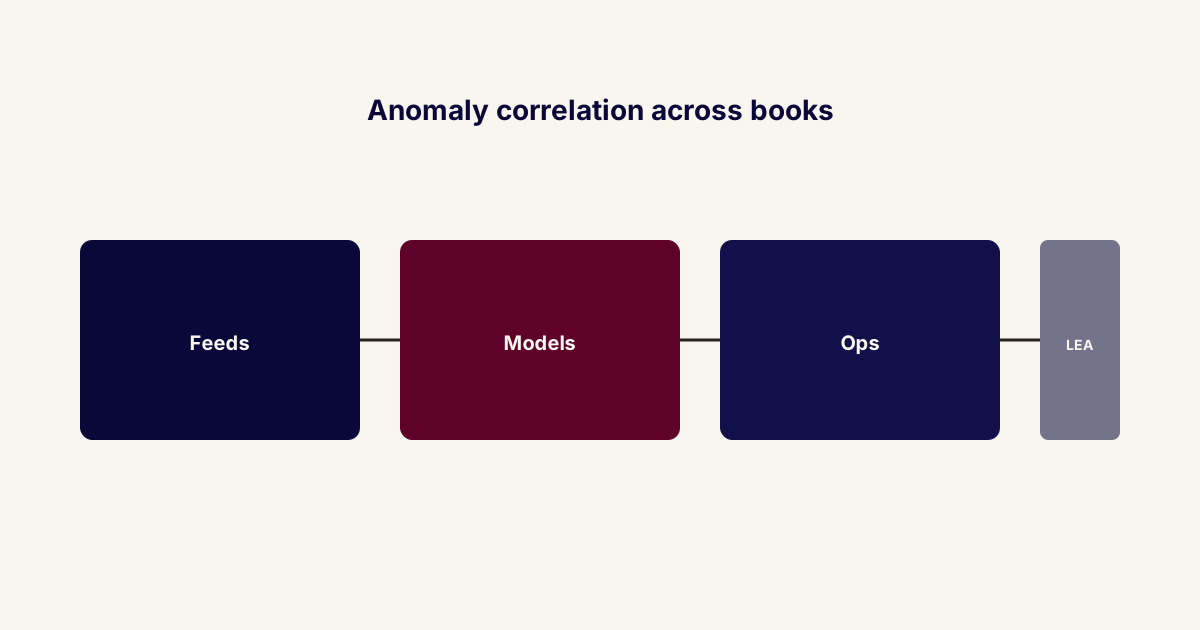
Cross-operator intelligence sharing amplifies the effectiveness of individual monitoring programs. Suspicious betting patterns that appear insignificant on one platform may become clearly anomalous when combined with data from peers. Industry bodies such as the International Betting Integrity Association facilitate secure, pseudonymized data exchanges that respect competition law and data protection requirements. Operators that participate in collaborative sharing networks gain broader visibility while contributing to a collective defense that raises the cost of manipulation across the entire regulated market.
Regulatory frameworks increasingly mandate integrity cooperation between operators, leagues, and government agencies. Licensing conditions in jurisdictions such as the United Kingdom, New Jersey, and Ontario require operators to report suspicious activity within defined timeframes. Regulators consolidate these reports, identify cross-operator patterns, and coordinate with law enforcement when criminal thresholds are met. Operators should maintain documented referral procedures that specify escalation criteria, evidence packaging standards, and communication protocols for interaction with regulatory investigators.
Evidence packages prepared for law enforcement must meet standards that differ substantially from internal risk assessments. Investigators require chain-of-custody documentation, timestamped transaction logs with cryptographic integrity proofs, and narrative summaries that explain betting market mechanics in terms accessible to prosecutors and judges. Integrity teams that invest in evidence preparation templates and maintain relationships with specialist law enforcement units accelerate the path from detection to criminal prosecution, strengthening the deterrent effect that protects the broader market.

Machine learning models increasingly assist with alert triage by scoring incoming signals against historical manipulation cases and known benign patterns. Supervised models trained on confirmed integrity breaches can prioritize alerts with the highest likelihood of true positives, reducing analyst workload and improving response times. However, model outputs should serve as decision support rather than autonomous triggers for market suspension. Human analysts retain authority on edge cases where reputational consequences, contractual obligations, or regulatory sensitivities demand nuanced judgment.
Integrity monitoring necessarily involves the analysis of bettor behavior, creating tension with data protection and privacy frameworks. Operators must ensure that surveillance activities have a clear legal basis, whether through legitimate interest provisions, regulatory mandates, or explicit consent mechanisms. Data sharing agreements with leagues and fellow operators require careful review to confirm compliance with cross-border transfer restrictions, purpose limitation principles, and retention policies. Legal counsel should approve every data sharing arrangement before activation.
When integrity concerns require market voiding or result withholding, customer communications become a critical operational discipline. Bettors expect prompt, transparent explanations, yet operators must avoid disclosing investigation details that could compromise ongoing inquiries. Pre-approved communication templates that provide factual information without speculative commentary help customer service teams respond consistently under pressure. Social media monitoring should accompany every integrity event, as rumors propagate faster than formal investigations can produce conclusions, demanding proactive narrative management.
Measuring integrity program effectiveness requires a balanced scorecard that combines operational and outcome metrics. Alert precision, defined as the ratio of true positives to total alerts generated, indicates model quality. Time to suspend a suspicious market measures operational responsiveness. Post-event validation, comparing model flags against confirmed manipulation outcomes, tracks detection accuracy over time. False negative analysis, reviewing events later identified as manipulated that the system failed to flag, reveals blind spots requiring model retraining or data source expansion.
Vendor due diligence for data feed providers should extend beyond technical latency benchmarks to encompass financial resilience, business continuity planning, and geographic coverage depth. A provider that collapses mid-season leaves operators scrambling for alternatives with incomplete historical baselines. Contract provisions should include data escrow arrangements, performance penalty clauses linked to accuracy metrics, and defined exit assistance obligations. Operators benefit from maintaining relationships with at least two qualified data providers for every competition tier they actively offer.
Looking ahead, the convergence of higher regulatory expectations, more sophisticated manipulation techniques, and expanding market coverage will demand continuous investment in integrity infrastructure. Operators should prioritize three areas in 2026 and beyond: strengthening cross-operator data sharing through standardized alert formats, embedding machine learning into alert triage workflows with robust human oversight, and building evidence preparation capabilities that accelerate law enforcement referrals. Organizations that treat integrity as a strategic differentiator rather than a compliance burden will earn both regulatory favor and consumer trust.