Insights · Report · Cloud · Apr 2026
Region selection, encryption key custody, admin access boundaries, and exit planning when sovereignty requirements intersect with multi-region architectures.

Sovereign cloud offerings have proliferated rapidly as regulators across the European Union, Southeast Asia, the Middle East, and Latin America codify expectations for data residency, operational control, and lawful access boundaries. Hyperscale providers now maintain dedicated sovereign regions, and a growing cohort of national and regional operators positions sovereignty as a core differentiator. Yet buyers continue to struggle with inconsistent definitions, conflating where data physically resides with who can administer it, which subprocessors touch it during an incident, and under which jurisdiction a court order compels disclosure.
This playbook provides a structured operating framework for organizations navigating sovereignty requirements in multi-region cloud architectures. It consolidates field experience from regulated industries including financial services, healthcare, public sector, and critical infrastructure into repeatable decision models, reference patterns, and governance checklists. The goal is not to prescribe a single architecture but to equip technology leaders with the classification discipline and operational rigor needed to satisfy regulators without sacrificing engineering velocity or inflating cloud costs beyond defensible thresholds.
The first step in any sovereignty program is distinguishing hard legal mandates from risk preferences. Data residency laws vary dramatically in scope and enforcement. Some jurisdictions require that personal data of citizens remain within national borders at rest and in transit. Others focus solely on government data or specific sectors such as healthcare records and financial transactions. Mislabeling a risk preference as a hard regulatory constraint drives expensive infrastructure duplication, brittle failover topologies, and operational complexity that compounds over time with every new workload onboarded to the platform.
The playbook opens with a decision tree that classifies each data category against its applicable regulatory regime, the jurisdictions of end users, and the sensitivity tier assigned by the organization's own data governance framework. This classification exercise produces a residency map that dictates region selection, replication boundaries, and metadata handling rules. Without this upfront investment, teams default to the most restrictive interpretation for every workload, a pattern that inflates costs by 30 to 50 percent in our benchmarking studies without delivering proportional risk reduction.
We can present findings in a working session, map recommendations to your portfolio and risk register, and help you prioritize next steps with clear owners and timelines.
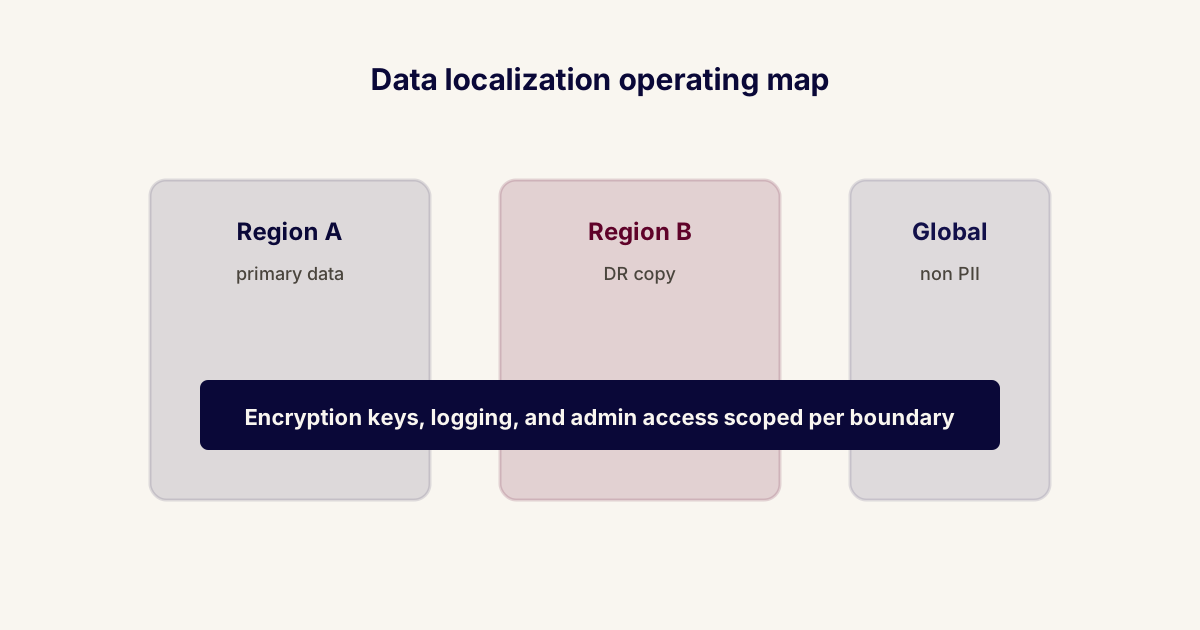
Region selection itself requires evaluating factors beyond geographic proximity. Availability zone density, interconnect latency to primary user populations, the provider's subprocessor list for that specific region, and the legal entity that operates the data center all influence whether a region truly satisfies sovereignty requirements. Several hyperscalers operate sovereign regions through local joint ventures or government-partnered entities, which changes the contractual chain of custody. Buyers should map each candidate region against a standardized scorecard that weights legal compliance, operational capability, and commercial terms equally.
Encryption key management receives dedicated treatment because it represents the single most consequential technical control in a sovereignty architecture. Customer-managed encryption keys stored in hardware security modules within the sovereign jurisdiction ensure that the cloud provider cannot decrypt data at rest without explicit customer involvement. Double encryption layering, where the provider wraps data with its own key and the customer applies a second layer, adds defense in depth but complicates key rotation procedures. Organizations must document key ceremony protocols, define quorum requirements for key generation and recovery, and rehearse scenarios where a key custodian is unreachable during a production incident.
Hardware security module placement deserves careful planning. Deploying HSMs in the same sovereign region as the workloads they protect satisfies residency expectations, but teams must also address backup key material storage, cross-region disaster recovery for the HSM cluster itself, and latency introduced by cryptographic operations on the critical path of transactional workloads. Cloud-native key management services with regional isolation options offer a simpler operational model, though some regulators require dedicated HSM tenancy rather than multi-tenant managed services. The playbook includes a comparison matrix covering six major HSM deployment models.
Administrative access is the hidden residency leak that undermines otherwise well-architected sovereign deployments. Break-glass accounts held by global operations teams, vendor support engineers with cross-region diagnostic access, and observability pipelines that aggregate telemetry into a central region outside the sovereignty boundary all represent vectors through which administrative metadata or customer data can traverse jurisdictional borders. Organizations must define explicit access policies that restrict administrative operations to personnel and systems located within approved jurisdictions, and enforce those policies through identity provider controls, conditional access rules, and just-in-time privilege elevation workflows.
Tabletop exercises should include scenarios where a foreign administrative path must be disabled instantly. Simulating an incident in which the only available on-call engineer sits outside the sovereign jurisdiction tests whether escalation procedures, backup personnel rosters, and automated access revocation mechanisms function under pressure. These exercises consistently reveal gaps in runbooks, particularly around vendor support workflows where the provider's own incident response team may operate from a jurisdiction the customer has not approved.
Logging and monitoring architectures often default to global aggregation for operational convenience. Centralized SIEM platforms, unified dashboards, and cross-region log shipping pipelines deliver powerful observability but can violate residency constraints when metadata, access logs, or diagnostic traces flow outside approved boundaries. The playbook details patterns for federated log collection that keeps raw telemetry within the sovereign region while forwarding only aggregated, anonymized signals to a central operations hub. This approach preserves SRE effectiveness without exposing regulated data to unauthorized jurisdictions.
Metadata itself requires classification. Request headers, database query logs, user session identifiers, and application performance traces can contain personal data or reveal patterns that regulators consider sensitive. Teams should audit their telemetry pipelines to identify which fields constitute regulated data under applicable law, then apply redaction, tokenization, or regional containment rules accordingly. Overlooking metadata residency is one of the most common compliance gaps our assessments uncover, and it frequently surfaces during regulatory audits as a finding that is both embarrassing and expensive to remediate after the fact.
Disaster recovery must respect sovereignty boundaries without exception. A failover region that violates residency requirements defeats the purpose of the primary region's careful architectural controls. Organizations need warm standby configurations that remain within approved jurisdictions, which may limit the geographic diversity available for resilience. The playbook documents three reference patterns for sovereign disaster recovery: intra-country zone failover for nations with multiple availability zones, bilateral treaty region pairing for jurisdictions with mutual adequacy agreements, and degraded-mode local operation for scenarios where no compliant secondary region exists.

Recovery time and recovery point objectives must be recalibrated for sovereign constraints. Synchronous replication across jurisdictional borders is typically prohibited, which means recovery point objectives for cross-region failover default to asynchronous replication lag windows. Teams should quantify acceptable data loss in business terms, test failover procedures quarterly, and maintain documented evidence of recovery capability for regulatory review. Regulators increasingly expect not just a disaster recovery plan but demonstrable proof that the plan functions within sovereignty constraints under realistic failure conditions.
Exit planning is non-negotiable in any sovereign cloud engagement. Contracts should describe portable data formats, minimum viable export throughput rates, assistance obligations during termination, and the timeline within which the provider must certify deletion of all customer data and metadata. Sovereignty without exit rights merely trades one dependency for another. Organizations should conduct annual portability drills that validate export procedures, confirm data format compatibility with alternative platforms, and measure actual transfer rates against contractual commitments.
Vendor lock-in risk intensifies in sovereign deployments because the pool of compliant providers is inherently smaller than the global market. Proprietary managed services, region-specific APIs, and platform features available only in sovereign editions all increase switching costs. Mitigation strategies include maintaining canonical data models in version-controlled repositories independent of any provider, abstracting provider-specific services behind stable internal interfaces, and periodically validating that critical workloads can execute on at least one alternative compliant platform.
AI and machine learning workloads introduce a particularly complex sovereignty dimension. Model training pipelines may inadvertently copy datasets across regional boundaries when distributed compute clusters span multiple zones. Inference endpoints that cache prompt context or log input-output pairs for model improvement can create secondary data stores outside the sovereign perimeter. Purpose-built AI zones with private endpoints, network-level egress restrictions, and data loss prevention controls reduce the probability that a well-meaning engineer moves a regulated dataset to the wrong subscription or tenant.
Organizations should establish clear policies for where training data resides, which regions host inference compute, and how model artifacts are versioned and stored. Federated learning techniques that keep raw data local while sharing only model weight updates offer a promising architectural pattern for sovereignty-constrained AI programs, though the maturity of available tooling varies significantly across cloud providers. The playbook includes an evaluation framework for assessing federated learning readiness across five dimensions: data sensitivity, model complexity, compute availability, regulatory acceptance, and operational maturity.
Organizational readiness determines whether a sovereign cloud program delivers lasting compliance or devolves into a checkbox exercise. Cross-functional governance boards that include legal, compliance, security, infrastructure, and application development representation should own the sovereignty policy framework and review exceptions quarterly. Platform engineering teams need dedicated tooling for automated compliance scanning that detects residency violations at deployment time rather than during periodic audits. Training programs should ensure that every engineer who provisions infrastructure understands the sovereignty boundaries applicable to their workloads and the consequences of misconfiguration.
Looking ahead, sovereignty requirements will intensify as more jurisdictions enact data localization statutes and existing regulations expand in scope. Organizations that invest now in classification discipline, encryption key governance, administrative access controls, and portable architecture patterns will navigate this evolving landscape with confidence. Those that treat sovereignty as a one-time compliance project rather than a continuous operational capability will find themselves repeatedly scrambling to remediate gaps under regulatory pressure, at significantly higher cost and risk than a proactive, well-governed program demands.