Insights · Report · Security · Apr 2026
Segmentation, remote access, patch discipline, and supplier risk for plants adopting Industry 4.0 analytics without inviting ransomware to the PLC layer.

Manufacturing modernization is accelerating across every vertical, pushing telemetry collection, predictive maintenance algorithms, and ERP integration closer to the plant floor than ever before. Legacy OT networks were designed for isolated, deterministic communication between controllers, sensors, and actuators. They were never intended to sit adjacent to internet-routable traffic or cloud-bound data pipelines. When organizations pursue convergence without deliberate architecture, they create lateral movement paths that allow IT-originated incidents to propagate directly into safety-critical control systems, threatening both operational continuity and physical safety.
The consequences of inadequate segmentation are no longer theoretical. Ransomware campaigns targeting manufacturing have surged in frequency and sophistication since 2023, with attackers specifically seeking footholds that bridge corporate networks into production environments. A compromised engineering workstation with access to both the enterprise domain and a PLC programming interface becomes the pivot point for attacks that can halt assembly lines, corrupt batch recipes, or disable safety interlocks. Security leaders in manufacturing must treat convergence as an architectural discipline, not merely a networking convenience enabled by dropping firewalls between zones.
This report provides a structured framework for securing the OT and IT boundary in smart manufacturing environments. It draws on field assessments conducted across discrete and process manufacturing facilities and maps controls to the Purdue Enterprise Reference Architecture, IEC 62443 zone and conduit models, and pragmatic operational constraints that plant managers face daily. The guidance applies equally to greenfield smart factory deployments and brownfield retrofits where legacy controllers coexist with modern edge computing platforms.
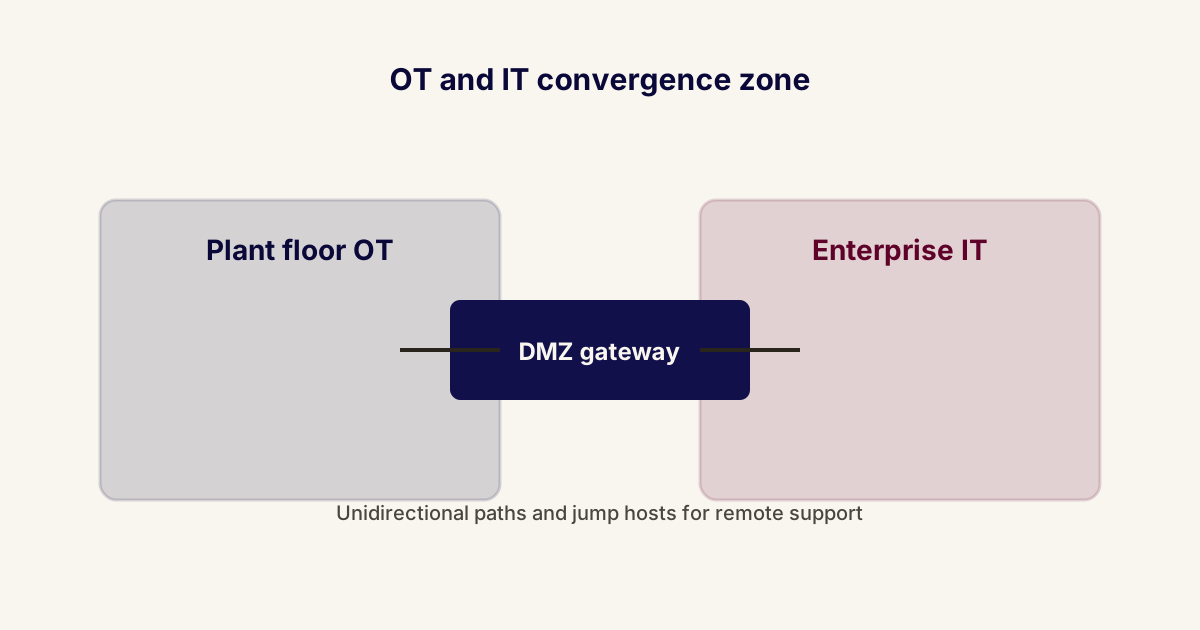
The Purdue model organizes plant infrastructure into hierarchical levels, from Level 0 physical processes through Level 4 enterprise systems. Effective security segmentation enforces strict traffic rules at each level boundary. Level 0 and Level 1, encompassing sensors, actuators, and basic controllers, should only communicate upward to Level 2 supervisory systems through deterministic, allowlisted protocols. Level 3 manufacturing execution systems serve as the natural demarcation zone between operations technology and enterprise IT. Traffic crossing this boundary should traverse a well-monitored industrial DMZ that permits only specific, authenticated application flows.
We can present findings in a working session, map recommendations to your portfolio and risk register, and help you prioritize next steps with clear owners and timelines.
Micro-segmentation within each Purdue level provides defense in depth beyond perimeter controls. Grouping controllers by production cell, isolating safety instrumented systems on dedicated network segments, and enforcing protocol-level filtering at switch ports collectively limit the blast radius of any single compromise. Organizations that rely solely on a single firewall between IT and OT overlook the reality that threats can originate inside the plant from rogue USB devices, compromised vendor laptops, or misconfigured wireless access points deployed for convenience without security review.
Remote access represents the highest-risk convenience in converged manufacturing environments. Vendor maintenance sessions, contractor troubleshooting, and cloud-based analytics dashboards all require connectivity paths that, if poorly governed, create persistent tunnels into the most sensitive layers of the control network. Standing VPN connections from external parties directly to programmable logic controllers should be prohibited except under extraordinary circumstances, and even then should trigger real-time alerts. The recommended approach combines just-in-time credential elevation, session recording with full packet capture, explicit multi-party approval workflows, and automatic session termination after defined time windows.
Cloud connectivity for analytics and digital twin platforms introduces a distinct remote access challenge. Plant data flowing to cloud-hosted machine learning models or visualization dashboards must traverse a unidirectional or tightly controlled outbound path. Inbound command channels from cloud services back to plant controllers should be avoided wherever possible. Where bidirectional communication is genuinely required, it should pass through a protocol-breaking proxy in the industrial DMZ that validates every instruction against an allowlist of safe operations. This pattern prevents cloud-side compromises from cascading into physical process manipulation.
Patching OT assets demands a fundamentally different cadence and risk calculus than enterprise IT patch management. Controllers running real-time operating systems or proprietary firmware cannot be rebooted on a monthly schedule without coordinating with production planning, validating patch compatibility in a staging environment, and securing rollback procedures. The maturity model in this report distinguishes four tiers of patch readiness, from organizations that apply no patches and rely entirely on network isolation, through those with validated staging environments and automated deployment pipelines synchronized to planned maintenance windows.
Compensating controls become essential when patches cannot be applied promptly. Application allowlisting on HMI stations and engineering workstations prevents unauthorized executables from running even when underlying operating systems remain unpatched. Network isolation through VLAN segmentation and host-based firewalls limits the reachability of vulnerable assets. Intrusion detection signatures tuned to known exploit patterns for specific controller firmware versions provide early warning while patch validation proceeds. These layered compensating measures reduce residual risk to acceptable levels without forcing premature patching that could destabilize production processes.
Supplier and third-party risk extends well beyond traditional IT vendor management in manufacturing contexts. Firmware updates for PLCs, drives, and safety controllers arrive through channels that often bypass standard IT change management. Embedded certificates, cryptographic keys, and communication libraries within controller firmware create a supply chain attack surface that most organizations do not inventory. Procurement teams should require software bill of materials documentation for critical controllers, mandate vulnerability disclosure timelines in vendor contracts, and include incident notification clauses that align with the same expectations placed on enterprise software providers.

Detection engineering for OT environments differs substantially from corporate SIEM configurations. Standard IT security monitoring focuses on authentication anomalies, endpoint telemetry, and network flow analysis. OT detection must additionally capture physical process anomalies such as unexpected temperature deviations, valve position changes outside recipe parameters, and motor speed fluctuations that could indicate controller manipulation. Unexpected PLC program downloads, HMI configuration changes, and firmware update attempts outside approved maintenance windows all warrant high-priority alerting with operations context that enables rapid triage by personnel who understand both the cyber and physical implications.
Building an effective OT security operations capability requires bridging the cultural and organizational gap between IT security teams and plant operations staff. Security analysts who lack manufacturing process knowledge cannot effectively triage alerts about control system behavior. Conversely, control engineers who dismiss cybersecurity concerns as IT overhead leave critical vulnerabilities unaddressed. The recommended model establishes a converged security operations center with analysts cross-trained in both domains, supported by runbooks that map detection signatures to specific operational impacts and predefined response actions approved by plant management.
Workforce preparation through joint OT and IT tabletop exercises is essential for incident response readiness. Scenarios should test decision authority conflicts that arise when IT security wants to quarantine a network subnet that also carries safety-critical telemetry. Plant operators must practice isolating compromised zones while maintaining safe shutdown capabilities. Exercises should include supply chain compromise scenarios where a trusted vendor update introduces malicious code, forcing teams to coordinate forensic investigation, vendor communication, and production continuity simultaneously under time pressure.
Regulatory and compliance alignment provides additional structure for OT security programs but should not be treated as the ceiling for protection. IEC 62443 offers the most comprehensive framework for industrial automation security, with requirements spanning component, system, and organizational maturity levels. NIST Cybersecurity Framework mappings help organizations communicate OT risk in language that enterprise risk committees understand. Sector-specific regulations in pharmaceuticals, food and beverage, and energy add further requirements around data integrity, safety system independence, and reporting timelines that security programs must incorporate.
Closing recommendations emphasize that sustainable OT security programs must align with production realities. Security initiatives that ignore maintenance calendars, demand unplanned downtime for patching, or restrict operator access without adequate alternatives will lose plant sponsorship and quietly erode over time. The most effective programs earn operational trust by demonstrating that security controls improve visibility into plant health, reduce unplanned downtime caused by cyber incidents, and protect the reliability metrics that plant managers are measured against. Security framed as a production enabler, rather than an overhead burden, gains the sustained executive investment required for long-term resilience.