Insights · Report · Security · May 2026
Telemetry and command segmentation, supply chain assurance for radios and FPGAs, and coordination with commercial space traffic when cyber events resemble interference.

Space systems represent some of the most complex distributed cyber-physical architectures in operation today. Ground segments, comprising mission operations centers, telemetry tracking and command stations, data processing facilities, and network interconnects, carry the majority of the attack surface. Adversaries recognize that compromising a ground network is significantly easier than interfering with a hardened satellite in orbit, making terrestrial infrastructure the primary vector for space-related cyber incidents.
The threat landscape for satellite ground segments has intensified considerably over the past three years. Nation-state actors have demonstrated the capability and willingness to target space infrastructure, as evidenced by incidents involving European broadband satellite networks at the onset of geopolitical conflicts. Criminal groups have also expanded their interest, viewing space operators as high-value ransomware targets with limited tolerance for downtime and strong incentives to pay for rapid recovery.
This report provides a structured framework for satellite operators, ground station vendors, and their cybersecurity teams to assess and strengthen cyber resilience across the ground segment. It addresses network segmentation, cryptographic key lifecycle management, hardware supply chain assurance, cyber-RF situational awareness integration, cloud ground station trust models, and incident disclosure protocols. The analysis draws on operational lessons from both defense and commercial space programs.
Network segmentation between mission operations, ground station equipment, corporate IT, and customer data distribution pathways forms the foundational layer of ground segment cyber defense. Flat network architectures that permit lateral movement between these domains invite catastrophic compromise scenarios where ransomware deployed through a phishing email on a corporate workstation propagates into mission-critical command and control systems. Strict segmentation with monitored jump hosts and unidirectional data diodes mitigates this risk class effectively.
Mission operations networks require the most stringent isolation. These environments handle spacecraft commanding, telemetry processing, orbit determination, and maneuver planning. Access controls should enforce role-based permissions with multi-factor authentication for all operator sessions. Dedicated privileged access workstations that cannot browse the internet or receive email eliminate the most common initial access vectors. Network monitoring within mission operations zones should flag any traffic pattern that deviates from the established baseline of ground-to-space communication protocols.
We can present findings in a working session, map recommendations to your portfolio and risk register, and help you prioritize next steps with clear owners and timelines.
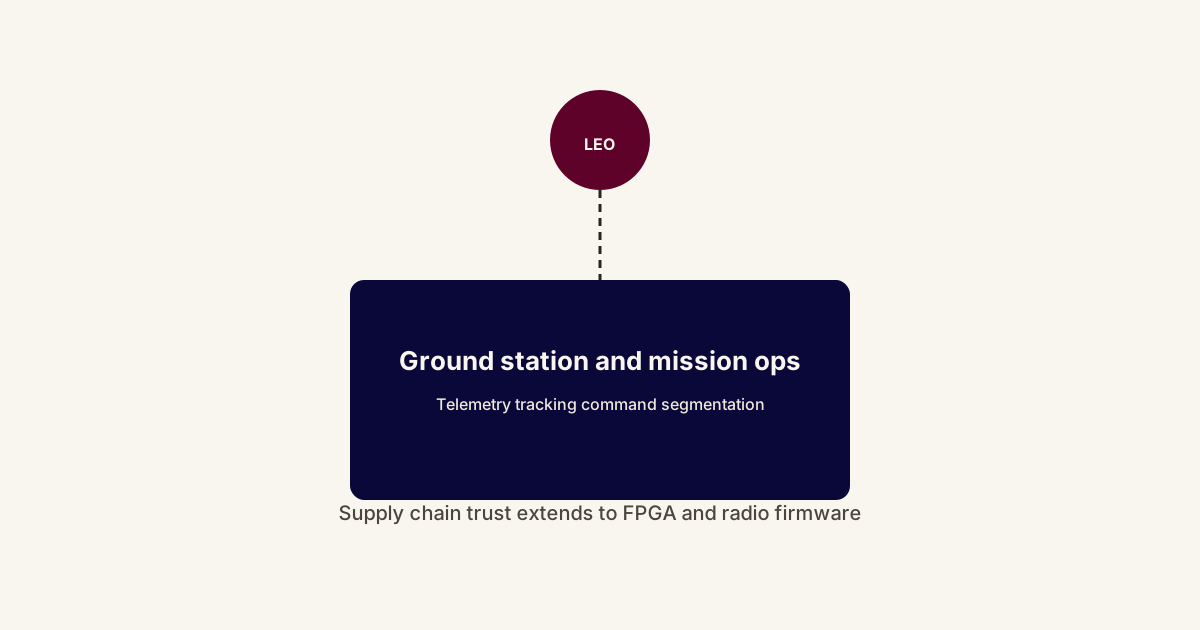
Ground station radio frequency equipment and signal processing hardware occupy a distinct security zone bridging physical and digital domains. Antenna control units, frequency converters, modems, and baseband processors must be inventoried and hardened against unauthorized firmware modification. Configuration management for this equipment should track every software version and patch applied, with cryptographic verification of update packages before installation. Unauthorized changes to modem configurations can redirect or corrupt uplink commands without triggering traditional IT security alerts.
Cryptographic key management for command authentication demands rigorous lifecycle planning that extends from key generation through distribution, rotation, and eventual revocation. Command uplink encryption prevents adversaries from injecting unauthorized instructions into spacecraft, making key compromise a mission-ending event. Key ceremonies should follow documented procedures with dual-person integrity controls, and key material must be stored in hardware security modules rated to appropriate assurance levels. Revocation procedures must account for personnel departures, vendor contract terminations, and firmware rotation schedules.
Organizations frequently underestimate the operational complexity of maintaining cryptographic agility across multi-satellite constellations. Each spacecraft may require unique command encryption keys, telemetry decryption keys, and inter-satellite link authentication credentials. Ground segment key management systems must scale to handle hundreds or thousands of active key pairs while maintaining audit trails that satisfy both internal governance requirements and regulatory obligations. Automating key rotation wherever possible reduces the risk of human error that manual processes inevitably introduce at operational tempo.
Hardware supply chain assurance for radios and field-programmable gate arrays represents a critical but often neglected dimension of ground segment security. FPGAs used in signal processing and modem functions are reconfigurable, meaning a compromised bitstream loaded during manufacturing or maintenance could introduce covert backdoor functionality. Commercial satellite operators should adopt supply chain integrity practices adapted from defense industrial standards, including component provenance documentation, tamper-evident packaging, and independent verification of delivered firmware images against reference builds.
Vendor risk management extends beyond initial procurement to encompass the entire lifecycle of ground segment components. Maintenance contracts that grant vendors remote access to ground station equipment create persistent access pathways that adversaries can exploit through supply chain compromise of the vendor itself. Organizations should enforce least-privilege access for vendor support sessions, require multi-factor authentication, record all remote sessions for audit, and segment vendor access networks from operational mission systems. Periodic vendor security assessments should validate that these controls remain effective.
Situational awareness in satellite operations traditionally focuses on RF spectrum monitoring, tracking signal interference, jamming, and unintentional frequency conflicts. Cyber situational awareness adds a complementary dimension by correlating network security telemetry with RF anomaly data. Some ground segment incidents initially present as signal interference but originate from compromised software that alters modem parameters or corrupts telemetry processing algorithms. Integrating cyber and RF monitoring into a unified common operating picture enables operators to distinguish between electromagnetic threats and software-origin anomalies more rapidly.
Building an effective cyber-RF fusion capability requires investment in both technology and organizational structure. Security operations center analysts typically lack RF engineering expertise, while satellite operations engineers rarely possess cybersecurity training. Cross-functional teams staffed with personnel who understand both domains, or structured analyst exchange programs between security and operations centers, close this knowledge gap. Shared dashboards that overlay network intrusion detection alerts with spectrum monitoring data give both teams simultaneous visibility into correlated events that neither could identify independently.
Cloud ground station as a service offerings from major infrastructure providers have transformed the economics of satellite communications. Operators can now lease antenna time and signal processing capacity without building or maintaining physical ground stations. This model shifts trust boundaries substantially. Threat models must account for multi-tenant isolation risks where multiple operators share physical antenna infrastructure, provider administrative access to signal processing pipelines, and the shared responsibility demarcation between provider infrastructure security and operator application security.
Organizations adopting cloud ground station services should negotiate contractual provisions that address security incident notification timelines, forensic evidence preservation obligations, and the right to conduct independent security assessments of shared infrastructure. Standard cloud service agreements rarely accommodate the unique requirements of satellite command and control workloads. Legal and security teams must collaborate to define acceptable risk thresholds and ensure that service level agreements explicitly address scenarios where a cybersecurity incident at the provider level could disrupt mission operations.
Incident disclosure for satellite ground segment compromises intersects national security considerations, commercial contractual obligations, and regulatory reporting requirements in ways that few other industries experience. A cyber incident affecting a dual-use satellite constellation may simultaneously trigger classified government notification channels, commercial customer breach notification obligations, and securities disclosure requirements. Pre-agreed communication decision trees that assign authority for each disclosure pathway reduce the risk of contradictory public statements, delayed notifications, or inadvertent classification spillage during high-pressure incident response.
Regulatory frameworks governing space cybersecurity continue to evolve rapidly across multiple jurisdictions. The United States Space Policy Directive on cybersecurity establishes baseline expectations for space system operators, while European and allied nations develop complementary requirements. Satellite operators with global customer bases must monitor and reconcile these overlapping regulatory obligations. Compliance mapping exercises that identify common control requirements across jurisdictions reduce duplicative effort and provide a unified governance baseline that satisfies multiple regulatory regimes simultaneously.
Workforce development remains one of the most significant constraints on space cybersecurity maturity. The intersection of satellite operations, RF engineering, and cybersecurity expertise is exceptionally narrow, and competition for qualified personnel is intense across government and commercial sectors. Organizations should invest in structured cross-training programs that develop hybrid competencies, establish partnerships with universities offering space cybersecurity curricula, and create career progression pathways that incentivize long-term retention of personnel with this rare combination of domain skills.
Tabletop exercises provide a low-risk mechanism for testing ground segment incident response plans against realistic threat scenarios. This report includes structured exercise frameworks covering malicious command injection attempts, loss of telemetry during simultaneous IT network outages, ransomware propagation across segmentation boundaries, and coordinated supply chain compromise affecting multiple ground station vendors. Regular execution of these exercises, with participation from technical staff, executive leadership, legal counsel, and communications teams, builds the organizational muscle memory required for effective real-world response.
Looking ahead, satellite ground segment cybersecurity will grow more complex as constellations scale, autonomous operations reduce human oversight, and adversary capabilities continue to advance. Organizations that invest now in disciplined network segmentation, cryptographic key lifecycle management, hardware supply chain integrity, integrated cyber-RF situational awareness, and mature incident response frameworks will establish the resilience foundation necessary to operate through contested space environments. The ground segment is where space cybersecurity is won or lost, and the window for proactive investment is narrowing.