Insights · Report · Data & AI · Apr 2026
How product, legal, and risk teams review AI-powered features before launch so public statements stay substantiated and supervision-ready.

Marketing teams face mounting pressure to label every product feature as intelligent, predictive, or autonomous. At the same time, regulators and plaintiffs' counsel are increasingly comparing public claims against actual model behavior, training data provenance, and output reliability metrics. The gap between promotional language and technical reality creates material legal exposure that traditional marketing review processes were never designed to address. Organizations that treat customer-facing AI copy as part of the model risk boundary, rather than a downstream communications exercise, are better positioned to withstand regulatory scrutiny.
The urgency is compounded by an accelerating enforcement landscape. The FTC has issued consent orders targeting AI performance claims that lacked substantiation. The EU AI Act introduces transparency obligations that extend to how AI capabilities are represented in commercial materials. National authorities in the United Kingdom, Canada, and Australia have published guidance linking advertising standards to algorithmic accountability. Companies marketing AI-powered products across multiple jurisdictions face a patchwork of requirements that demand coordinated governance rather than ad hoc legal review.
A central failure mode is the disconnect between the teams that build models and the teams that describe them. Data scientists optimize for precision, recall, and fairness metrics. Marketing teams optimize for engagement, differentiation, and conversion. Without a shared vocabulary and structured review process, technically accurate performance characteristics get translated into superlatives that regulators interpret as unsubstantiated promises. Bridging this translation gap requires a governance mechanism that brings both perspectives into a single decision framework before any claim reaches the public.
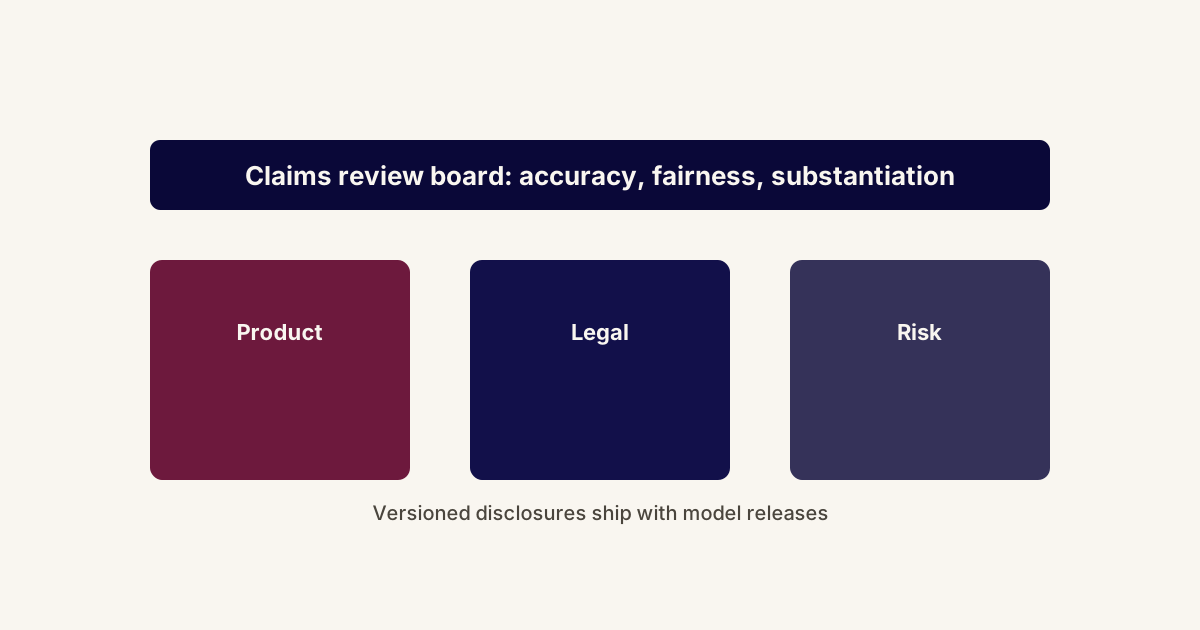
We recommend establishing a claims review board with representation from product management, legal counsel, marketing leadership, and model risk oversight. This board should convene at defined milestones in the product launch cycle, not as a last-minute gate but as a collaborative design partner. Early engagement allows the board to shape messaging direction while evidence is still being compiled, reducing costly late-stage rewrites and launch delays that frustrate both engineering and go-to-market teams.
We can present findings in a working session, map recommendations to your portfolio and risk register, and help you prioritize next steps with clear owners and timelines.
The claims review board should operate under a published charter that defines scope, escalation authority, and decision timelines. Scope should cover all externally visible statements about AI capabilities, including website copy, press releases, sales enablement materials, chatbot greetings, help center articles, and investor presentations. Escalation authority determines when the board can block a launch versus when it can only recommend changes. Decision timelines, ideally five to seven business days for standard reviews, prevent the board from becoming a bottleneck that teams route around.
Substantiation files form the evidentiary backbone of responsible AI marketing. Borrowing from consumer protection practice, each claim should be backed by a substantiation package that includes the datasets used for performance benchmarks, the comparison baselines against which improvement is measured, confidence intervals where statistical claims are made, and documentation of known failure modes. Vague superlatives such as best-in-class or industry-leading invite regulatory scrutiny unless accompanied by specific, verifiable, and current measurement methodology.
Performance benchmarks deserve particular attention because they decay. A model evaluated on a held-out test set at launch may degrade as input distributions shift over time. Claims that were accurate at release can become misleading six months later without ongoing validation. Governance frameworks should tie claim validity to model monitoring outputs, triggering automatic review when performance metrics drop below the thresholds that originally substantiated the marketing language. This linkage between monitoring infrastructure and claims management is a distinguishing characteristic of mature AI governance programs.
Regional nuance adds considerable complexity. The EU AI Act classifies certain AI systems as high-risk and mandates disclosure of intended purpose, performance limitations, and foreseeable misuse scenarios. In the United States, the FTC evaluates AI marketing claims under its existing authority to prohibit unfair or deceptive acts, applying a reasonable consumer standard. Australia's ACCC has signaled increased scrutiny of algorithmic pricing and recommendation claims. Marketing teams operating globally need jurisdiction-specific claim variants, not a single set of approved copy deployed everywhere.
Fairness and accessibility intersect marketing when AI models affect eligibility decisions, pricing outcomes, or service quality. Claiming that an algorithm provides personalized recommendations without disclosing that recommendation quality varies across demographic groups can constitute both a marketing misrepresentation and a fair lending or civil rights violation. Governance frameworks should require marketing teams to consult fairness audit results before making claims about personalization, accuracy, or equitable outcomes. Disclosure alone does not serve as a shield; remediation plans and ongoing monitoring commitments should accompany any public statement about fairness.
Third-party models complicate the claims ownership chain. When a product embeds a vendor-supplied language model, image classifier, or risk scoring engine, the marketing claims about that product inherit the vendor's performance characteristics, limitations, and failure modes. Contracts should explicitly allocate responsibility for substantiating claims that originate from vendor capabilities. Escalation paths for vendor performance degradation should be contractual, not merely relational. If a vendor overstates the accuracy of their model and your product repeats that overstatement to end users, regulatory liability flows downstream to the entity making the consumer-facing claim.
Digital channels require synchronized messaging to prevent contradictory claims from proliferating across customer touchpoints. A product page may describe an AI feature as highly accurate while a help center article warns users to verify all outputs manually. Sales decks may promise autonomous decision-making while terms of service disclaim all liability for algorithmic outputs. These inconsistencies erode customer trust and create discovery risks in litigation. Content management integrations that link approved claim versions to every publishing surface reduce drift and ensure that updates propagate consistently.
Chatbots and virtual assistants present a unique claims governance challenge because they generate customer-facing language dynamically. A support chatbot that describes its own capabilities in response to user questions is effectively making marketing claims in real time. Organizations should define guardrails for how AI systems describe themselves, including approved capability descriptions, mandatory limitation disclosures, and escalation triggers for questions the system cannot answer accurately. Testing these guardrails under adversarial prompting conditions reveals edge cases that static marketing review would never surface.

Incident communications deserve a dedicated playbook within the claims governance framework. When a model is rolled back, retrained on different data, or placed into a degraded operating mode, customer-facing claims about that model's capabilities may become instantly inaccurate. The playbook should define how to revise marketing materials within hours of a model incident, how to explain degraded functionality to affected users without creating additional legal exposure, and how to coordinate messaging between public relations, legal, and customer support teams under time pressure.
Model versioning creates a claims lineage challenge that few organizations manage well. Version 2.3 of a model may support the claim of 95 percent accuracy on a specific task, but version 2.4, trained on updated data, may not. Claims governance must track which model version substantiates which claim and trigger re-evaluation when versions change. Without this traceability, organizations risk promoting capabilities that no longer exist in the production system, a scenario that regulators view as particularly egregious because it suggests systemic governance failure.
Risk tiering provides a proportionate governance response that avoids applying heavyweight review to low-stakes features while ensuring rigorous scrutiny where it matters most. High-tier launches, those involving autonomous decisions affecting consumer finances, health, or eligibility, warrant deep statistical review, third-party audit, and board-level sign-off. Medium-tier features, such as recommendation engines or search ranking improvements, require substantiation files and legal review. Low-tier enhancements, like UI copy that references underlying AI without performance claims, still need basic accuracy checks but can proceed through abbreviated review.
Internal training is an often overlooked component of claims governance. Sales teams, customer success managers, and support agents all make verbal and written statements about AI capabilities in their daily interactions. If these teams lack training on approved messaging boundaries, they become uncontrolled claim vectors that bypass every formal review process. Quarterly enablement sessions, approved talking points for common customer questions, and accessible claim registries reduce the risk of informal channels undermining carefully governed public statements.
Competitive positioning introduces additional temptation to overstate AI capabilities. When a rival claims their model outperforms the industry average, product marketers face pressure to respond with equivalent or stronger language. Claims governance frameworks should include competitive claim assessment protocols that evaluate rival statements for substantiation quality before authorizing responsive messaging. Matching an unsubstantiated competitor claim with an equally unsubstantiated counter-claim doubles the regulatory exposure rather than neutralizing it.
Looking ahead, responsible AI marketing governance will become a baseline expectation rather than a differentiator. Regulatory enforcement actions will continue to increase in frequency and severity. Consumer awareness of AI limitations is growing, raising the standard for what constitutes a reasonable expectation. Organizations that invest now in claims review boards, substantiation infrastructure, channel synchronization, and incident playbooks will navigate this evolving landscape with confidence. Those that treat AI marketing governance as an afterthought will find that the cost of remediation far exceeds the cost of prevention.