Insights · Report · Industry · Feb 2026
A sector-by-sector view of workload placement, data residency patterns, and exit readiness.

Cloud adoption in regulated industries follows a fundamentally different trajectory than in less constrained sectors. Supervisory expectations, data residency mandates, and sector-specific audit requirements shape every workload placement decision. This index provides a structured, sector-by-sector assessment of how financial services, healthcare, energy, telecommunications, and public sector organizations are positioning cloud infrastructure in 2026, with particular attention to data sovereignty, operational resilience, and exit preparedness.
Our methodology scores each sector across five dimensions: workload migration maturity, data residency compliance posture, vendor concentration risk, exit readiness, and supervisory engagement sophistication. Scores draw from anonymized client assessments, regulatory filing analysis, and direct interviews with infrastructure leaders across more than sixty organizations. The resulting index enables peer benchmarking that reflects actual operational conditions rather than vendor marketing claims or aspirational roadmap targets.
Financial services remains the most advanced regulated sector in cloud adoption maturity, though the picture is far from uniform. Tier-one global banks have migrated substantial portions of non-critical analytics and customer engagement workloads to hyperscaler environments. Core banking, payment processing, and trade execution systems, however, remain predominantly on-premises or in private cloud configurations. Regulatory scrutiny from bodies such as the European Banking Authority and the Office of the Comptroller of the Currency continues to shape a cautious posture toward placing systemically important workloads on shared infrastructure.
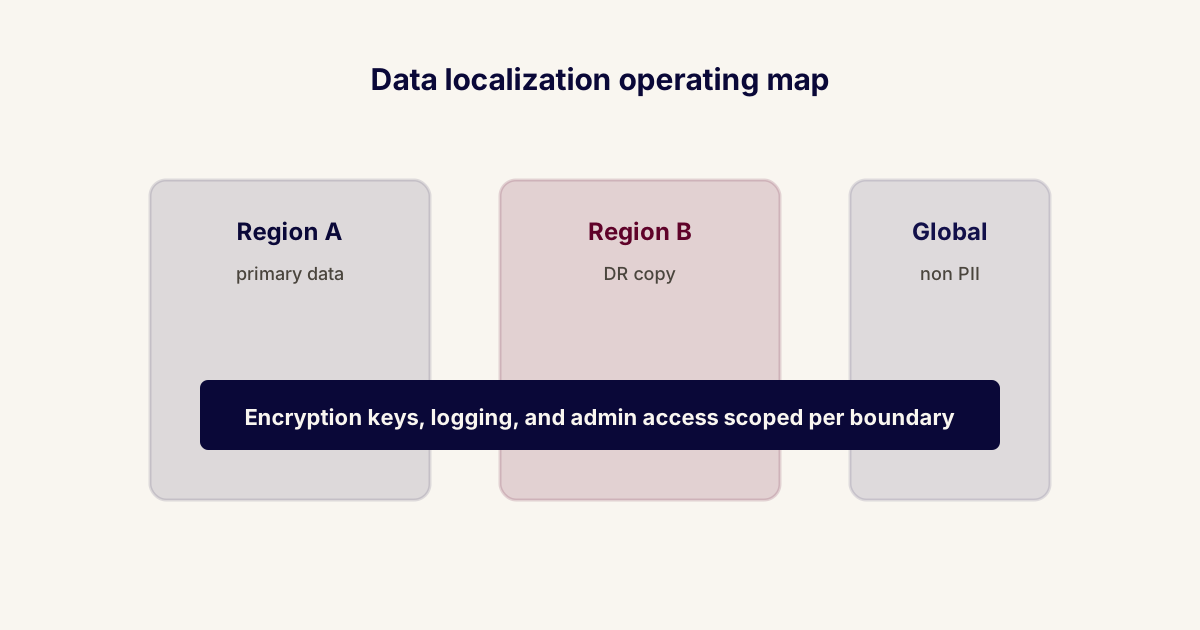
Data residency patterns in financial services reveal growing multi-cloud complexity. Institutions operating across jurisdictions increasingly deploy region-locked configurations to satisfy local data localization requirements while maintaining centralized risk analytics. This architecture introduces operational overhead in key management, network segmentation, and incident response coordination. Organizations that invest in policy-as-code frameworks to automate residency enforcement consistently outperform peers relying on manual compliance verification processes.
Healthcare cloud adoption accelerated significantly following the pandemic, yet the sector continues to grapple with the intersection of patient privacy regulation and cloud-native architecture. HIPAA in the United States, GDPR in Europe, and emerging health data protection frameworks in Asia Pacific impose layered obligations on data controllers and processors. Cloud providers offering HIPAA-eligible services have expanded their certified footprints, but responsibility for configuration, access control, and breach notification remains firmly with the covered entity.
We can present findings in a working session, map recommendations to your portfolio and risk register, and help you prioritize next steps with clear owners and timelines.
Interoperability mandates are reshaping how healthcare organizations architect their cloud estates. The 21st Century Cures Act and FHIR-based data exchange requirements push providers toward API-first integration models hosted on scalable cloud infrastructure. Organizations that treat interoperability compliance as a cloud architecture driver, rather than a bolt-on concern, achieve both regulatory alignment and operational efficiency. Those that retrofit compliance onto legacy hosting arrangements face compounding technical debt and audit exposure.
The energy sector presents a bifurcated adoption profile. Upstream exploration and production companies leverage cloud compute for seismic data processing, reservoir modeling, and predictive maintenance analytics at scale. Downstream utilities and grid operators, subject to critical infrastructure protection regulations such as NERC CIP in North America, maintain stricter boundaries around operational technology environments. The convergence of IT and OT networks in smart grid deployments creates novel cloud security challenges that existing regulatory frameworks are only beginning to address.
Telecommunications providers occupy a unique position as both consumers and enablers of regulated cloud services. Network function virtualization and the migration of 5G core workloads to cloud-native platforms represent the most architecturally ambitious regulated cloud programs in any sector. Regulators focused on lawful intercept capabilities, data retention obligations, and network resilience expect operators to demonstrate that virtualized network functions meet the same availability and security standards as their hardware-based predecessors.
Public sector cloud adoption varies dramatically by national strategy and procurement maturity. Countries with dedicated government cloud frameworks, such as the United Kingdom G-Cloud marketplace and the United States FedRAMP authorization program, demonstrate higher adoption rates and more structured security assurance processes. Nations without centralized cloud procurement guidance experience fragmented adoption, inconsistent security baselines, and duplicated assessment efforts across agencies that increase cost without proportionally reducing risk.
Data residency has evolved from a compliance checkbox into a core architectural concern. The proliferation of data localization laws across more than seventy jurisdictions creates a complex overlay that influences region selection, replication topology, encryption key placement, and disaster recovery design. Organizations operating globally cannot rely on a single residency strategy. Instead, they require a residency policy engine that evaluates each data classification against applicable jurisdictional rules and enforces placement constraints programmatically at the infrastructure provisioning layer.
Vendor concentration risk scores reveal a persistent tension between operational efficiency and regulatory resilience. Consolidating workloads on a single hyperscaler simplifies skills development, tooling standardization, and commercial negotiation. Regulators, however, increasingly view single-provider dependency as a systemic risk, particularly when multiple institutions within a sector converge on the same platform. The European Digital Operational Resilience Act explicitly requires financial entities to assess and manage ICT third-party concentration risk at both entity and sector levels.
Multi-cloud strategies adopted to mitigate concentration risk introduce their own challenges. Maintaining equivalent security controls, identity federation, network segmentation, and observability across two or more cloud providers demands platform engineering investment that many organizations underestimate. Our index data shows that organizations scoring highest on vendor diversification frequently score lowest on operational consistency, suggesting that spreading workloads without investing in cross-cloud abstraction layers creates a different category of risk rather than eliminating concentration exposure.

Exit readiness remains the weakest scored dimension across every sector in the index. Despite contractual termination clauses that appear robust on paper, few organizations maintain tested portability runbooks that address data extraction, application re-platforming, identity migration, and network reconfiguration in a coordinated sequence. The absence of regular exit drills means that theoretical portability bears little resemblance to practical recoverability. Regulators are beginning to require documented and tested exit plans, particularly for critical or important functions outsourced to cloud providers.
Building genuine exit readiness requires a layered approach. At the data layer, organizations should maintain canonical schemas and export formats independent of any provider-specific storage engine. At the application layer, containerized deployments with infrastructure-as-code definitions enable workload mobility across compatible runtimes. At the operational layer, monitoring, alerting, and incident management configurations must be portable or reproducible. Organizations that treat exit planning as a continuous engineering discipline, rather than a one-time documentation exercise, consistently score higher in our index assessment.
Supervisory engagement sophistication has emerged as a differentiating factor in regulated cloud programs. Organizations that proactively brief regulators on their cloud strategy, share risk assessment methodologies, and invite supervisory feedback before major migrations report smoother approval processes and fewer post-deployment compliance findings. Reactive engagement, where organizations notify regulators only after material changes, correlates with longer remediation cycles and elevated supervisory scrutiny during subsequent examinations.
The role of shared responsibility models in regulated environments deserves more rigorous treatment than most organizations currently apply. Standard shared responsibility documentation from cloud providers delineates security obligations at the infrastructure, platform, and application layers. Regulated organizations must extend this model to incorporate compliance responsibilities, audit evidence generation, incident escalation protocols, and regulatory reporting obligations. A compliance-aware shared responsibility matrix, maintained jointly by cloud engineering and risk management teams, closes the accountability gaps that generic provider documentation leaves open.
Cost governance in regulated cloud environments carries additional complexity. Encryption overhead, enhanced logging for audit trails, multi-region replication for residency compliance, and dedicated tenancy for sensitive workloads all inflate unit economics relative to unregulated deployments. Organizations that fail to model these compliance-driven cost premiums during migration planning consistently exceed budget forecasts by twenty to forty percent. Accurate cost modeling requires tagging strategies that attribute spend to regulatory requirements, enabling finance teams to distinguish compliance cost from discretionary consumption.
Looking ahead, the regulated cloud adoption landscape will be shaped by three converging forces. First, regulatory frameworks will continue to mature, with prescriptive guidance on operational resilience testing, concentration risk management, and cross-border data transfer mechanisms. Second, cloud providers will deepen their compliance automation capabilities, embedding regulatory controls into platform services rather than leaving implementation entirely to customers. Third, organizations that invest in platform engineering, policy-as-code, and continuous exit readiness will separate themselves from peers still treating cloud compliance as a manual, periodic audit exercise. The index will continue to track these shifts, providing the benchmarking foundation that boards and regulators increasingly demand.