Insights · Report · Industry · May 2026
Finality models, fraud scoring at wire speed, reconciliation with batch cores, and customer support playbooks when irrevocable transfers meet user error and authorized push payment scams.

Instant payment schemes have fundamentally reshaped customer expectations across retail banking, corporate treasury, and merchant acquiring. Settlement that once took a business day now completes in seconds, and consumers have internalized that speed as the baseline for every subsequent transaction. This acceleration also transformed fraud economics: stolen credentials can drain accounts before victims notice a single alert. Risk operations teams must now match the latency of payment messages themselves, not the pace of overnight batch processing.
This report provides a comparative analysis of finality rules, recall windows, dispute mechanisms, and liability frameworks across the major instant payment rails operating in 2026. It covers FedNow, the RTP network, SEPA Instant Credit Transfer, Faster Payments in the United Kingdom, UPI in India, and PIX in Brazil. Product managers, compliance officers, and engineering leaders will find a shared vocabulary for evaluating scheme differences before committing to marketing language around irreversibility and settlement guarantees.
Finality models vary significantly between schemes. Some rails treat message acceptance as irrevocable, granting the payee immediate good funds with no technical recall path. Others maintain narrow exception windows, typically measured in minutes, during which the originating institution can request a return under specific fraud-related conditions. Understanding these distinctions is essential because they dictate the contractual commitments your institution can make to both sending and receiving customers. Misrepresenting finality creates legal exposure and erodes trust when disputes arise.
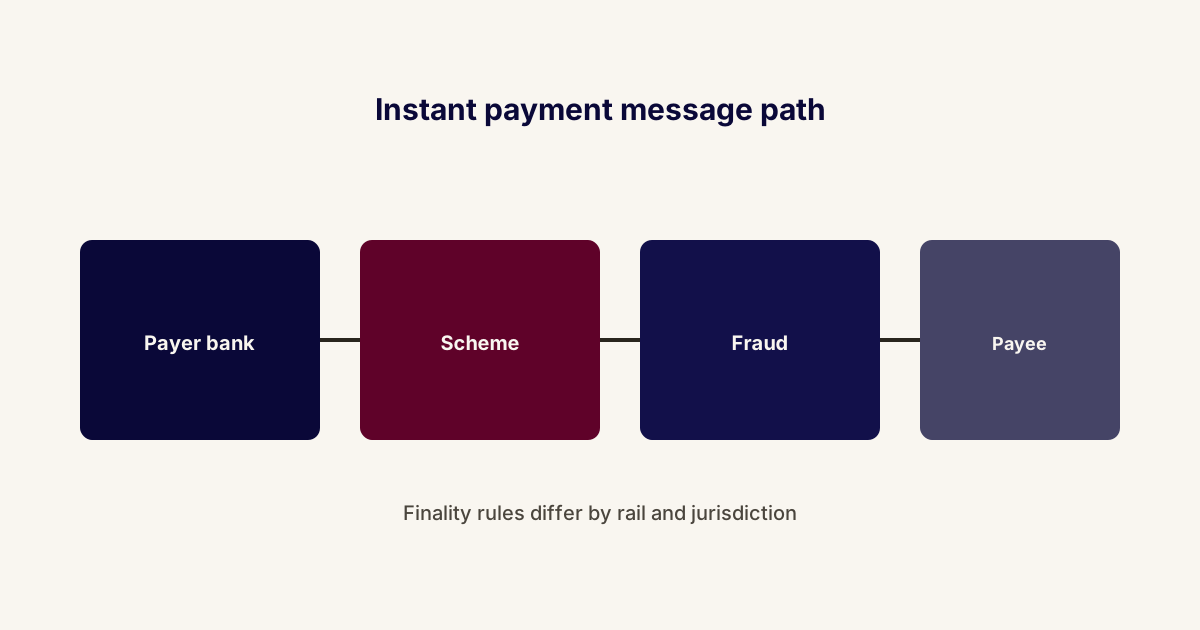
The irrevocable nature of most instant payments creates a one-directional risk profile that differs sharply from card networks and direct debit schemes. In card-based ecosystems, chargebacks provide a consumer protection mechanism that shifts liability after the fact. Instant rails offer no equivalent reversal right once finality is achieved. This asymmetry concentrates fraud prevention effort on the pre-authorization moment, raising the stakes for real-time decision engines that must approve or decline within the scheme's mandated response window, often under one second.
We can present findings in a working session, map recommendations to your portfolio and risk register, and help you prioritize next steps with clear owners and timelines.
Real-time fraud scoring at wire speed demands a fundamentally different architecture than traditional batch-oriented detection. Legacy fraud platforms that rely on overnight feature refreshes and rule engines evaluated after settlement cannot protect instant payment corridors. Modern approaches deploy streaming feature stores that update customer behavioral profiles, beneficiary reputation signals, and device fingerprint data within milliseconds of each transaction event. The scoring model must return a decision before the scheme timeout expires, leaving no room for synchronous callouts to slow external services.
Feature engineering for instant payment fraud models requires careful selection of signals that balance predictive power with computational cost. High-value features include velocity of outbound transfers within rolling time windows, deviation from established beneficiary patterns, device and session anomaly indicators, and behavioral biometrics such as typing cadence during payment initiation. Each feature must be computable within the latency budget. Teams should maintain a feature cost registry that tracks the P99 computation time for every model input to prevent latency regressions during model retraining cycles.
Authorized push payment scams represent the fastest-growing fraud vector in instant payment ecosystems. Unlike account takeover, where criminals exploit stolen credentials, APP fraud involves the genuine account holder initiating the transfer under social engineering pressure. The victim authorizes the payment willingly, believing they are paying a legitimate contractor, resolving a tax obligation, or protecting funds from a fabricated threat. This dynamic complicates liability allocation because traditional authentication controls pass cleanly, and the payment instruction originates from the customer's own verified device.
Effective APP fraud mitigation requires layered interventions that extend beyond transaction monitoring. Confirmation of payee services, which verify that the recipient name matches the account details, reduce misdirected payments and create friction that disrupts scam scripts. Dynamic warning screens calibrated by risk score, mandatory cooling-off periods for first-time high-value transfers, and in-app educational prompts all contribute to an overall defense posture. Institutions should document the evidence packages they require before issuing goodwill refunds, establishing clear internal thresholds that balance customer retention with moral hazard concerns.
Core banking reconciliation presents a persistent architectural challenge for institutions that process instant payments. Most core ledger systems were designed around end-of-day batch cycles, with settlement files driving general ledger postings in sequential, auditable runs. Instant payment messages arrive continuously and demand immediate balance updates, creating a mismatch between the event-driven payment layer and the batch-oriented accounting backbone. Bridging this gap without introducing reconciliation breaks requires deliberate middleware design and rigorous idempotency guarantees.
The middleware layer responsible for mapping instant payment messages to ledger entries must enforce idempotent posting semantics, preventing duplicate credits or debits when clients retry after network timeouts. It should maintain visible exception queues that finance and operations teams trust as their single source of truth for unresolved items. Automated matching engines that pair scheme confirmations with internal journal entries reduce manual investigation effort, but they require well-defined tolerance rules for timing differences, currency rounding, and fee allocation across participating institutions.
Customer support tooling for instant payments must surface transaction status, counterparty identifiers, risk hold reasons, and scheme response codes in a unified agent interface. Support representatives need enough context to explain why a payment was delayed, declined, or flagged without exposing internal fraud model scores or proprietary risk signals. Designing this information boundary requires collaboration between product, compliance, and customer experience teams to define which data elements are safe for verbal disclosure and which must remain restricted.
Dispute resolution playbooks for instant payments differ materially from card or ACH dispute workflows. Because most instant rails lack a formal chargeback mechanism, institutions must rely on bilateral communication with the receiving bank, voluntary return requests, and, in some jurisdictions, regulatory reimbursement frameworks. Playbooks should define escalation paths by fraud type, document the maximum response times each counterparty institution has committed to, and include template correspondence that meets regulatory notification requirements without creating unintended liability admissions.

Cross-border instant payment corridors introduce foreign exchange conversion, sanctions screening, and correspondent banking complexity into an already constrained latency budget. Linking domestic instant rails across jurisdictions, as seen in initiatives connecting SEPA Instant with Southeast Asian real-time systems, requires harmonized message formats, pre-funded nostro positions, and bilateral agreements on exception handling. Each additional compliance check consumes milliseconds that accumulate quickly. Institutions must engineer their screening latency rather than treating it as an afterthought layered onto an existing domestic flow.
Sanctions and anti-money-laundering screening for instant payments cannot rely on the same list-matching infrastructure used for SWIFT messages processed in minutes. Screening engines must complete name matching, fuzzy logic scoring, and alert disposition within the scheme's end-to-end timeout. This demands pre-indexed watchlists, optimized matching algorithms, and clear escalation protocols for borderline hits. A false positive that triggers manual review effectively blocks the payment, so calibration of screening thresholds directly affects customer experience and competitive positioning in instant payment markets.
Metrics and reporting frameworks for instant payment risk operations should balance fraud loss totals against false decline rates, screening latency percentiles, and mean time to resolve stuck or ambiguous messages. Executives who monitor only aggregate loss figures miss critical signals about customer friction and operational bottlenecks. A balanced scorecard that tracks approval rates by risk tier, median investigation closure time, and scheme-level availability provides the multidimensional view required to allocate investment across fraud prevention, operational resilience, and customer experience improvements.
Operational resilience planning must account for scheme outages, network partitions, and degraded mode scenarios that are unique to always-on instant payment infrastructure. Unlike batch windows that offer natural maintenance breaks, instant rails operate continuously with uptime expectations exceeding 99.99 percent. Institutions need tested failover procedures, graceful degradation strategies that queue payments during brief outages, and clear communication templates for customer-facing status updates. Tabletop exercises simulating extended scheme downtime reveal gaps in runbooks that static documentation reviews consistently miss.
Duplicate settlement investigations represent an underappreciated operational risk in instant payment environments. When client applications retry payment requests after ambiguous timeout responses, the scheme may process both the original and the retry, resulting in double credits to the beneficiary. Detection requires real-time deduplication logic at the payment initiation layer, supplemented by post-settlement reconciliation scans that flag matching amounts, beneficiaries, and submission timestamps within configurable windows. Recovery procedures should include pre-agreed bilateral return protocols with major counterparty banks.
Looking ahead, the convergence of instant payments with request-to-pay overlays, embedded finance distribution channels, and programmable money constructs will expand the attack surface and operational complexity that risk teams must manage. Institutions that invest now in streaming fraud infrastructure, engineered compliance latency budgets, resilient reconciliation middleware, and scenario-tested operational playbooks will hold a durable advantage. Those that attempt to retrofit batch-era controls onto real-time rails will face mounting losses, regulatory scrutiny, and competitive erosion as instant payments become the default settlement expectation worldwide.