Insights · Report · Security · Apr 2026
Evidence preservation, notification clocks, coverage triggers, and tabletop patterns that keep legal, IR, and carriers coordinated when extortion actors move fast.

Ransomware remains the most financially disruptive threat facing mid-market and enterprise organizations alike. Average ransom demands have escalated sharply, while dwell times have compressed from weeks to hours as adversaries automate lateral movement and encryption routines. Simultaneously, cyber insurance underwriters are tightening coverage terms, raising retention thresholds, and demanding verifiable evidence of security controls before binding policies. The gap between what insurers expect and what incident response teams deliver under pressure creates exposure that no premium payment alone can resolve.
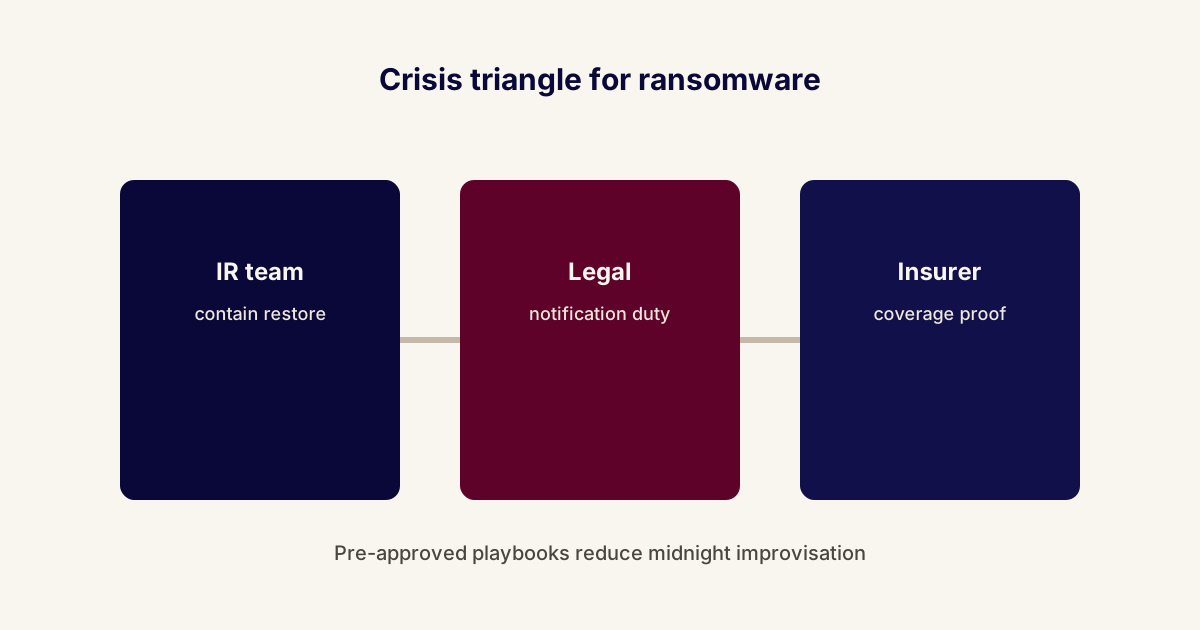
This report examines the alignment challenge through a crisis triangle framework connecting three critical functions: incident response, legal counsel, and the cyber insurance program. Each vertex of this triangle owns distinct deliverables during an active ransomware event. Incident response teams must produce containment evidence and forensic artifacts. Legal counsel manages regulatory notification analysis and privilege protections. The insurance function tracks coverage prerequisites, carrier communication protocols, and claims documentation requirements. When these functions operate in isolation, organizations experience duplicated commands, missed filing deadlines, and contested reimbursement claims.
Alignment between these three functions cannot be improvised during a crisis. Decision timelines compress dramatically once encryption begins, leaving little room for role clarification or process discovery. Organizations that invest in pre-incident coordination, including shared terminology, escalation matrices, and joint runbooks, consistently achieve faster containment, smoother regulatory interactions, and stronger claims outcomes. The time to build these relationships and rehearse these protocols is during calm quarters, not during active extortion events.
Evidence preservation represents the single most consequential factor in determining insurance claims outcomes. Chain of custody for system logs, network captures, and endpoint telemetry must be established within the first hours of detection. Immutable backup verification, documented scope of any decryption attempts, and timestamped containment actions form the evidentiary foundation that adjusters and forensic auditors will scrutinize. Organizations that lack a pre-defined evidence collection checklist routinely lose recoverable claim value because critical artifacts are overwritten or contaminated during triage.
We can present findings in a working session, map recommendations to your portfolio and risk register, and help you prioritize next steps with clear owners and timelines.
Forensic hygiene extends beyond log preservation to encompass the integrity of the investigative process itself. Responders should use write-blocked imaging for affected systems, maintain separation between investigation and remediation environments, and document every analytical step in a contemporaneous journal. Insurance carriers increasingly retain their own forensic firms to validate the policyholder's investigation. Discrepancies between internal findings and carrier-directed forensics can delay or reduce claim payments, making procedural rigor a financial imperative rather than merely a technical best practice.
Notification timelines introduce overlapping legal obligations that vary by jurisdiction, data classification, and contractual commitment. State breach notification laws in the United States impose deadlines ranging from thirty to seventy-two hours after discovery, while GDPR mandates supervisory authority notification within seventy-two hours of becoming aware of a personal data breach. Contractual obligations to customers, business partners, and regulators may impose even tighter windows. Legal counsel must map these parallel clocks before an incident occurs so the response team can prioritize communications without guesswork.
Cyber insurance policies contain their own notification requirements that sit alongside regulatory obligations. Most policies mandate carrier notification within twenty-four to forty-eight hours of a qualifying security event. Failure to notify within the specified window can void coverage entirely, regardless of the claim's merit. The definition of a qualifying event differs across policy wordings, making it essential for legal and insurance teams to align on trigger language during the policy procurement phase rather than debating definitions during an active breach.
Coverage triggers and exclusion clauses demand close reading well before renewal season. War exclusion language has expanded significantly following state-sponsored ransomware campaigns attributed to nation-state actors. Some underwriters now include infrastructure exclusions for unpatched critical vulnerabilities or for environments lacking multi-factor authentication on privileged accounts. Organizations should conduct an annual policy review that maps every exclusion clause to their current control posture, identifying gaps where coverage assumptions diverge from operational reality.
The insurance questionnaire process itself has become a control validation exercise. Underwriters increasingly verify responses through technical evidence, including external attack surface scans, security rating scores, and third-party audit reports. Misrepresentations on applications, even unintentional ones, can serve as grounds for claim denial. Security leaders should maintain a living control inventory that maps directly to common questionnaire categories, including endpoint detection, backup testing cadence, privileged access management, and email security configuration. This inventory ensures renewal responses remain accurate and auditable.
Ransom negotiation and payment decisions occupy a uniquely sensitive intersection of legal, ethical, and operational considerations. Law enforcement agencies in multiple jurisdictions discourage payment while acknowledging that organizations must weigh operational survival against policy positions. OFAC sanctions compliance in the United States adds a regulatory dimension, as payments to designated entities expose the organization to enforcement action regardless of the operational pressure. This report does not offer legal advice on payment decisions. It does recommend that general counsel prepare a decision framework, including sanctions screening procedures and board escalation criteria, well in advance of any extortion demand.
Double extortion has become the dominant ransomware model, combining data encryption with data exfiltration and the threat of public disclosure. This evolution complicates both the incident response and insurance dimensions. Data exfiltration may trigger privacy breach notification obligations independent of whether systems are restored, and insurance coverage for extortion payments may differ from coverage for data breach liability. Response plans must address both vectors simultaneously, with clear escalation paths for scenarios where the attacker demonstrates possession of sensitive data.

Third-party and supply chain ransomware incidents introduce additional coordination complexity. When a managed service provider or critical vendor suffers a ransomware attack, the downstream organization faces incident response obligations without direct access to affected systems or forensic evidence. Insurance coverage for third-party incidents depends heavily on policy language around dependent business interruption and contingent coverage extensions. Organizations should verify these provisions annually and establish communication protocols with key vendors that specify notification timelines, evidence sharing agreements, and mutual aid expectations.
Tabletop exercises serve as the primary mechanism for testing alignment across the crisis triangle. Effective ransomware tabletops go beyond technical containment scenarios to include legal notification sequencing, carrier communication timing, executive decision points, and board escalation triggers. Scenario design should encompass double extortion, cloud control plane compromise, third-party MSP involvement, and simultaneous regulatory inquiries. Each exercise should produce specific action items with owners and deadlines, and debriefs should update runbooks within two weeks before institutional memory fades.
Exercise frequency and participation breadth correlate directly with response effectiveness. Annual tabletops satisfy minimum compliance expectations, but quarterly exercises with rotating scenarios build genuine muscle memory. Participation should extend beyond the security team to include legal counsel, communications staff, finance leadership, and at least one board member or designated committee liaison. Exercises that exclude any vertex of the crisis triangle reinforce the silos that cause coordination failures during real incidents.
Technology tooling during a ransomware crisis must prioritize clarity over comprehensiveness. War rooms, ticketing systems, and executive dashboards proliferate when teams default to their departmental tools rather than converging on a single authoritative timeline. Organizations should designate one coordination platform, pre-configured with role-based channels, evidence repositories, and status templates, before an incident forces improvised alternatives. Tool sprawl during active response slows decision velocity and fragments the evidentiary record that insurance claims and regulatory investigations will later examine.
Board reporting metrics should translate technical incident response performance into strategic risk indicators. Mean time to detect and mean time to contain provide operational benchmarks, while the percentage of critical systems with offline backups tested quarterly measures resilience investment. Post-incident control improvement completion rate and insurance coverage adequacy ratio signal program maturity over time. Boards benefit from trend analysis across quarters rather than point-in-time snapshots, as sustained improvement trajectories demonstrate programmatic health more convincingly than any single incident outcome.
Building a sustainable ransomware response and insurance alignment program requires investment across people, processes, and documentation long before an attack materializes. Assign explicit ownership of the crisis triangle coordination function, whether within the CISO organization, risk management, or a dedicated resilience office. Fund annual policy reviews, quarterly tabletop exercises, and continuous control inventory maintenance as recurring program expenses rather than discretionary projects. Organizations that treat alignment as a standing capability rather than a crisis reaction consistently achieve better containment outcomes, stronger claims recoveries, and more favorable renewal terms.