Insights · Report · Security · Mar 2026
Inventory methods, hybrid transition patterns, and governance checkpoints for teams modernizing algorithms without boiling the ocean.

Quantum readiness is easy to overhype and hard to operationalize. Conference keynotes warn of an imminent cryptographic apocalypse, yet the practical reality for most enterprises is far more mundane. Organizations do not need slogans; they need a complete, prioritized inventory of cryptographic usage and a migration plan that respects production constraints. This report provides a phased framework that security architecture and enterprise risk teams can adopt without disrupting the services that generate revenue today.
The core threat model motivating urgency is harvest now, decrypt later. Adversaries with long planning horizons can capture encrypted traffic today and store it until a sufficiently capable quantum computer becomes available. Data with confidentiality requirements extending beyond ten years, including trade secrets, diplomatic communications, health records, and financial instruments, falls squarely inside this risk window. Organizations that dismiss quantum readiness as distant ignore the fact that the data they protect today may already be in collection pipelines they cannot observe.
Standards bodies have responded with concrete deliverables. NIST finalized its first set of post-quantum cryptographic standards in 2024, selecting ML-KEM for key encapsulation and ML-DSA for digital signatures. These algorithms are not speculative research; they are published standards with reference implementations shipping in major cryptographic libraries. Enterprise teams that wait for a second wave of standards before beginning migration planning risk compressing a multi-year effort into a crisis timeline driven by regulatory mandates or supply chain requirements.
Phase one of any readiness program is discovery. Teams must locate every certificate, VPN tunnel, database encryption layer, message queue TLS binding, backup archive, and vendor-managed service that conceals algorithm choices behind an API. Discovery is harder than it sounds because cryptographic dependencies hide in firmware, embedded devices, legacy middleware, and partner connections that no single team fully owns. Automated scanning tools can accelerate the process, but manual review of configuration baselines remains essential for completeness.
A successful inventory goes beyond listing algorithms. Each discovered cryptographic asset requires classification by confidentiality horizon, data sensitivity, regulatory scope, and operational criticality. A public-facing web certificate that rotates annually poses a different risk profile than a root trust anchor embedded in hardware security modules with a fifteen-year lifecycle. Classification drives prioritization, and prioritization prevents the paralysis that results from treating every endpoint as equally urgent.
We can present findings in a working session, map recommendations to your portfolio and risk register, and help you prioritize next steps with clear owners and timelines.
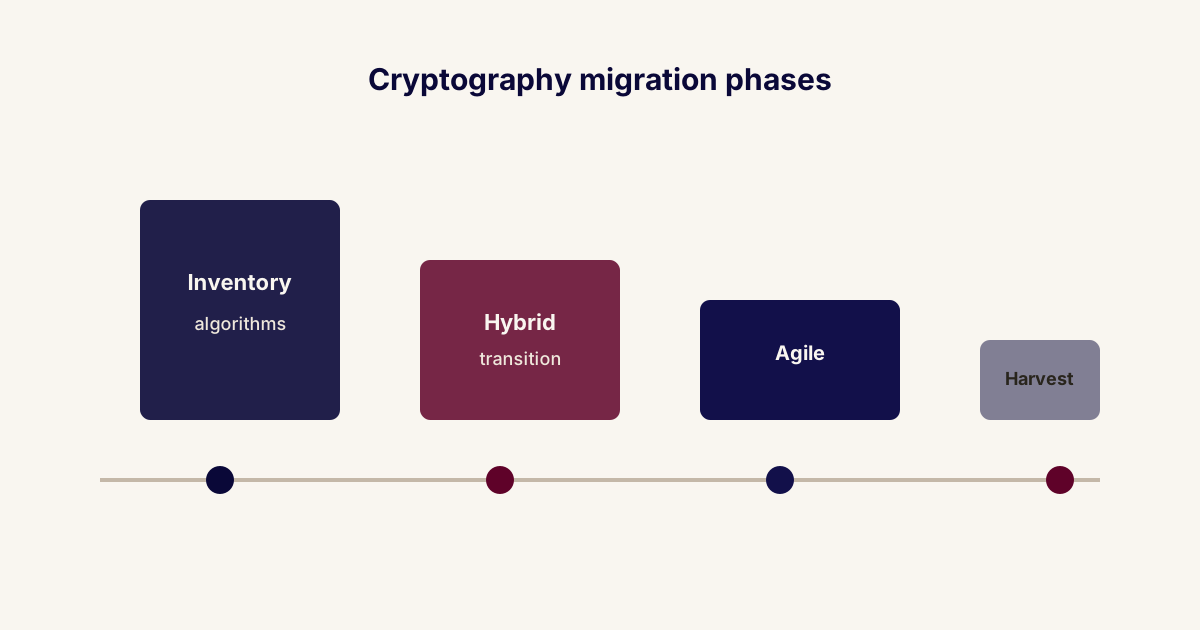
Phase two shifts focus from discovery to agility. Crypto agility is the architectural property that allows an organization to change algorithms, key lengths, and protocol parameters without multi-week engineering projects. Centralized policy engines that push cipher suite configurations to endpoints, automated certificate lifecycle management, and infrastructure-as-code templates that parameterize algorithm selections all contribute to agility. The goal is not instant perfection but a posture that can absorb future algorithm changes at operational tempo rather than project tempo.
Testing harnesses deserve dedicated investment during this phase. Post-quantum algorithms produce larger key sizes and different performance characteristics compared to classical predecessors. ML-KEM ciphertexts are roughly thirty times larger than their ECDH equivalents, which can affect packet fragmentation, TLS handshake latency, and connection establishment rates. Performance regression suites that exercise critical paths under realistic load conditions prevent surprises when algorithm changes reach production. Teams that skip this step frequently discover throughput degradation only after deployment, leading to costly rollbacks.
Automated key and certificate rotation is a prerequisite, not an enhancement. Organizations that still rely on spreadsheet-tracked manual renewal processes will find quantum migration unmanageable at scale. Modern certificate lifecycle platforms integrate with internal certificate authorities, cloud provider key management services, and hardware security modules to enforce rotation policies, revoke compromised material, and maintain audit trails. Investing in rotation automation before beginning algorithm changes pays dividends across the entire migration timeline.
Hybrid cryptographic schemes feature prominently in real-world rollouts because interoperability dominates practical deployment concerns. A hybrid approach combines a classical algorithm with a post-quantum algorithm in a single handshake or encryption operation, ensuring that security remains intact even if one component is later found vulnerable. This pattern works well for transport layer security, where both endpoints can be updated in coordinated releases. It fits less naturally in scenarios involving persistent storage or offline decryption, where key management complexity multiplies.
Legacy client compatibility requires explicit risk acceptance documentation. Not every system in an enterprise estate can upgrade to post-quantum algorithms on the same timeline. Industrial control systems, embedded medical devices, and long-lived IoT deployments may run firmware that cannot be patched. For these cases, organizations should document the residual risk, define compensating controls such as network segmentation or additional monitoring, and establish review triggers that revisit the exception when vendor upgrades or device replacements become feasible.
Data with long confidentiality horizons warrants a dedicated workstream. Backup tapes, legal hold stores, regulatory archives, and cold storage repositories are easy to overlook because they sit outside daily operational visibility. Yet these assets represent the highest-value targets for harvest now, decrypt later adversaries. The report recommends retention tagging that travels with the data object itself, not only within primary database metadata. Tags should record the encryption algorithm, key identifier, and a target re-encryption date that aligns with the organization's quantum migration roadmap.
Re-encryption of archival data is operationally expensive and must be planned well in advance. Large archive volumes may require dedicated processing windows, temporary compute capacity, and coordination with records management and legal teams to maintain chain of custody. Organizations that defer re-encryption planning until algorithms are deprecated will face compressed timelines and elevated risk of data exposure during the transition. Early pilot programs targeting a representative subset of archival data provide cost and duration estimates that inform enterprise-wide budgeting.
Vendor management is inseparable from technical migration. Cloud key management services, hardware security module contracts, and SaaS applications that perform client-side encryption all require explicit post-quantum roadmaps from their providers. Procurement questionnaires should ask for supported algorithm families, committed upgrade timelines, customer-visible change windows, and fallback procedures if algorithm deprecation occurs faster than anticipated. Vendors unable to articulate a concrete plan represent supply chain risk that should be escalated to enterprise risk committees.

Third-party risk extends beyond direct technology vendors. Partners, payment processors, and regulated counterparties that exchange encrypted data with your organization must also be assessed for quantum readiness. Asymmetric readiness, where one party migrates while the other cannot, creates interoperability gaps that disrupt business processes. Joint migration planning sessions with critical partners, documented in formal agreements, reduce the probability of handshake failures and data exchange interruptions during the transition period.
Governance structures determine whether quantum readiness remains a coherent program or fragments into disconnected initiatives. A steering committee comprising representatives from security architecture, enterprise risk, infrastructure operations, application development, legal, and procurement provides the cross-functional oversight that single-team efforts lack. Meeting cadence should be monthly during active migration phases and quarterly during steady-state monitoring, with escalation paths to executive leadership for budget and timeline decisions.
The report includes RACI templates that clarify accountability at each migration phase. Discovery is typically owned by security architecture with contributions from infrastructure and application teams. Algorithm selection is a shared responsibility between security research, engineering, and compliance. Deployment execution falls to platform and application teams, while risk acceptance for legacy exceptions rests with business unit leaders who own the affected data. Clear accountability prevents the diffusion of responsibility that stalls large-scale security programs.
Key performance indicators must be measurable by security operations, not only presentable on architecture slides. Recommended metrics include the percentage of TLS endpoints enforcing approved post-quantum cipher policies, mean time to rotate enterprise root trust stores, the fraction of archival data re-encrypted with quantum-resistant algorithms, and the count of vendor contracts with documented post-quantum commitments. Dashboards that surface these metrics in real time enable the steering committee to identify stalled workstreams and reallocate resources before deadlines compress.
Board-level communication requires a different register than technical program updates. Directors and executive leadership need concise framing: what the risk is, what the organization is doing about it, and what residual exposure remains. Fear-based messaging erodes credibility and invites disruptive overreactions. The report provides presentation templates that translate technical migration status into business language, mapping progress against regulatory expectations, industry benchmarks, and insurer requirements without resorting to sensationalism.
Alignment with privacy and legal teams is essential, particularly on lawful access and key escrow questions that intersect with post-quantum key management designs. Some jurisdictions are re-examining lawful interception frameworks in light of new encryption paradigms. Security teams that design key management architectures without consulting legal counsel risk building systems that conflict with evolving regulatory obligations. Early, structured engagement between cryptography engineers and legal advisors produces architectures that satisfy both security and compliance requirements.
Quantum readiness is not a single project with a defined end date. It is an ongoing capability that must evolve as algorithms mature, threat intelligence sharpens, and regulatory landscapes shift. Organizations that treat this as a checkbox exercise will find themselves repeating the effort when the next generation of standards arrives. Those that invest in crypto agility, governance discipline, and cross-functional coordination will absorb future changes as routine operational work, protecting data assets across whatever cryptographic transitions lie ahead.