Insights · Report · Industry · Apr 2026
Trust frameworks, accessibility, offline equity, and fraud resistance for agencies scaling digital wallets and unified service portals.

Citizens now expect the same convenience from government that they experience from banks, airlines, and retailers. Yet public agencies operate under constraints that the private sector rarely faces: universal service mandates, multi-decade backwards compatibility, strict procurement rules, and the obligation to serve people who lack smartphones, stable addresses, or reliable internet. Digital identity programs that optimize only for the easiest users risk deepening the divide between connected and underserved populations, undermining the very trust government must protect.
This report examines the operational patterns, architectural choices, and governance models that determine whether public sector digital identity programs deliver lasting value or become expensive liabilities. We draw on case studies from national identity programs in the European Union, the United Kingdom, Canada, Australia, and Singapore, along with state and municipal implementations in the United States. The analysis emphasizes patterns that survive political transitions rather than those that depend on a single champion or budget cycle.
Three dominant identity models compete for public sector adoption: centralized credential stores, federated identity networks, and citizen-held digital wallets. Centralized approaches, exemplified by national ID databases, offer simplicity in issuance and revocation but create single points of failure and attract sustained adversarial interest. Federated models distribute trust across multiple identity providers, reducing concentration risk at the cost of increased protocol complexity. Wallet-based architectures place credentials directly on citizen devices, enabling selective disclosure and offline verification, but they introduce device dependency and key management challenges.
No single model fits every agency context. Federated architectures suit multi-jurisdictional scenarios where provincial, state, or municipal agencies issue credentials independently but must accept each other's assertions. Wallet-based models excel where privacy is paramount and citizens need granular control over what attributes they share. Centralized stores remain appropriate for high-assurance functions such as border control and law enforcement lookups. Most governments will operate a hybrid portfolio, and the interoperability layer connecting these models demands more design attention than any individual credential format.
Trust frameworks provide the legal, technical, and operational rules that govern identity credential issuance, acceptance, and revocation. Without a clearly codified trust framework, agencies default to bilateral agreements that multiply linearly with each new participant. The European Digital Identity framework and Canada's Pan-Canadian Trust Framework illustrate how shared governance structures reduce onboarding friction, standardize assurance levels, and create predictable liability allocation. Agencies beginning their trust framework journey should start with a minimal viable rulebook and iterate rather than attempt comprehensive coverage from day one.
We can present findings in a working session, map recommendations to your portfolio and risk register, and help you prioritize next steps with clear owners and timelines.
Privacy by design is not optional in the public sector; it is a legal and constitutional baseline in most democratic jurisdictions. Digital identity systems should collect the minimum attributes necessary for each transaction, store data in purpose-bound compartments, and enforce retention limits through automated policy execution rather than manual review cycles. Attribute-based credentials that allow citizens to prove eligibility, such as age or residency, without revealing underlying personal data represent a meaningful privacy improvement over document-based verification flows that expose full identity records.
Fraud resistance in government identity systems requires a layered strategy rather than dependence on any single technology. Document verification, biometric matching, device binding, behavioral analytics, and in-person proofing each address different threat vectors. Remote identity proofing, which accelerated during pandemic-era service delivery, introduces presentation attack risks that require liveness detection and injection attack countermeasures. Agencies should maintain in-person fallback paths not only for inclusion but also as a fraud mitigation channel for high-risk transactions where remote assurance levels are insufficient.
Over-reliance on a single vendor for biometric matching or document verification creates concentration risk and limits negotiating leverage. Procurement strategies should require open interface specifications, portable data formats, and contractual exit clauses that allow migration within a reasonable timeline. Agencies that embed vendor-proprietary scoring models deep in adjudication logic find switching costs escalate rapidly, trapping programs in relationships that may not serve evolving threat landscapes or shifting policy priorities.
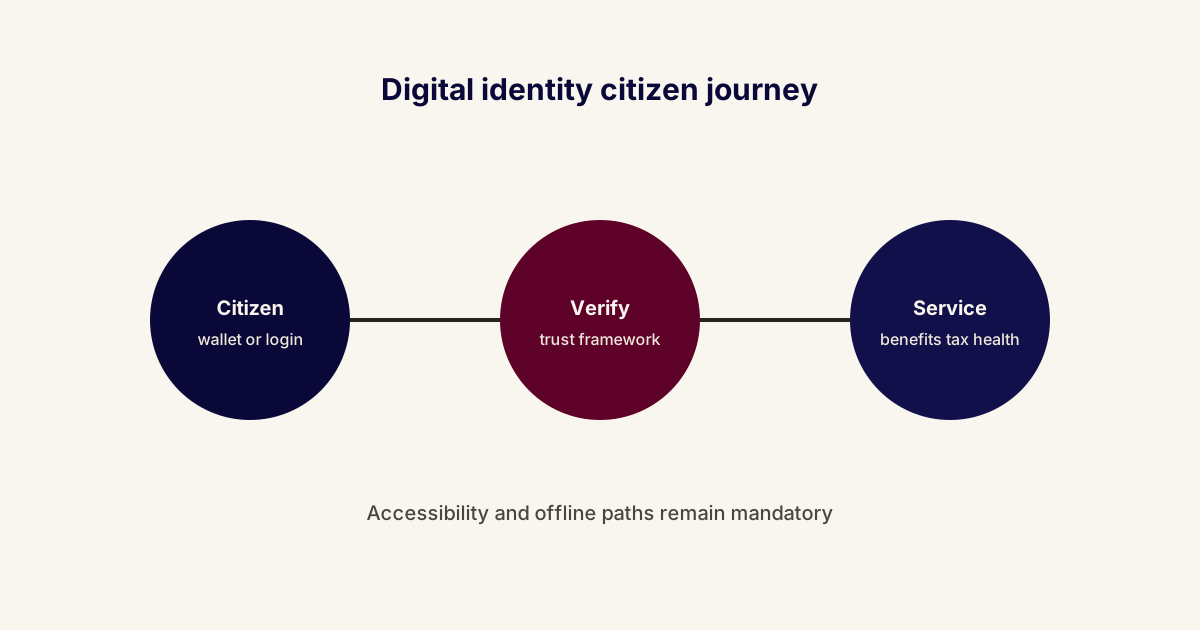
Accessibility is both a legal mandate and a design discipline that improves outcomes for all citizens. Digital identity enrollment and authentication journeys must work with screen readers, keyboard-only navigation, low-bandwidth connections, and simplified language variants. Testing with assistive technologies during development, not as a compliance afterthought, prevents costly remediation and ensures that citizens with disabilities can exercise their rights without intermediary assistance. Plain language requirements apply to every user-facing message, error state, and consent disclosure.
Offline equity deserves the same architectural attention as online convenience. Rural communities, disaster-affected areas, and populations with intermittent connectivity need identity verification pathways that function without real-time server communication. Offline-capable digital wallets that store verifiable credentials locally and present them via proximity protocols, such as NFC or QR-based exchange, address this requirement. However, revocation checking in offline scenarios remains an open challenge that agencies must address through short-lived credentials, revocation lists cached on verifier devices, or acceptable risk thresholds for low-value transactions.
Interagency data sharing represents one of the highest-value opportunities in public sector identity modernization. When a citizen proves their identity to one agency, that verification should propagate to other agencies through shared consent receipts and authoritative identifiers, eliminating redundant proofing that frustrates citizens and wastes agency resources. Achieving this vision requires agreement on shared metadata standards, canonical attribute schemas, and consent management infrastructure that tracks purpose, duration, and revocation across organizational boundaries.

Unified service portals that aggregate benefits enrollment, permit applications, tax filings, and license renewals behind a single authenticated session dramatically reduce citizen burden. The most effective portals employ a life-event model, organizing services around milestones such as having a child, moving to a new address, or retiring, rather than forcing citizens to navigate agency-centric hierarchies. Identity serves as the connective tissue for this model, enabling pre-population of known attributes and proactive notification of eligible benefits.
Metrics and performance measurement in digital identity programs require nuance beyond raw adoption counts. Login volume, enrollment completion rates, and digital channel share are necessary but insufficient indicators. Agencies should disaggregate metrics by age cohort, geographic region, language preference, and access channel to detect exclusion patterns that aggregate numbers obscure. Fraud loss rates, mean time to identity resolution after disputes, and citizen satisfaction scores across demographic segments provide a more complete picture of program health.
Breach response and mistaken identity resolution are operational capabilities that every digital identity program must maintain. When identity data is compromised, agencies face higher reputational stakes than private companies because citizens cannot choose an alternative government. Pre-drafted communications templates, escalation playbooks, and credential reissuance workflows should be tested through tabletop exercises at least annually. Transparent disclosure after incidents, delivered in plain language with concrete remediation steps, rebuilds public trust faster than delayed or legalistic responses.
Emerging standards such as W3C Verifiable Credentials, ISO 18013-5 mobile driving licenses, and OpenID for Verifiable Presentations are converging toward a common interoperability layer for digital identity. Agencies that align their credential formats with these standards position themselves for cross-border recognition and private sector acceptance. Early adoption carries implementation risk, but waiting for perfect standardization delays citizen benefit. A pragmatic approach issues credentials in emerging formats alongside traditional channels, building operational experience while maintaining backwards compatibility.
Organizational readiness often determines program success more than technology selection. Digital identity initiatives require sustained executive sponsorship, cross-agency governance bodies with decision-making authority, and dedicated product management teams that iterate based on citizen feedback. Programs that treat identity as a one-time IT procurement rather than an ongoing service capability consistently underdeliver. Staffing models should blend civil service continuity with specialized contractors for surge capacity during enrollment campaigns and technology transitions.
Looking ahead, public sector digital identity will evolve toward decentralized trust models, richer attribute ecosystems, and tighter integration with private sector relying parties. Governments that invest in modular architectures with open interfaces, inclusive design practices that serve every citizen, and governance frameworks that adapt to new threats will lead this transformation. The defining measure of success will not be the sophistication of the technology deployed but the breadth of the population it genuinely serves, including those who are hardest to reach.