Insights · Report · Industry · May 2026
eCOA, televisit telemetry, lab interfaces, and CDISC submission readiness when trials blend traditional sites with home-based participation.

Decentralized and hybrid clinical trials represent a structural shift in how pharmaceutical companies collect, validate, and submit clinical data. Traditional site-centric models consolidated data capture within controlled physical environments where monitors could verify source records in person. The expansion of home-based participation, direct-to-patient shipments, and remote assessments distributes data generation across dozens of touchpoints, each with distinct validation requirements, connectivity profiles, and regulatory expectations that demand rigorous architectural planning.
The data ecosystem of a modern hybrid trial spans electronic data capture systems, electronic clinical outcome assessment platforms, wearable biosensors, home nursing visit documentation, central and local laboratory interfaces, interactive response technology for randomization, and televisit platforms. Each system produces structured and unstructured records at varying frequencies. Without a unified integration layer that enforces consistent subject identifiers and timestamp standards, reconciling these streams into a coherent clinical database becomes a manual, error-prone exercise.
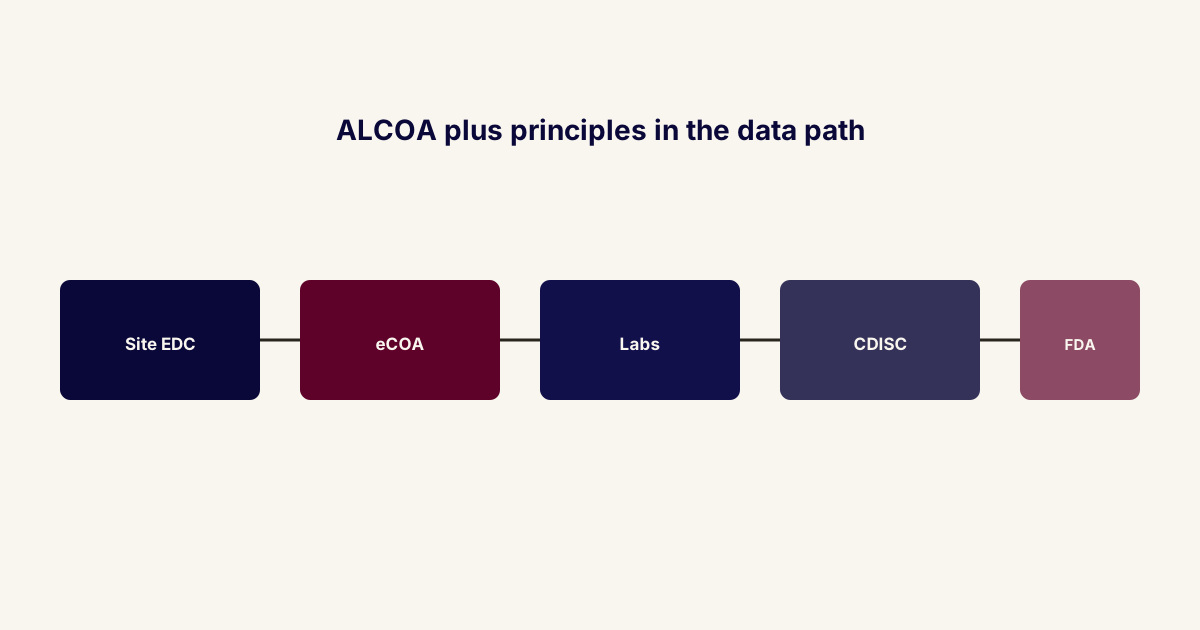
Regulatory authorities across the FDA, EMA, PMDA, and NMPA continue to expect that all clinical data meet ALCOA plus attributes: attributable, legible, contemporaneous, original, and accurate, with the additional requirements of completeness, consistency, endurance, and availability. Decentralized modalities do not exempt sponsors from these obligations. Every data element captured on a patient smartphone, wearable device, or home nursing tablet must trace to its originating event with the same rigor expected of an investigator-entered case report form at a physical site.
Electronic clinical outcome assessments present unique challenges in decentralized settings. Patient-reported outcomes captured on provisioned or bring-your-own devices must enforce completion windows, prevent retrospective entry, and record device-level metadata for audit reconstruction. Compliance rates decline when applications are difficult to navigate or when notification cadences overwhelm participants. Sponsors should conduct usability testing with representative patient populations before deployment and monitor completion trends centrally to intervene before missing data compromises endpoint integrity.
We can present findings in a working session, map recommendations to your portfolio and risk register, and help you prioritize next steps with clear owners and timelines.
Wearable biosensors generate continuous physiological data streams that dwarf traditional clinical data volumes. A single actigraphy sensor worn for a twelve-week study can produce gigabytes of raw accelerometer output per participant. Sponsors must define clinically meaningful derived endpoints before the study begins, establish validated algorithms for signal processing, and document the chain of custody from raw sensor output to analysis-ready datasets. Treating wearable data as an afterthought rather than a first-class data source introduces avoidable regulatory risk.
Televisit platforms introduce telemetry data that sits outside conventional clinical data management workflows. Video consultation timestamps, connectivity quality metrics, and investigator assessment notes captured during remote visits require integration into the trial master file and clinical database. Many sponsors underestimate the metadata burden of televisits, failing to capture session identifiers that link a remote assessment to the corresponding electronic case report form entry, creating gaps that monitors and auditors will flag during inspection.
Identity and linkage errors multiply when participants interact with clinical systems through personal devices and home environments rather than controlled site infrastructure. A subject who reinstalls an eCOA application, replaces a smartphone, or shares a household tablet can generate orphaned records that compromise data integrity. Master subject key management, device binding policies, and re-enrollment verification procedures require explicit protocol-level definitions and documented test evidence demonstrating that the system correctly handles each disruption scenario.
Privacy compliance in decentralized trials operates at the intersection of multiple regulatory frameworks simultaneously. A global study with European participants triggers GDPR obligations, American sites invoke HIPAA protections, and additional national clinical trial regulations in countries such as Japan, Brazil, and China layer further requirements. Consent management platforms must capture jurisdiction-specific authorizations and enforce data processing boundaries that reflect each participant's applicable regulatory context without creating operational complexity that delays site activation.
Data localization requirements for genomic and biomarker subsets add further complexity to cross-border trial operations. Several jurisdictions restrict the transfer of genetic data across national borders, requiring regional processing and storage infrastructure. Sponsors must architect their data pipelines to route sensitive subsets through compliant environments while maintaining the analytical linkages needed for integrated efficacy and safety analyses. Early engagement with regulatory affairs teams and data protection officers prevents costly mid-study redesigns when localization obligations surface after enrollment begins.
Risk-based monitoring strategies adapted for decentralized modalities should blend central statistical monitoring with targeted source data verification. The traditional approach of one hundred percent source data verification at physical sites is neither feasible nor scientifically justified when data originates from validated electronic systems with built-in edit checks and audit trails. Central monitors should focus on detecting data anomalies, enrollment irregularities, and protocol deviations through statistical algorithms that surface risk signals across the entire study population.
Targeted source verification in hybrid trials should concentrate monitoring resources on high-risk data points identified through central analytics. Critical safety endpoints, primary efficacy variables, and consent documentation warrant direct verification, while routine demographic and dispositional data captured through validated electronic systems can rely on automated consistency checks. This risk-proportionate approach preserves data quality while reducing the operational burden and travel costs that make traditional monitoring unsustainable for geographically dispersed decentralized studies.
Vendor transitions during an active clinical trial represent one of the highest-risk operational scenarios in decentralized study management. When an eCOA provider, wearable vendor, or televisit platform requires replacement mid-study, sponsors must execute migration playbooks that include parallel operation periods, statistical comparability analyses, and documented impact assessments. Data continuity cannot be assumed through contractual assurances alone. Technical validation with reconciliation of pre-migration and post-migration records must demonstrate that no data was lost, altered, or orphaned during the transition.

CDISC standards remain the backbone of regulatory submission data packaging, and decentralized trial data must conform to these requirements regardless of its originating modality. Study Data Tabulation Model datasets for submission to the FDA, and Analysis Data Model datasets for statistical analysis, require that every data element traces to a defined standard. Sponsors should establish CDISC mapping specifications during protocol development rather than deferring standardization to the database lock phase, where late mapping decisions introduce transformation errors and delay filing timelines.
Submission readiness reviews should begin well before database lock and should include comprehensive trace matrices linking protocol-defined endpoints to their corresponding analysis datasets. Each primary and secondary endpoint must map through a documented chain from the case report form or device data source, through SDTM domains, to ADaM analysis datasets, and finally to the tables, listings, and figures presented in the clinical study report. Late discoveries of mapping gaps or derivation inconsistencies delay regulatory filings far more than the upfront investment in early alignment.
Cybersecurity risk management for decentralized trial devices has become a regulatory expectation rather than a best practice recommendation. Patient-facing ePRO applications, wearable firmware, and televisit platforms present attack surfaces that could compromise data integrity or participant privacy. Sponsors should conduct threat modeling exercises, maintain software bills of materials for all patient-facing applications, and establish incident response procedures specific to clinical technology. Tabletop exercises simulating device compromise or data exfiltration scenarios prepare cross-functional teams for rapid, coordinated responses.
Social media and digital recruitment channels introduce data integrity considerations that traditional trial designs did not anticipate. Recruitment surges driven by social media campaigns can overwhelm screening capacity, incentivize fraudulent enrollment attempts, and introduce selection biases that affect study generalizability. Sponsors should implement identity verification controls at screening, monitor enrollment velocity for anomalous patterns, and document recruitment channel attribution to support subgroup analyses that assess whether recruitment source influences outcome distributions.
Interoperability between decentralized trial technology vendors remains an underaddressed challenge across the industry. Most eCOA platforms, wearable data aggregators, and televisit solutions were designed as standalone products rather than components of an integrated clinical data ecosystem. Sponsors frequently discover integration gaps during user acceptance testing, when data formats, timestamp conventions, or subject identifier schemes prove incompatible across systems. Mandating adherence to FHIR-based or CDISC ODM-based data exchange standards in vendor contracts reduces integration friction and accelerates study startup timelines.
The trajectory of decentralized clinical trials points toward increasing regulatory clarity, maturing technology stacks, and broader patient acceptance of remote participation models. Sponsors who invest in robust data architecture, rigorous vendor governance, risk-based monitoring frameworks, and early submission readiness planning will convert the flexibility of hybrid trial designs into faster enrollment, richer datasets, and more efficient regulatory interactions. Those who treat decentralization as a logistical convenience without addressing its data management implications will face audit findings, submission delays, and compromised trial integrity.