Insights · Report · Industry · Apr 2026
Dual-running legacy messages alongside structured ISO traffic, reconciliation discipline, and testing harnesses that reduce cutover drama for treasury and operations.

ISO 20022 represents the most significant structural change to global payments messaging in decades. Unlike previous format upgrades, this migration redefines how transaction data is structured, enriched, and consumed across every layer of the payments value chain. Financial institutions that treat ISO 20022 as a mere technical conversion risk overlooking the strategic opportunity embedded in richer, more granular payment data. Readiness requires coordinated action across technology, operations, treasury, and compliance functions.
The scope of ISO 20022 adoption extends far beyond SWIFT messaging. Domestic payment clearing systems, real-time gross settlement networks, and card scheme processing infrastructures are converging on the standard. The European Central Bank, the Federal Reserve's FedNow service, and SWIFT's cross-border payment initiative all mandate or strongly encourage ISO 20022 formats. Organizations operating across multiple geographies face overlapping timelines, each with jurisdiction-specific enrichment requirements and compliance nuances that demand careful coordination.
At a technical level, ISO 20022 replaces flat or semi-structured message formats with richly typed XML schemas that carry substantially more data per transaction. A SWIFT MT103 payment instruction, for example, maps to a pacs.008 message with expanded fields for debtor and creditor identification, purpose codes, regulatory reporting indicators, and remittance information. This expanded payload enables straight-through processing improvements but also exposes data quality gaps that legacy formats conveniently masked through truncation and free-text conventions.
The data enrichment opportunity is the most underappreciated dimension of ISO 20022 readiness. Structured remittance information, legal entity identifiers, and purpose codes enable automated reconciliation, sanctions screening precision, and analytics capabilities that were previously impossible at scale. Treasury operations can match incoming payments to open invoices without manual intervention when remittance data arrives in structured fields rather than free-text blocks. Organizations that build enrichment capabilities early will realize operational savings well before mandate deadlines.
Readiness begins with a comprehensive inventory of message types, counterparty relationships, and enrichment rules currently in production. Teams should catalog which fields their core banking systems, ledgers, and downstream analytics platforms truly require versus which fields exist solely for compliance pass-through or are carried forward from legacy conventions. This mapping exercise reveals transformation complexity and identifies fields where data quality investment will yield the highest return during migration.
We can present findings in a working session, map recommendations to your portfolio and risk register, and help you prioritize next steps with clear owners and timelines.
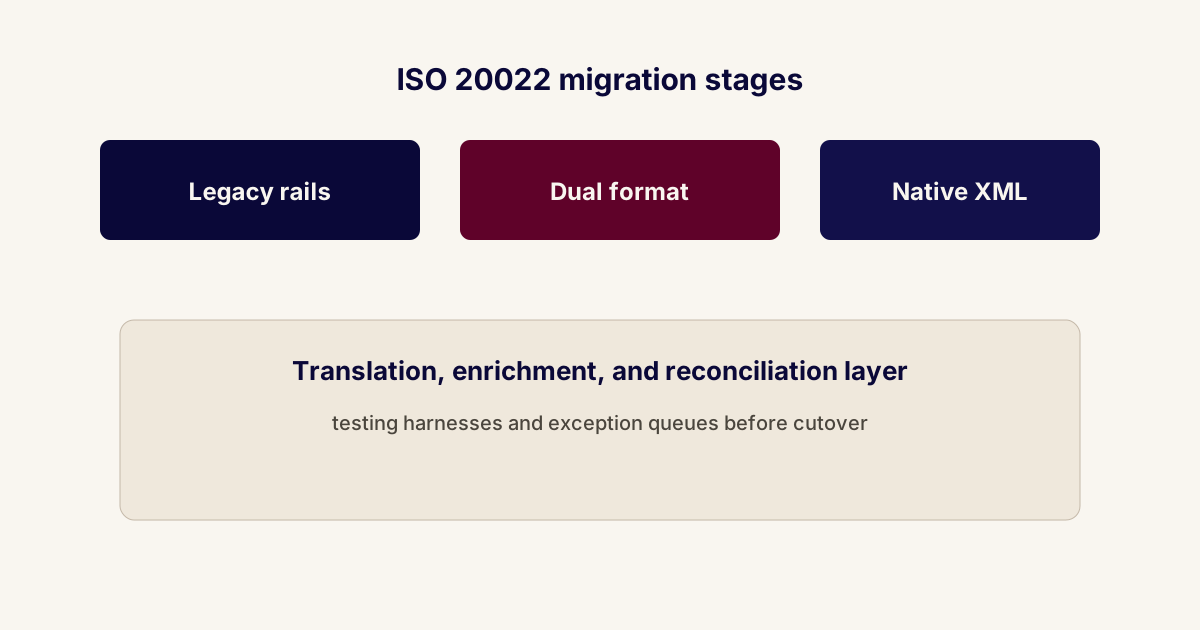
Dual-running periods, where legacy and ISO 20022 messages coexist in parallel, present the highest operational risk in the migration timeline. Institutions must maintain translation layers that convert between formats without data loss, rounding errors, or field truncation. The translation logic itself becomes a critical system component requiring version control, automated regression testing, and monitoring for silent failures. Underestimating the duration and complexity of dual-running is the most common planning error observed across early adopters.
Parity testing during dual-format operations should compare legacy and ISO message paths for sampled transactions on a daily basis, not only during scheduled dress rehearsals. Automated difference reports that flag discrepancies in amounts, dates, counterparty identifiers, and status codes shorten root cause analysis when reconciliation breaks surface. Testing discipline should extend to negative scenarios, including malformed messages, timeout conditions, and partial enrichment failures that stress exception handling logic under realistic load.
Exception queue management becomes substantially more complex during coexistence periods. Legacy exception workflows were designed around a known set of error codes and repair actions. ISO 20022 introduces new exception categories related to schema validation failures, enrichment gaps, and structured data quality rejections. Operations teams need updated runbooks that map each new exception type to a specific investigation and resolution procedure, with clear escalation paths when automated repair is insufficient.
Vendor and correspondent bank testing requires contractual clarity well before cutover dates. Test window schedules, anonymized sample data provision, rollback responsibilities, and joint rehearsal commitments should be formalized in bilateral agreements. A correspondent or payment processor that cannot commit to structured testing milestones introduces risk that project managers should escalate immediately rather than absorb through schedule padding. Early identification of testing blockers preserves the buffer needed for remediation cycles.
Regulatory expectations around ISO 20022 adoption vary significantly by jurisdiction and supervisory authority. Some regulators mandate specific enrichment fields for sanctions screening or transaction reporting purposes, while others treat the migration as an industry-led initiative with softer compliance timelines. Compliance teams should maintain a jurisdiction-level requirements matrix that tracks mandatory fields, reporting format changes, and supervisory expectations. This matrix becomes a living document updated as regulatory guidance evolves through consultation periods.

Operations and customer support teams require plain-language playbooks for known error codes and common exception scenarios. When a payment stalls in processing, frontline staff should not be improvising responses from a 200-page technical specification. Playbooks should include decision trees for common failure modes, templated client communications for delay notifications, and escalation criteria that route complex issues to specialist resolution teams. Investment in operational readiness reduces reputational risk during the transition period.
Corporate treasury clients represent a critical stakeholder group that requires proactive communication throughout the migration. Large corporate customers managing cash positions across multiple banks are particularly sensitive to payment timing disruptions. A communications plan should include advance notice of testing windows, clear explanation of any temporary processing changes, and a dedicated support channel for migration-related inquiries. Honest timelines and transparent progress reporting build trust that protects commercial relationships through inevitable transition friction.
The measurement framework for ISO 20022 readiness should center on operational outcomes rather than project milestones. Key performance indicators include the percentage of total payment traffic processed on native ISO formats, mean time to clear exceptions in the ISO path compared to legacy, the ratio of defects discovered in production versus testing, and straight-through processing rates for enriched messages. Trend analysis matters more than point-in-time snapshots, as migration success unfolds over months rather than a single cutover event.
Data governance investment made during ISO 20022 migration yields compounding returns beyond the immediate project scope. Clean, structured payment data improves fraud detection model accuracy, enables more precise liquidity forecasting, and supports regulatory reporting automation. Organizations that treat the migration purely as a compliance obligation miss the opportunity to establish data quality foundations that serve analytics, risk management, and product development functions for years to come.
Strategic positioning in a post-migration landscape favors institutions that move beyond minimum compliance toward value-added payment services. Rich ISO 20022 data enables request-to-pay services, enhanced remittance offerings, and real-time cash management tools that differentiate commercial banking propositions. Early movers who build these capabilities during the migration window, rather than after it closes, establish competitive advantages that late adopters will struggle to replicate once the standard becomes baseline infrastructure across the industry.
Payments modernization through ISO 20022 adoption is not a single event but a multi-year transformation that touches technology, operations, compliance, and client relationships simultaneously. Institutions that invest in disciplined inventory, rigorous testing, operational readiness, and strategic data exploitation will navigate the transition with confidence. Those that treat it as a minimum-viable compliance exercise will find themselves re-engineering systems and repairing client trust long after mandate deadlines have passed.