Insights · Report · Industry · May 2026
Index design, oracle integrity, basis risk disclosure, and payout rails when weather sensors and satellite feeds replace traditional loss adjustment for certain risks.

Parametric insurance is reshaping how carriers deliver rapid payouts for weather, natural catastrophe, and agricultural perils. Unlike traditional indemnity products that reimburse documented losses after extended adjustment cycles, parametric programs trigger payment when an objective index crosses a predefined threshold. Indices commonly track wind speed, rainfall accumulation, earthquake magnitude, or temperature deviation. The global parametric market is projected to exceed twelve billion dollars in gross written premium by 2028, driven by climate volatility and growing demand for faster post-event liquidity.
The core value proposition is speed and transparency. Policyholders know in advance the exact conditions under which a payout occurs and the exact amount they will receive. This eliminates the adversarial dynamic that can characterize traditional claims negotiation. For carriers, parametric structures reduce loss adjustment expense ratios and free underwriting capacity for higher-margin specialty lines. The simplicity of the product, however, introduces its own design and governance challenges that this report examines in detail.
Internet of Things devices now serve as the primary data backbone for many parametric programs. Connected weather stations, soil moisture probes, river level gauges, and seismic accelerometers stream real-time telemetry to cloud-based oracle platforms that evaluate trigger conditions continuously. This shift from periodic manual readings to automated sensor networks has reduced the time between a qualifying event and payout initiation from weeks to hours in leading programs. Sensor density and placement directly influence the precision of trigger evaluation.
Index design is the single most consequential decision in any parametric program. The chosen metric must correlate closely with the insured loss, be sourced from a tamper-resistant and auditable data provider, and be comprehensible to policyholders without specialized training. Composite indices that blend multiple variables, such as wind speed combined with storm surge depth, can improve correlation but add complexity to policyholder communication. Every additional variable requires clear documentation of weighting methodology and data sourcing.
Oracle integrity is the foundation on which parametric trust rests. An oracle, in this context, is the authoritative data source that determines whether a trigger threshold has been breached. Public weather services, satellite imagery providers, and government seismic networks all serve as oracles. When a program relies on a single oracle, it inherits that source's downtime risk, measurement bias, and update latency. Leading programs employ multi-oracle consensus architectures that require agreement across at least two independent sources before initiating a payout.
We can present findings in a working session, map recommendations to your portfolio and risk register, and help you prioritize next steps with clear owners and timelines.
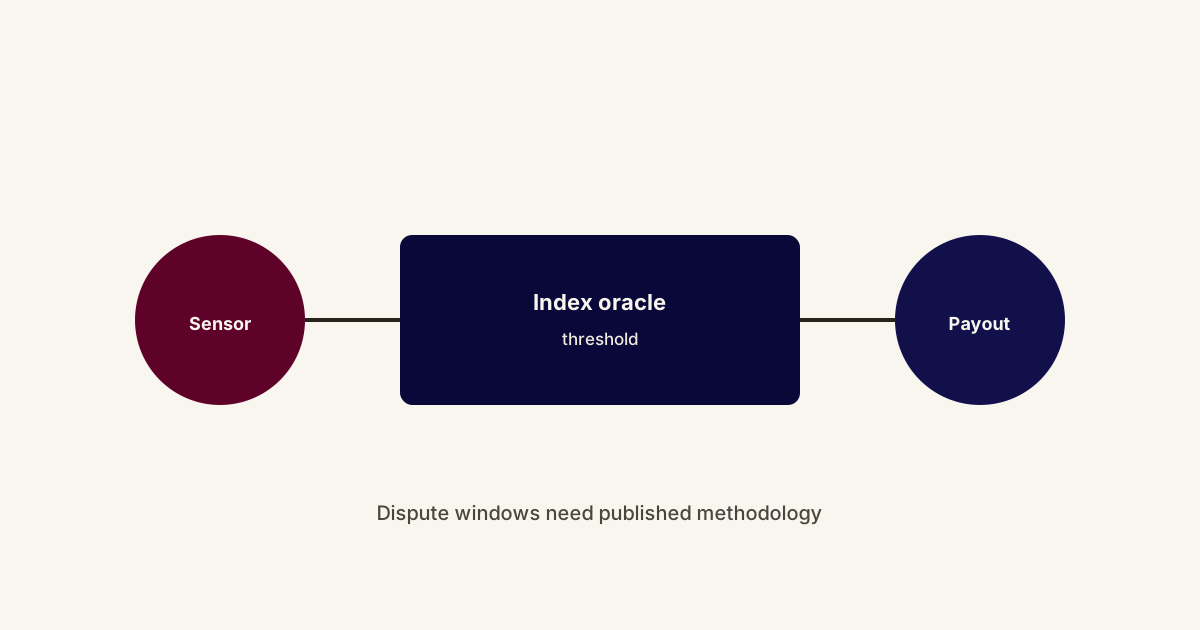
Data provenance chains must be auditable from sensor to settlement. Each reading should carry a timestamp, geolocation, device identifier, and calibration certificate reference. Immutable logging of raw readings, threshold evaluations, and payout decisions enables post-event audit by reinsurers, regulators, and policyholders alike. Programs that treat oracle data as opaque inputs rather than governed assets expose themselves to disputes that erode customer confidence and attract regulatory scrutiny.
Basis risk represents the fundamental limitation of parametric insurance. It arises when the index payout does not match the policyholder's actual loss, either overpaying or underpaying relative to damage sustained. A farmer whose crops suffer localized hail damage may receive no payout if the nearest weather station recorded wind speeds below the trigger threshold. Transparent disclosure of basis risk at point of sale is both an ethical obligation and a regulatory expectation in every jurisdiction where parametric products are offered.
Mitigating basis risk requires a multi-layered strategy. Increasing sensor density narrows the gap between index readings and localized conditions. Hybrid products that combine a parametric first layer with a traditional indemnity top-up allow policyholders to close the gap when index payouts fall short of actual damage. Microzone indexing, where trigger thresholds vary by geographic grid cell rather than broad region, further improves correlation. Each mitigation approach adds cost, so actuarial teams must model the trade-off between reduced basis risk complaints and increased program expense.
IoT sensor custody and calibration represent operational risks that many parametric programs underestimate. A drifted anemometer reading wind speeds two knots below actual conditions can suppress payouts across an entire portfolio tranche. Calibration schedules should follow manufacturer specifications at minimum, with field audits conducted at least annually. Chain-of-custody protocols must document every installation, maintenance visit, firmware update, and physical relocation. Programs that outsource sensor management to third parties should include calibration SLAs and independent verification rights in their service agreements.
Satellite and radar-derived indices extend parametric coverage to regions where ground-based sensor infrastructure is sparse or unreliable. Synthetic aperture radar can estimate flood extent, vegetation stress indices can proxy crop loss, and thermal infrared imagery can approximate wildfire perimeter progression. These remote sensing products offer broad geographic coverage at relatively low marginal cost per policy. However, they carry documented error bands that vary by terrain, cloud cover, and revisit frequency. Communicating these limitations in policyholder-facing materials requires deliberate plain-language effort.
Cybersecurity for parametric field hardware demands the same rigor applied to any operational technology environment. IoT sensors deployed in remote agricultural fields, coastal installations, and mountain weather stations present attractive targets for adversaries seeking to manipulate trigger outcomes. Threat models should account for physical tampering, credential theft, firmware manipulation, and denial-of-service attacks on data transmission channels. Encrypted telemetry, hardware attestation, certificate-based device identity, and anomaly detection on reading patterns form the baseline security posture for production sensor networks.
Claims automation is the operational payoff of well-designed parametric architecture. When a trigger event occurs, the oracle evaluation engine should automatically calculate the payout amount, verify policy status and coverage limits, initiate compliance screening, and queue the disbursement instruction to the payment rail. End-to-end automation from trigger detection to funds arrival in the policyholder's account can be achieved within 72 hours for well-engineered programs. Manual intervention should be reserved for exception handling, not standard processing.

Payout rail selection influences both speed and cost of settlement. Direct bank transfers via established payment networks remain the default for commercial policies, while mobile money disbursement serves agricultural microinsurance programs in emerging markets. Prepaid card loading and digital wallet credits offer alternatives for consumer-facing products. Each rail carries distinct regulatory requirements around anti-money laundering screening, sanctions checking, and beneficiary verification. Programs operating across multiple jurisdictions must map each rail's compliance obligations before launch.
Treasury and reinsurance integration requires careful orchestration. Parametric payouts can arrive in concentrated bursts after widespread weather events, creating liquidity demands that differ sharply from the gradual claims emergence pattern of traditional lines. Treasury teams must pre-position funds or maintain committed credit facilities sized to the probable maximum loss scenario. Reinsurance treaties should specify trigger verification procedures, data sharing protocols, and dispute resolution mechanisms that account for the automated nature of parametric settlements.
Reinsurers increasingly require independent verification of trigger events before honoring their obligations under parametric treaties. Building third-party audit hooks into the oracle evaluation pipeline from inception avoids costly retrofitting. Independent verification services that maintain their own sensor networks or subscribe to alternative data feeds can provide the confirmatory evidence reinsurers need. Audit trail completeness, including raw data, threshold calculations, and payout logic versioning, directly influences reinsurer confidence and treaty pricing.
Regulatory frameworks for parametric insurance vary significantly across jurisdictions. Some regulators classify parametric products as insurance contracts subject to standard solvency requirements, while others treat them as derivative instruments under financial services regulation. This classification determines licensing obligations, capital adequacy calculations, and consumer protection requirements. Programs with cross-border ambitions must conduct jurisdiction-by-jurisdiction regulatory mapping and engage local counsel before market entry. Regulatory clarity is improving but remains inconsistent globally.
Operational readiness testing must simulate extreme scenarios before any parametric program goes live. Load testing the oracle evaluation engine at ten times expected peak trigger volume, rehearsing multi-currency payout disbursement across all configured rails, and conducting tabletop exercises for oracle failure and sensor compromise scenarios are essential pre-launch activities. Programs that skip operational stress testing frequently discover capacity bottlenecks during their first major event, precisely when reliable performance matters most to policyholders and reinsurers.
Key performance indicators for parametric programs differ from traditional insurance metrics. Basis risk complaint rate per thousand policies, mean time from trigger event to funds arrival, oracle uptime percentage, sensor calibration compliance rate, and payout accuracy measured against independent verification sources form the core dashboard. Programs should establish target thresholds for each metric at inception and review performance quarterly. Continuous improvement cycles driven by these metrics distinguish mature parametric operations from experimental pilots.
The parametric insurance market will continue to expand as climate volatility intensifies demand for rapid post-event liquidity and IoT infrastructure costs decline. Success will favor programs that invest in oracle governance, sensor integrity, transparent basis risk communication, and operationally resilient claims automation. Carriers that treat parametric products as simple index bets rather than sophisticated technology-enabled insurance programs will struggle with customer retention and regulatory challenges. The opportunity is substantial, but execution discipline determines which programs earn lasting policyholder trust.