Insights · Report · Industry · May 2026
Strong customer authentication, token scopes, aggregator due diligence, and incident allocation when data leaks or mistaken payments flow through licensed third-party providers.

Open banking ecosystems connect banks, licensed third-party providers, fintech applications, and millions of end users through standardized APIs and machine-readable consent artifacts. Despite years of regulatory development across the European Union, the United Kingdom, Australia, Brazil, and an expanding list of jurisdictions, confusion persists about which party is the data controller, which is the processor, and who ultimately pays when a security incident exposes account information or triggers an erroneous payment.
The cost of that confusion is no longer theoretical. Regulatory enforcement actions, class-action litigation, and reputational damage have followed every high-profile open banking incident since 2023. Financial institutions that treat consent management as a checkbox exercise rather than an engineering discipline expose themselves to compounding liability. This report provides a structured framework for consent lifecycle governance, third-party due diligence, and incident allocation designed to reduce both legal risk and operational friction.
At its core, open banking consent is an architectural primitive, not merely a legal document. Every consent grant initiates a chain of API calls, token issuances, data transfers, and audit events. When that chain is poorly instrumented, organizations cannot answer basic forensic questions after an incident: what data left the perimeter, which credentials authorized the transfer, and whether the customer genuinely approved the scope that was exercised. Treating consent as infrastructure rather than paperwork changes how teams design, deploy, and monitor their API platforms.
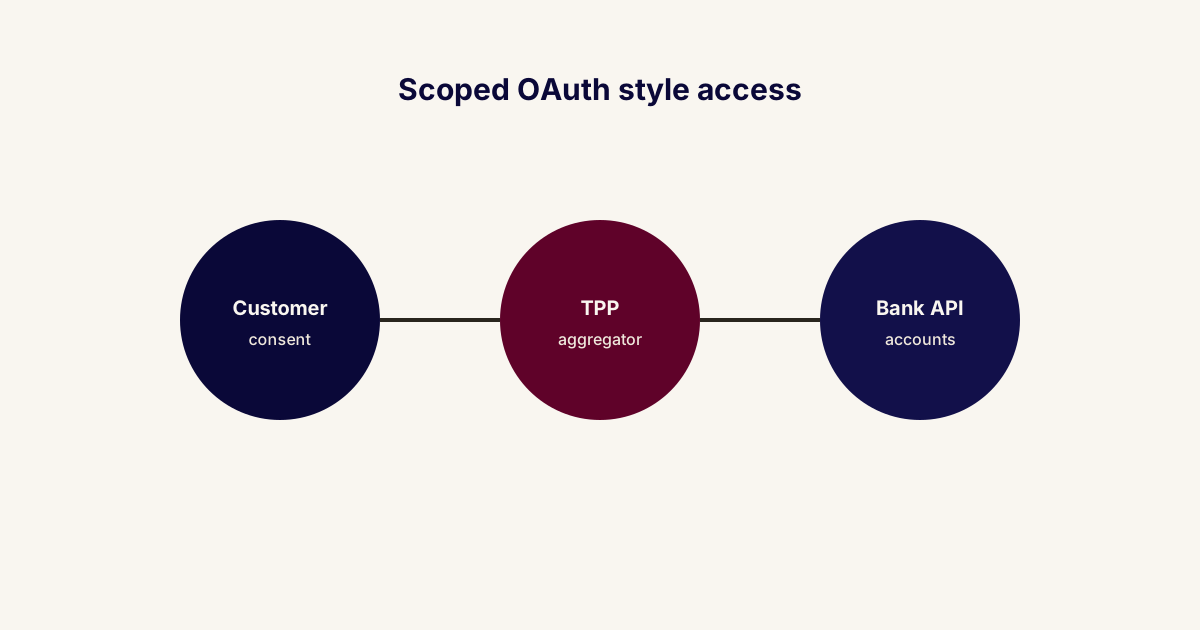
Consent lifecycle management begins at enrollment. During onboarding, the customer authenticates with the account-servicing payment service provider and explicitly authorizes a defined set of data permissions for the requesting third-party provider. Engineering teams must ensure that enrollment screens render permission scopes in plain language, record the precise timestamp and channel of approval, and generate a durable consent receipt that both the bank and the third party can reference independently. Incomplete enrollment metadata is the root cause of most disputed consent claims.
We can present findings in a working session, map recommendations to your portfolio and risk register, and help you prioritize next steps with clear owners and timelines.
Scope limitation is the second critical control point. Third-party providers should request the narrowest set of account views and transaction histories that their product genuinely requires. Banks, in turn, should enforce granular scope definitions at the API gateway level rather than relying on broad read-all permissions. When a personal finance aggregator needs only balance information, granting full transaction detail access violates the principle of least privilege and inflates the blast radius of any future credential compromise.
Consent refresh and re-authorization intervals vary significantly across regulatory regimes. The revised Payment Services Directive in Europe mandates re-authentication every ninety days for account information services, while Australia's Consumer Data Right permits longer durations under certain conditions. Engineering teams should parameterize these intervals in configuration rather than hardcoding a single national pattern into a global application. Feature flags tied to jurisdiction codes allow product teams to adapt refresh behavior without redeploying core banking middleware.
Revocation must be instantaneous and verifiable. When a customer withdraws consent through any channel, whether the bank's mobile application, a third-party dashboard, or a call center interaction, the downstream API tokens must be invalidated within seconds, not hours. Organizations that rely on nightly batch processes to propagate revocations create windows of unauthorized data access that regulators view as material non-compliance. Real-time event-driven architectures using webhook callbacks or message queues are now the expected standard.
Audit export rounds out the lifecycle. Regulators, ombudsmen, and dispute resolution panels increasingly request machine-readable consent histories during investigations. Banks and third parties should maintain immutable audit logs that capture every consent state transition, the identity of the initiating party, and the technical mechanism used. Exporting these records in standardized formats such as JSON or CSV with cryptographic integrity hashes accelerates regulatory response times and demonstrates operational maturity.
Strong customer authentication and dynamic linking requirements form the security backbone of open banking payment initiation. Under PSD2 and its successors, every payment must be dynamically linked to the specific amount and payee at the moment of authorization. Engineering teams must resist the temptation to cache or reuse authentication tokens across transactions. Each payment initiation should trigger a fresh authentication ceremony that binds the customer's approval to the exact parameters of that single transfer, preventing replay attacks and unauthorized amount modifications.
Aggregator due diligence extends well beyond initial onboarding questionnaires. Banks should treat critical aggregators as material vendors subject to ongoing monitoring, periodic security assessments, and board-level concentration risk reporting. Due diligence programs should evaluate the aggregator's financial resilience, penetration testing cadence, incident response maturity, and subprocessor dependencies. A single aggregator routing traffic for dozens of fintech applications concentrates systemic risk in ways that traditional vendor management frameworks were not designed to capture.
Subprocessor transparency deserves particular attention. Many third-party providers rely on fourth parties for hosting, analytics, fraud scoring, or identity verification. Banks rarely have direct contractual relationships with these downstream entities, yet a breach at a fourth-party provider can expose the same customer data that the bank originally released through its API. Contractual clauses should require third parties to disclose all subprocessors, notify the bank before adding new ones, and flow down equivalent security obligations throughout the supply chain.

Data minimization is both a regulatory requirement and a practical risk reduction strategy. Third-party providers should implement field-level filtering at the point of API consumption, discarding data elements that are not essential to the stated use case. Banks can reinforce this discipline by offering tiered API products with progressively narrower data payloads. A budgeting application that only needs transaction categories and amounts should never receive full counterparty details, memo fields, or internal reference numbers.
Liability allocation in open banking contracts must map directly to observable technical controls. Generic indemnity clauses that assign all risk to the third party without specifying logging standards, encryption requirements, or incident notification timelines are difficult to enforce and even harder to operationalize. Effective contracts define shared responsibility matrices that tie each party's obligations to specific telemetry signals: token usage logs, API call volumes, error rates, and data retention schedules. When a breach occurs, these signals become the evidentiary foundation for allocating fault.
Incident response across open banking ecosystems requires coordinated playbooks that span organizational boundaries. A data exposure originating at a third-party provider but affecting bank customers demands parallel workstreams: the third party investigates root cause and containment, while the bank manages customer notification and regulatory disclosure. Pre-negotiated joint response templates, shared communication channels, and designated escalation contacts reduce the mean time to coordinated action. Organizations that lack these agreements default to adversarial finger-pointing that damages every brand in the chain.
Customer communication after a third-party incident is a reputational minefield. Customers typically hold their bank responsible regardless of where the failure actually occurred. Joint notification templates should be drafted during onboarding, not during a crisis. These templates need to explain what happened, what data was affected, what the customer should do, and how the ecosystem partners are collaborating to prevent recurrence. Transparent communication preserves trust far more effectively than legal disclaimers or blame redirection.
Operational metrics provide the early warning system that prevents consent disputes from escalating into regulatory actions. Key indicators include consent grant volume by third-party provider, revocation rates as a percentage of active grants, API error budgets segmented by endpoint, mean time to disable a compromised client credential, and the ratio of consent refresh successes to failures. Dashboards that surface these metrics in near real time allow risk and compliance teams to detect anomalies before they become incidents.
Looking ahead, the open banking consent landscape will grow more complex as jurisdictions expand scope to include insurance, pensions, and investment accounts. Variable recurring payments, long-lived mandates, and cross-border data flows will introduce new consent patterns that current frameworks do not fully address. Organizations that invest now in flexible, well-instrumented consent infrastructure will adapt faster than those locked into rigid, jurisdiction-specific implementations. The competitive advantage belongs to institutions that treat consent as a product capability rather than a compliance burden.